Your digging level
Description
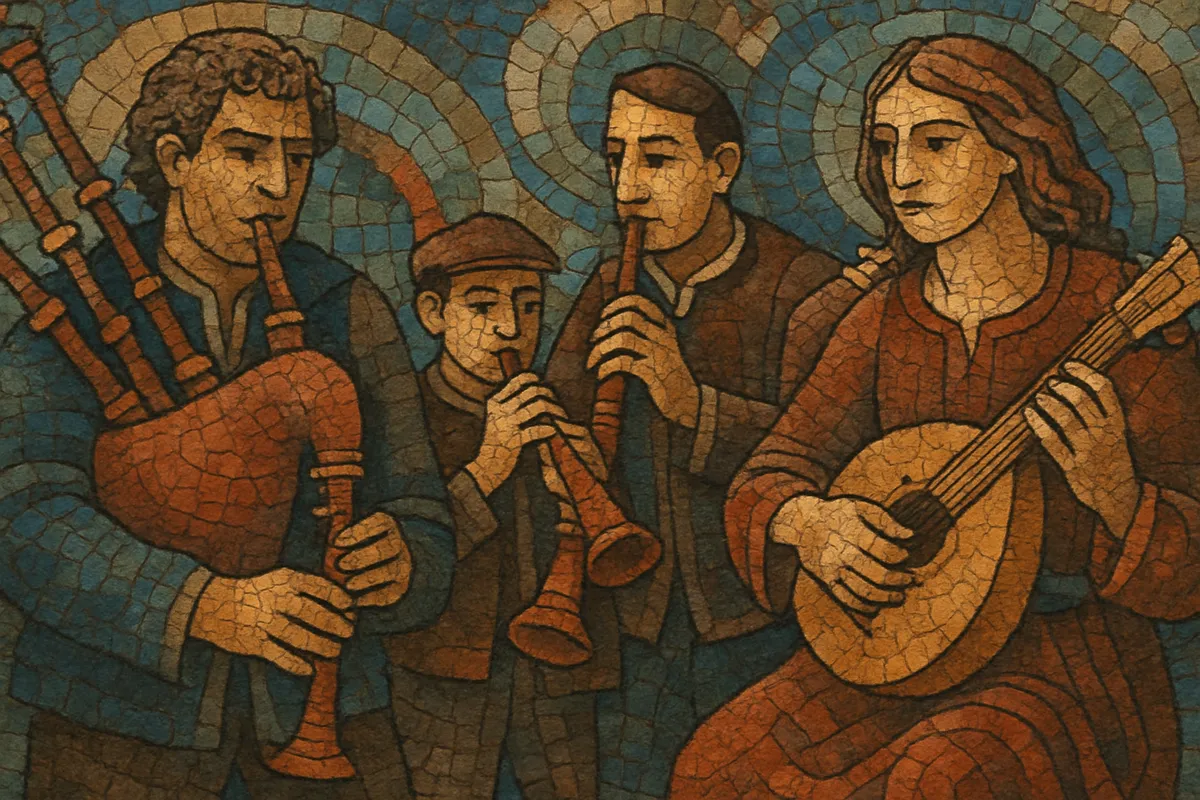
Bagad (plural: bagadoù) is the modern Breton pipe-and-drum ensemble tradition from Brittany, France. A typical bagad combines Great Highland bagpipes (binioù braz), double-reed bombardes, and a Scottish-style drum corps (snares, tenors, and bass), performing arranged suites based on traditional Breton dance melodies.
Unlike informal folk dance bands, bagadoù are staged ensembles with precise drill, competition-oriented arrangements, and a characteristic bright, martial sonority. Their repertoire draws on regional dance forms (gavotte, an dro, hanter-dro, plinn, ridée, laridé, and more), presented in multi-part suites that spotlight melodic variation, antiphony between bombarde and pipes, and intricate drum orchestrations.
While rooted in Breton folk music, the bagad format was shaped by Scottish pipe band practice, resulting in a uniquely Breton yet pan-Celtic ensemble sound that has become a cultural emblem of Brittany and a centerpiece of the regional musical revival.
History
Bagadoù emerged in the 1940s during a broader Breton cultural revival. The ensemble concept was inspired by Scottish pipe bands encountered through Celtic exchanges, yet rooted in local traditions of binioù (bagpipe) and bombarde playing for Breton dances. The organization Bodadeg ar Sonerion (BAS), founded in 1943, standardized pedagogy and ensemble practice, catalyzing the rapid formation of bagadoù across Brittany.
By the 1950s, graded competitions fostered a repertoire of arranged "suites" combining regional dance airs into cohesive concert pieces. Precision drill, uniform tuning (the pipes’ concert pitch near B♭), and Scottish-influenced snare technique (flourishing tenor drums and bass drum voicings) became hallmarks. The National Championship of Bagadoù—often tied to the Festival Interceltique de Lorient—emerged as the premier showcase, encouraging innovation while preserving dance roots.
Leading ensembles refined orchestration between bombarde and bagpipes, introduced counter-melodies and harmonized parts, and commissioned original compositions in traditional modes. Cross-genre collaborations (with Breton folk, rock, and symphonic projects) raised international visibility and helped place the bagad sound within the wider pan-Celtic movement. Recordings and tours broadened audiences beyond Brittany.
Modern bagadoù remain community-based yet professional in execution, with rigorous training pipelines and youth sections. Their competition suites blend fidelity to regional styles with contemporary arranging craft, making the bagad a living tradition—simultaneously emblematic of Breton identity and connected to global Celtic performance practices.