

Your digging level

For this genre
0/8
🏆
Sign in, then listen to this genre to level up

Description

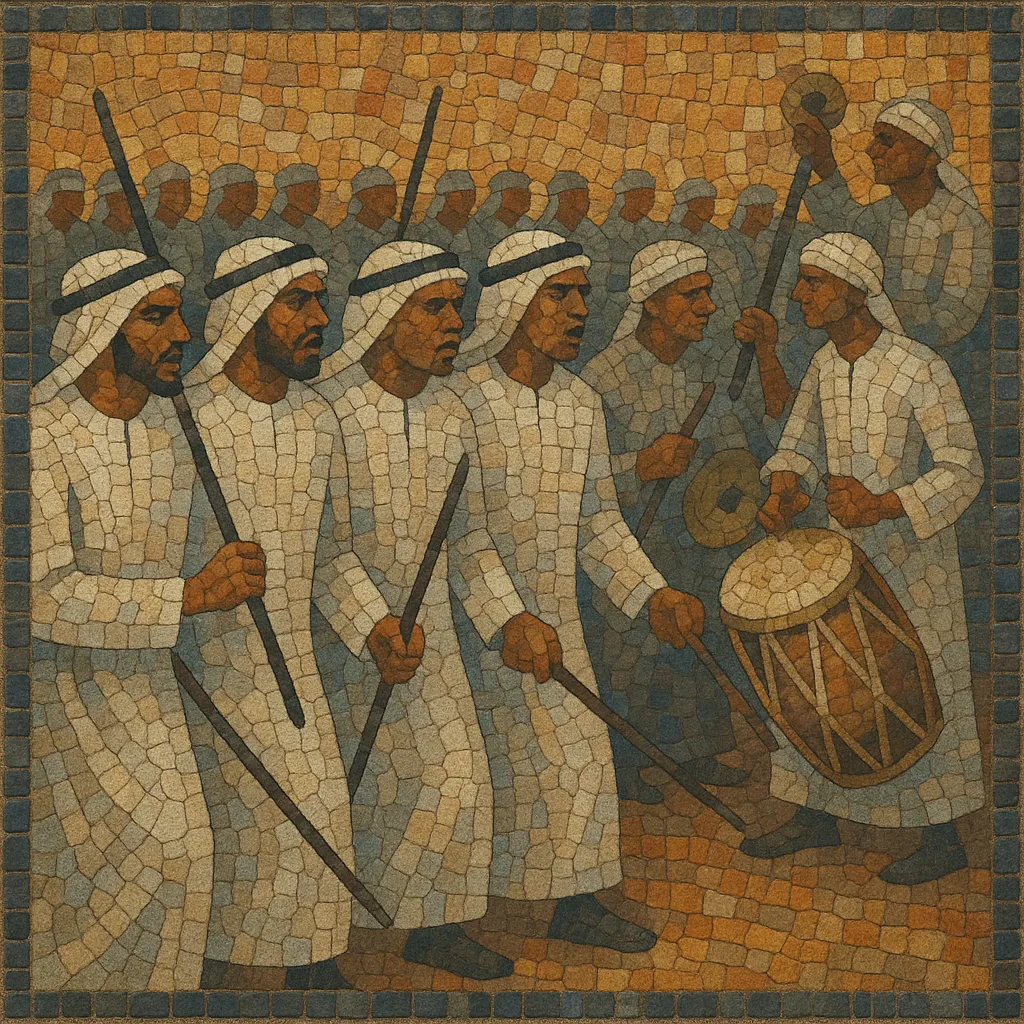
Ayyalah (also spelled yowlah/ayalah) is a traditional Khaliji‑Bedouin group performance from the United Arab Emirates (and northwestern Oman) that combines antiphonal chant, interlocking drum rhythms, and synchronized, martial choreography with rifles or canes.

Two facing rows of men chant short, triumphant verses in call‑and‑response while stepping in unison and brandishing unloaded rifles or thin canes; a battery of large and small frame drums drives a steady duple pulse. The spectacle evokes a victorious return from battle and is performed today at weddings, national celebrations, festivals, and official ceremonies. Closely related variants include razfah (UAE) and ardah (broader Arabian Peninsula) and are often grouped under the umbrella of yowlah.


Sources: Spotify, Wikipedia, Discogs, RYM, MB, user feedback and other online sources

History

Bedouin Roots and Early Function

Ayyalah originated among Bedouin tribes of what is now the United Arab Emirates and neighboring northwestern Oman. As a "weapon dance," it symbolized martial prowess and unity: performers would simulate a victorious return, spinning rifles or canes while chanting brief couplets that praised bravery, honor, and tribal cohesion.

From War Tableau to Civic Ceremony

Across the late 19th and 20th centuries, ayyalah transitioned from a battlefield‑inflected tableau to a heritage performance marking weddings, religious feasts, and communal festivals. The form’s core elements—two facing ranks of men, antiphonal chanting, and a central drum battery—remained intact while lyrics and contexts broadened to include praise, blessings, and communal joy.

Codification and Public Presentation

During the oil era and state formation in the mid‑ to late‑20th century, ayyalah became a prominent cultural emblem in the UAE. Heritage troupes formed in each emirate, and performances entered schools, national day parades, and diplomatic events. Closely related forms—such as razfah in the UAE and ardah elsewhere on the Arabian Peninsula—were presented alongside ayyalah, reinforcing a shared Gulf identity.

Recognition and Contemporary Practice

In 2014, "Al‑Ayyala, a traditional performing art of the United Arab Emirates and Oman" was inscribed on UNESCO’s Representative List of the Intangible Cultural Heritage of Humanity, acknowledging its role in social cohesion and cultural transmission. Today, ayyalah thrives through community ensembles, police and military bands, and youth programs, with women’s participation commonly expressed through clapping and celebratory ululation alongside the male ranks.

How to make a track in this genre

Ensemble and Setup
•   Two facing rows of male performers (often 10–20 per side) stand shoulder to shoulder. A central percussion group (large bass drum and several smaller frame drums) anchors the sound. Rifles (unloaded) or light canes are twirled and raised in choreographed unison.
Rhythm and Meter
•   Use a steady duple meter (2/4 or 4/4) at a moderate marching tempo (roughly 90–110 BPM). •   The large bass drum (al‑ras) articulates the main beats; smaller frame drums (e.g., tabl/rahmani/mirwas depending on local practice) create interlocking off‑beats and fills. •   Handclaps and small metallic idiophones (where used) reinforce the groove.
Melody and Maqām
•   Compose short, syllabic chant phrases suited to antiphonal exchange. Typical Gulf (Khaliji) modal colors include maqām Bayāt, Ḥijāz, and Rāst. •   Melodic range is narrow (often centered around a few scale degrees) to support strong group unison. If available, a double‑reed (mizmar) or end‑blown flute (nay) can add brief ornamental calls.
Texts and Delivery
•   Write compact couplets praising courage, hospitality, unity, ancestry, or the occasion (wedding, national day, welcome). Keep lines rhythmically punchy to align with steps and drum hits. •   Use call‑and‑response: a leader (or front rank) intones a line; the opposing row answers in unison. Project with a clear, chest‑voice chant rather than ornate solo melisma.
Choreography and Flow
•   Coordinate simple, synchronized steps (forward rock and back, slight knee bends) timed to the drum accents. •   Include unison cane or rifle lifts, spins, and shoulder‑level sweeps at phrase cadences. Maintain visual symmetry between the two lines.
Form
•   Structure performances in cycles: Intro drum call → antiphonal chant stanza → brief instrumental/clapping break → new stanza. Repeat and build intensity by increasing drum fills and heightening gestures.
Instrumentation (typical)
•   Large bass drum (al‑ras) •   Small/medium frame drums (tabl, rahmani, mirwas—local names vary) •   Optional: mizmar or nay, metallic clappers, handclaps, ululation from accompanying women •   Rifles (unloaded) or canes for visual/martial choreography

Top albums

Top tracks

Locked
Share your favorite track to unlock other users’ top tracks

Upcoming concerts

in this genre
Influenced by
Has influenced

Download our mobile app

Get the Melodigging app and start digging for new genres on the go
© 2026 Melodigging
Melodding was created as a tribute to Every Noise at Once, which inspired us to help curious minds keep digging into music's ever-evolving genres.
Buy me a coffee for Melodigging
