

Your digging level
Description
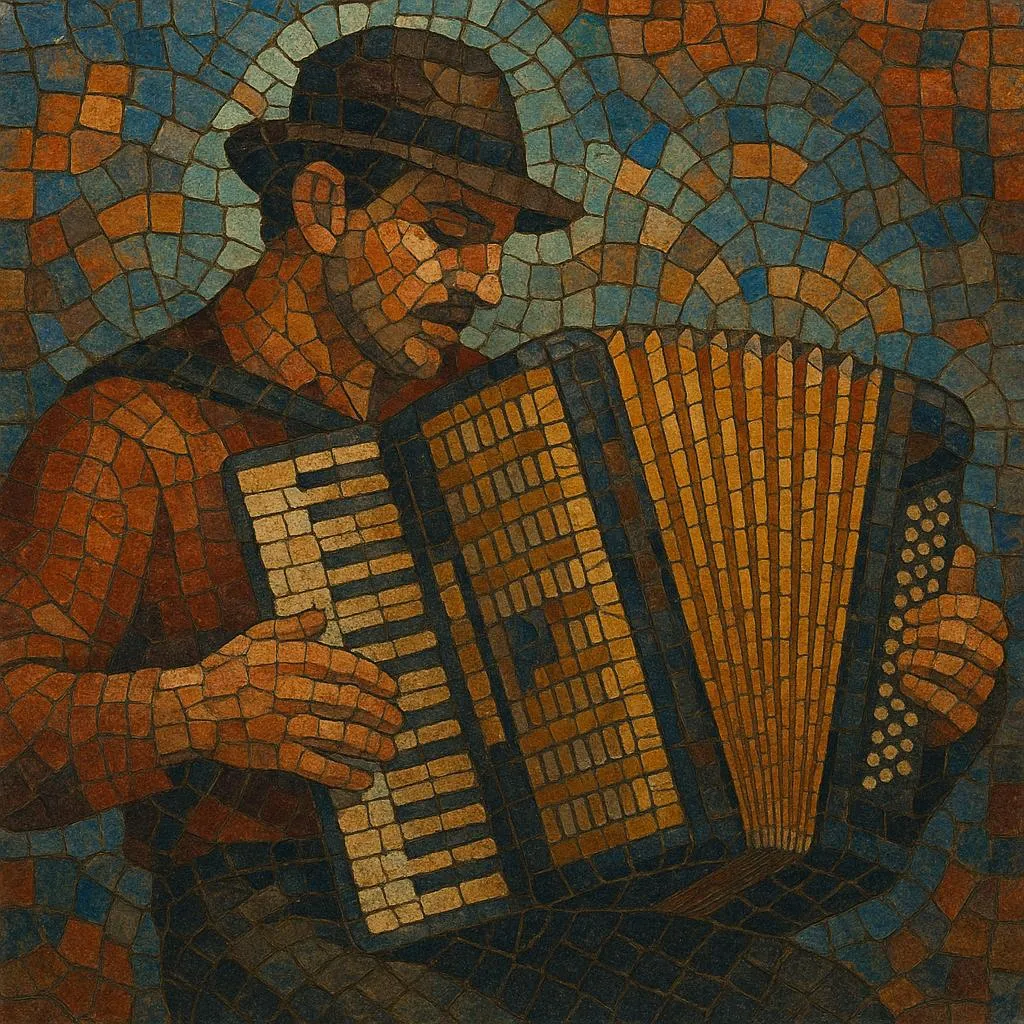
Akordeon refers to accordion-centered music: repertoire and performance practices in which the accordion (in its various systems) is the lead voice. Because the instrument is portable and harmonically self-sufficient, it appears across dance, folk, popular, and classical contexts.
The sound world ranges from bright, reedy two-steps and polkas to lyrical musette waltzes, driving norteño and forró grooves, Cajun/zydeco shuffles, and concert works that exploit bellows phrasing, left-hand bass patterns, and colorful registrations. In short, akordeon is less a single genre than an instrument-focused tradition that has shaped—and been shaped by—regional styles on several continents.
History
The modern accordion was patented in Vienna by Cyril Demian in 1829, with related free-reed instruments being developed in German-speaking regions around the same time. Its portability, volume, and ability to supply melody, harmony, and bass lines made it an ideal substitute for small ensembles in social dance settings.
By the mid–1800s, accordions were common in Central and Eastern Europe, accompanying polkas, mazurkas, waltzes, and schottisches. In Paris, the bal-musette scene adopted the instrument, refining a lyrical, tremolo-rich sound that became emblematic of French urban dance culture.
Migratory networks carried the instrument to the Americas and beyond. It became central to a spectrum of regional idioms: Cajun and zydeco in Louisiana; Tex-Mex conjunto and Tejano along the U.S.–Mexico border; vallenato and merengue típico in Colombia and the Dominican Republic; chamamé in Argentina; norteño across northern Mexico; and forró in Brazil. Each scene developed distinctive left-hand bass patterns, right-hand articulation, and repertoire suited to local dance forms.
From the early 20th century onward, virtuoso players and composers expanded the concert repertoire, and jazz accordionists explored swing, bebop, and fusion approaches. Postwar manufacturers standardized keyboard and button systems, while artists refined bellows technique, registration, and extended effects.
Today, akordeon spans conservatory-level classical performance, experimental and electronic hybrids, and thriving folk/pop scenes. Modern players incorporate amplification, effects processing, and cross-genre collaboration while preserving the instrument’s core expressive traits: dynamic phrasing via bellows, idiomatic bass-chord patterns, and rich timbral color.



