Genres
Artists
Albums
Make Music
Sign in
Sign in
Artists
Ancient Roman Music
Artists
Ancient Roman Music
Walter Maioli
4 albums
Listen
Genres
Sound Collage
Sound collage is a practice and genre that assembles disparate recorded sounds—speech, field recordings, musical fragments, noise, and media detritus—into a new, cohesive work. It treats recorded sound as raw material to be cut, layered, looped, juxtaposed, and transformed, often privileging texture, timbre, and context over conventional melody and harmony. Emerging from mid‑century tape and electroacoustic experiments, sound collage spans avant‑garde, popular, and club contexts, ranging from radical tape splices to sample‑dense pop and hip‑hop. Because it recontextualizes existing audio, it can be narrative, political, archival, or purely abstract—oscillating between documentary and dreamlike mosaic.
Discover
Listen
Musique Concrète
Musique concrète is an electroacoustic approach to composition that uses recorded real‑world sounds (objets sonores) as primary material rather than traditional instruments or notation. Composers edit, splice, loop, reverse, time‑stretch, filter, and otherwise transform these recordings to create works designed for loudspeakers. Emerging in late‑1940s France, it introduced acousmatic listening—focusing on the sound itself, detached from its source—along with a morphology‑based vocabulary of gesture, texture, and timbre. Historically realized on tape and now on digital audio workstations, musique concrète privileges montage and transformation over conventional harmony and meter, inviting listeners into a rich, tactile world of sonic phenomena.
Discover
Listen
Nature Recordings
Nature recordings are unaccompanied, minimally edited captures of natural soundscapes such as birdsong, wind, rain, surf, rivers, amphibians, insects, and other environmental ambiences. The emphasis is on documentary fidelity, long-form listening, and preserving dynamic range rather than musical composition in the traditional sense. Releases often present extended, uninterrupted tracks from a single habitat or time window (e.g., dawn chorus, coastal storm, tropical rainforest at night), inviting listeners to experience place through sound. While closely related to field recording and soundscape composition, nature recordings typically avoid added instruments or overt sound design, privileging biophony and geophony with as little anthrophony (human-made noise) as possible.
Discover
Listen
Ancient Roman Music
Ancient Roman music refers to the musical practices of the Roman Republic and Empire, roughly from the early centuries BCE through Late Antiquity. It was largely monophonic and orally transmitted, used in civic ritual, theater, private banquets, military life, and religious cults. Its core sound world combined Greco-Roman string and wind instruments (cithara, lyre, tibia/aulos) with percussion (tympanum, cymbala, crotala, sistrum) and powerful brass (tuba, cornu, bucina). The hydraulis (water organ) added a distinctive timbre to spectacles. Rhythm often followed poetic meters, and performance likely favored heterophonic textures and ornamented melodic lines over harmonic progressions. Rather than a single unified style, Roman music was a mosaic: theatrical and dance music for the ludi, refined kithara- and lyre-centered song for elite salons, processional and cultic soundscapes (including Egyptian-Isiac elements), and martial brass for command and ceremony.
Discover
Listen
Prehistoric Music
Prehistoric music refers to all musical activity that predates writing systems and recorded history. It encompasses the sounds, instruments, and performance practices of Paleolithic, Mesolithic, and Neolithic peoples long before formal musical notation or named composers existed. Rather than fixed repertoires, prehistoric music was a living practice tied to daily life, ritual, and environment. Voices, bone flutes, shell horns, drums, rattles, clapped stones (lithophones), and resonant caves functioned as both instruments and acoustic spaces. Its organization was likely cyclic and participatory, favoring pulse-driven rhythms, drones, call-and-response, and heterophony over harmonies and chords. Archaeological finds such as Aurignacian bone flutes in the Swabian Jura (Germany), the controversial Divje Babe artifact (Slovenia), and Jiahu flutes (China) attest to a wide geographic spread and deep antiquity. While unknowable in detail, prehistoric music laid the groundwork for the world’s ancient musical traditions.
Discover
Listen
Albums
Archeon - 200000 jaar muziek
Walter Maioli
Prehistoric Music
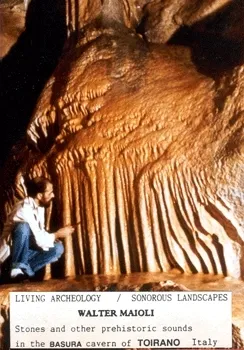
Living Archeology: Sonorous Landscapes
Walter Maioli
Prehistoric Music
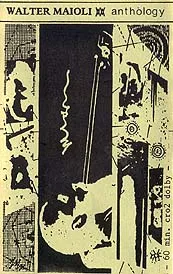
Anthology
Walter Maioli
Ancient Roman Music
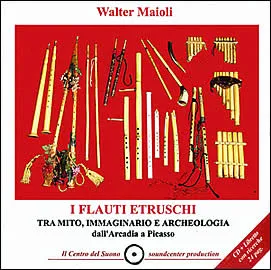
I flauti etruschi: Tra mito, immaginario e archeologia dall'Arcadia a Picasso
Walter Maioli
Ancient Roman Music
Similar artists
2
/5
John Cage
Indeterminacy
Classical
Experimental
2
/5
Chris Watson
Field Recording
Lowercase
Ambient
1
/5
Alvin Curran
Musique Concrète
Classical
Electronic
1
/5
Graham Lambkin
Musique Concrète
Avant-Garde
Electroacoustic
1
/5
Henri Pousseur
Avant-Garde
Experimental
Acousmatic
1
/5
Various Artists
Soundtrack
Afro-Funk
Alternative Rock
1
/5
Vanessa Rossetto
Field Recording
Sound Collage
Musique Concrète
GROUND-ZERO
Avant-Prog
Experimental Rock
Musique Concrète
Ákos Rózmann
Electroacoustic
Musique Concrète
Sound Collage
Minóy
Ambient
Drone
Experimental
Download our mobile app
Get the Melodigging app and start digging for new genres on the go
Download on the App Store
Get it on Google Play
© 2026 Melodigging
Give feedback
Legal
Melodding was created as a tribute to
Every Noise at Once
, which inspired us to help curious minds keep digging into music's ever-evolving genres.