Genres
Artists
Albums
Make Music
Sign in
Sign in
Artists
Latin
Artists
Latin
Bad Bunny
2016–2025
·
17 albums
Listen
5
/5
Genres
Sad Sierreno
Sad sierreño is a Gen-Z wave within Regional Mexicano that emphasizes intimate, melancholic guitar trios, confessional lyrics, and bedroom-pop aesthetics. It retains the core sierreño instrumentation—lead 12‑string requinto, rhythm guitar, and bass—while softening dynamics, slowing tempos, and foregrounding close‑miked vocals soaked in light reverb. Lyrically it fixates on heartbreak, loneliness, youthful yearning, and bittersweet nostalgia. Musically it often toggles between bolero/vals sierreño feels in minor keys and sparse 4/4 ballads, letting fingerpicked arpeggios and melodic requinto runs carry the emotional weight. The sound rose with U.S. Mexican-American youth, using social media virality to merge traditional sierreño with lo‑fi/indie sensibilities.
Discover
Listen
Trap Latino
Trap latino (Latin trap) is a Spanish-language offshoot of Southern U.S. trap that fuses the dark, bass-heavy aesthetics of trap with the rhythmic DNA and songwriting sensibilities of the Latin urbano spectrum (reggaeton, dembow, Latin hip hop). Beats typically sit around 70–75 BPM (or 140–150 BPM double-time), driven by sliding 808 bass lines, skittering hi-hat rolls, and crisp snares/claps. Vocals range from gritty rap to heavily Auto-Tuned, melodic hooks, often delivered in Spanish or Spanglish. Lyrical themes oscillate between street realism, romance, hedonism, and introspection, with production palettes favoring minor keys, eerie pads, bell/pluck motifs, and space that lets low-end energy shine. Born in Puerto Rico mid-2010s, the style quickly crossed into the broader Latin urbano market and global pop, reshaping the sound of contemporary Latin music and catalyzing crossovers with regional Mexican, pop, and reggaeton scenes.
Discover
Listen
Alternative R&b
Alternative R&B (often shortened to alt‑R&B or dubbed PBR&B) is a stylistic offshoot of contemporary R&B that fuses soul and hip hop vocal traditions with experimental electronic production and indie aesthetics. It is characterized by atmospheric, nocturnal sound design; sparse, half‑time or trap‑leaning drum patterns; deep sub‑bass; and intimate, often falsetto‑based vocals. Song forms frequently deviate from standard verse–chorus structures, favoring gradual builds, textural contrasts, and negative space. Harmonically, it leans toward minor modes and lush extensions (7ths, 9ths, add9s), while production favors reverb‑drenched pads, filtered synths, delicate guitar lines, and creative use of silence. Lyrically, the genre tends to be introspective and confessional—exploring themes of desire, vulnerability, alienation, and late‑night urban life—delivered with a cinematic, moody sensibility that bridges the underground and the mainstream.
Discover
Listen
Trap Boricua
Trap boricua is the Puerto Rican strain of Latin trap: a Spanish-language take on Southern U.S. trap aesthetics fused with the island’s reggaetón DNA and hip‑hop tradition. It is characterized by halftime 4/4 grooves (typically 65–75 BPM, or 130–150 BPM counted double‑time), heavy 808 sub-bass with slides, skittering 1/16 hi‑hats and triplet rolls, crisp claps/snares on the halftime backbeat, and atmospheric pads or minor‑key synth motifs. Vocals often mix melodic Auto‑Tuned hooks with gritty rap verses, switching between rapid‑fire syllables and laid‑back flows. Lyrically, artists blend barrio storytelling, bravado (fronteo), luxury and street codes with Puerto Rican slang, while also opening space for romance, introspection, and social commentary. The sound frequently hybrids with reggaetón (dembow cadences), R&B, and drill, making it both club‑ready and mood‑driven.
Discover
Listen
Twerk
Twerk is a high-energy club and festival style built around pounding 808 bass, head-nodding half‑time grooves at double‑time feel, and chantable hooks designed for the dancefloor. Typically sitting near 95–110 BPM, its percussion borrows the call‑and‑response patterns and bounce of New Orleans Bounce while embracing the sub‑heavy thump and party-forward attitude of Miami Bass. Modern productions often fold in trap-style hi-hats, crowd commands, and minimal, catchy riffs, prioritizing rhythm and movement over complex harmony.
Discover
Listen
Argentine Trap
Argentine trap is the Southern Cone’s spin on Latin trap and contemporary hip hop, forged by a generation raised on freestyle battles, YouTube, and low‑cost bedroom production. It blends the half‑time bounce of trap (heavy 808s, rattling hi‑hats, gliding bass) with Rioplatense Spanish, lunfardo slang, melodic Auto‑Tune hooks, and pop‑ready refrains. Compared with Puerto Rican and U.S. Latin trap, the Argentine branch often pivots between braggadocio and introspective, romantic, or melancholic storytelling, and it freely cross‑pollinates with reggaeton and pop to reach massive mainstream audiences.
Discover
Listen
Hjemmesnekk
Hjemmesnekk (Norwegian for "home‑made") is a grassroots, DIY tag within Norway’s russemusikk/party ecosystem used for tracks produced by graduating high‑school crews (russ) and their friends. Musically it sits at the crossroads of EDM, electro house, festival trap, and hardstyle, typically pairing chant‑like Norwegian hooks, rowdy call‑and‑response vocals, and oversized drops with big‑room leads, distorted kicks, sirens, and airhorns. Lyrics commonly reference the crew’s name, year, inside jokes, local pride, and end‑of‑school celebration culture. It is less a single codified style and more a hyper‑local, scene‑driven practice: fast, loud, celebratory tracks made with consumer DAWs, shared among peers, and blasted from buses and vans during the spring “russefeiring.”
Discover
Listen
New Tejano
New Tejano is a contemporary rejuvenation of Texas-Mexican (Tejano) music that blends the genre’s traditional accordion-forward polkas, cumbias, and rancheras with modern pop, R&B, and electronic production. It preserves signature elements—diatonic accordion riffs, bajo sexto strums, two-step and cumbia grooves—while embracing glossy synths, punchy drum programming, pop-leaning hooks, and bilingual storytelling. Compared with classic Tejano, New Tejano tends to favor hook-driven choruses, tighter radio/streaming song lengths, and crossover-friendly arrangements that sit comfortably alongside Latin pop and regional mexicano playlists. The result is music that still feels like a Saturday-night baile—joyful, danceable, and community-rooted—yet updated for the streaming era with contemporary sound design and a new generation of voices.
Discover
Listen
Pop Reggaeton
Pop reggaeton is a mainstream-friendly fusion of reggaeton’s dembow rhythm with pop songwriting, melody, and production polish. It keeps the genre’s signature off‑beat snare pattern and half‑time swing while foregrounding catchy toplines, bright synths, and clean, radio-ready mixes. Tempos typically sit around 85–100 BPM (or 170–200 BPM felt in halftime), with warm 808 subs, syncopated percussion, and hook‑centric choruses. Vocals—often in Spanish or Spanglish—lean toward memorable, romantic, or aspirational themes. Compared with classic reggaeton, pop reggaeton softens timbres, smooths cadences, and uses pop structures (verse–pre‑chorus–chorus–bridge) for broad crossover appeal.
Discover
Listen
Chicago Bop
Chicago bop is a buoyant, dance-driven offshoot of Chicago drill that emerged in the early 2010s. Where drill is dark and menacing, bop flips the script with upbeat tempos, bright synth melodies, and heavy Auto-Tune, encouraging party atmospheres and dance challenges. The style typically blends trap drum programming (808 kicks, fast hi-hat rolls, crisp claps) with sugary, bell-like or plucked synth leads and playful sing-rap flows. Lyrics lean toward fun, flexing, neighborhood slang, and dance instructions rather than street narratives, and the music is closely tied to the local “bop” dance movement that went viral on social media.
Discover
Listen
Corrido Tumbado
Corrido tumbado (sometimes called trap corrido) is a contemporary fusion of the traditional Mexican corrido with trap and hip hop aesthetics. It preserves acoustic, sierreño-style instrumentation—lead requinto guitar, rhythm guitar (often 12‑string), and tololoche or tuba—while adopting modern rhythmic feels, flows, and production habits from trap: half‑time grooves, skittering hi‑hats, 808 sub‑bass layers, ad‑libs, and light Auto‑Tune. Lyrically, it updates the corrido’s narrative tradition with first‑person storytelling about hustle, street life, migration, romance, luxury brands, and cannabis culture, frequently delivered with contemporary Mexican slang and occasional Spanglish. The result is a laid‑back yet gritty sound that bridges Regional Mexicano and global urban music cultures.
Discover
Listen
Lo Star
Lo star is a streaming-era umbrella tag used to group under-the-radar, low-profile artists who sit on the fringes of indie, alternative, DIY pop, and related scenes. Rather than denoting a single, tightly defined musical vocabulary, it marks a discovery space of self-produced or small-label projects with modest audiences, genre-fluid aesthetics, and a distinctly DIY approach to recording and release. Expect intimate vocals, inexpensive or home-studio production, hybrid acoustic/electronic textures, and songwriting that favors personal storytelling and immediacy over polish. Because it functions as a curatorial category for emerging or niche acts, the sonic palette spans indie rock and folk-pop to bedroom pop and lo-fi electronic, unified by scale, ethos, and distribution more than by strict musical rules.
Discover
Listen
Trap Triste
Trap triste (Spanish for “sad trap”) is a Spanish‑language offshoot of trap that emphasizes melancholic, introspective songwriting over minimalist, atmospheric beats. It blends minor‑key piano or guitar loops, airy pads, and reverb‑soaked textures with modern trap drum programming—808 slides, sparse kicks, and fast hi‑hat rolls. Vocals are typically sung‑rap with heavy Auto‑Tune, drawing on the emotive cadences of emo rap and the hazy feel of cloud rap while retaining Latin trap’s rhythmic backbone. Lyrically, it centers on heartbreak, loneliness, late‑night reflection, and personal vulnerability, often using straightforward, diary‑like phrasing that connects quickly with listeners on streaming platforms and social media.
Discover
Listen
Trap
Trap is a subgenre of hip hop that emerged from the Southern United States, defined by half-time grooves, ominous minor-key melodies, and the heavy use of 808 sub-bass. The style is characterized by rapid, syncopated hi-hat rolls, crisp rimshot/clap on the backbeat, and cinematic textures that convey tension and grit. Lyrically, it centers on street economies, survival, ambition, and introspection, with ad-libs used as percussive punctuation. Production is typically minimal but hard-hitting: layered 808s, sparse piano or bell motifs, dark pads, and occasional orchestral or choir samples. Vocals range from gravelly, staccato deliveries to melodic, Auto-Tuned flows, often using triplet cadences.
Discover
Listen
Reggaeton
Reggaeton is a contemporary urban dance music that blends the dembow rhythm of Jamaican dancehall with hip hop’s MC culture and Caribbean–Latin melodic sensibilities. Its hallmark is the propulsive, syncopated “dembow” drum pattern, typically around 85–100 BPM (often felt in half-time), which powers energetic verses and catchy, sung hooks. Lyrically, reggaeton is most often in Spanish or Spanglish and centers on dance, nightlife, flirtation, romance, and street life, with a performance style that alternates between rapped bars and melodic chorus lines. Production emphasizes tight, punchy drums, rolling 808 sub-bass, percussive plucks or stabs, and bright, hook-forward toplines—crafted for the club and tailored for crowd participation and perreo.
Discover
Listen
Urbano Latino
Urbano latino is an umbrella term for contemporary Spanish‑language urban music that fuses reggaeton, Latin trap, hip hop, R&B, and Caribbean dancehall/dembow aesthetics. It prioritizes rhythm-heavy production built from the dembow pattern, booming 808s, syncopated hi‑hats, and sleek synth textures, often paired with melodic hooks, Auto‑Tuned vocals, and call‑and‑response choruses. While rooted in Puerto Rican and Panamanian innovations of the 1990s, the genre became a global pop force in the 2000s and 2010s, driven by streaming platforms and cross‑border collaborations. Lyrical themes typically center on romance, nightlife, swagger, empowerment, and street perspective, frequently delivered in Spanish or Spanglish. The result is a dance‑forward, hook‑rich style that comfortably crosses between club, radio, and festival stages.
Discover
Listen
Pop Rap
Pop rap blends the rhythmic vocal delivery and beat-centric production of hip hop with the catchy hooks, polished structures, and radio-friendly sensibilities of pop music. It typically features melodic choruses (often sung), accessible themes, and mid-tempo grooves designed for mass appeal. Production prioritizes clean, bright sonics, simple harmonic progressions, and memorable top-line melodies, while verses keep to clear, punchy flows that are easy for broad audiences to follow. Because it sits between two commercial powerhouses—pop and hip hop—pop rap has frequently served as a gateway for mainstream listeners to explore rap, while giving hip hop artists a framework to cross over to pop charts.
Discover
Listen
Hip Hop
Hip hop is a cultural and musical movement that emerged from Black, Latino, and Caribbean communities, centering around rapping (MCing), DJing/turntablism, sampling-based production, and rhythmic speech over beats. It prioritizes groove, wordplay, and storytelling, often reflecting the social realities of urban life. Musically, hip hop is built on drum-centric rhythms (from breakbeats to 808 patterns), looped samples, and bass-forward mixes. Lyrically, it ranges from party anthems and braggadocio to political commentary and intricate poetic forms, with flow, cadence, and rhyme density as core expressive tools. Beyond music, hip hop encompasses a broader culture, historically intertwined with graffiti, b-boying/b-girling (breakdance), fashion, and street entrepreneurship, making it both an art form and a global social language.
Discover
Listen
Latin Pop
Latin pop is mainstream pop music performed primarily in Spanish (and sometimes Portuguese) that blends contemporary pop songwriting with Latin American and Iberian rhythms, harmonies, and vocal stylings. It typically features verse–pre-chorus–chorus forms, catchy hooks, polished production, and a balance between rhythmic drive and romantic lyric themes. Classic Latin pop often leans on bolero- and ballad-informed melodies and soft-rock textures, while modern Latin pop readily incorporates dance-pop, electronic, and urbano elements (such as reggaeton-influenced grooves) without losing its sing-along pop core.
Discover
Listen
Salsa
Salsa is a pan–Latin dance music forged primarily in New York City by Puerto Rican, Cuban, and other Caribbean diasporas. It synthesizes Afro‑Cuban rhythmic blueprints, Puerto Rican bomba and plena, jazz harmony, big‑band horn writing, and Nuyorican street culture into a tightly arranged yet improvisation‑friendly style. The music lives on the clave (either 2‑3 or 3‑2), with layered percussion (congas, bongó, timbales, cowbell, güiro, maracas), a tumbao bass that anticipates the beat, and piano montuno guajeos that interlock with the rhythm section. Call‑and‑response vocals (coro/pregón), punchy horn mambos and moñas, and instrumental solos energize the montuno section. Tempos range from medium to fast in 4/4, optimized for social dancing (commonly “on1” or “on2”). Across decades, salsa has branched into harder, percussion‑forward “salsa dura,” smoother “salsa romántica,” and regional scenes in Puerto Rico, Venezuela, and Colombia, while continuing to influence—and be influenced by—neighboring tropical and jazz idioms.
Discover
Listen
Latin
Latin (as a genre label) is a broad umbrella used by the recording industry to categorize popular music rooted in Latin America, the Caribbean, and the Iberian world, often characterized by syncopated Afro-diasporic rhythms, dance-forward grooves, and lyrics primarily in Spanish or Portuguese. As a marketplace category that took shape in the mid-20th century United States, it gathers diverse traditions—Afro-Cuban, Brazilian, Mexican, and Caribbean styles—into a shared space. In practice, "Latin" spans everything from big-band mambo and bolero ballads to contemporary pop, rock, hip hop, and dance fusions produced by artists of Latin American heritage.
Discover
Listen
Plena
Plena is an Afro–Puerto Rican music and dance genre that arose in working-class neighborhoods—most famously in Ponce and later Santurce—during the early 20th century. Often called the “periodical sung” (periódico cantado), plena songs chronicle everyday life, news, humor, and social commentary through concise verses and refrains. The core sound centers on panderos de plena (a family of frame drums in three sizes), the güiro scraper, handclaps, and call‑and‑response vocals. Rhythms are typically in 2/4 or 4/4 with syncopations related to Afro-Caribbean cells such as the habanera. While harmony is generally simple (I–IV–V with occasional modal color), plena’s power lies in its infectious groove, topical lyrics, and communal participation—qualities that later ensembles expanded with bass, brass (notably trombones), and dance-band arrangements.
Discover
Listen
Electronic
Electronic is a broad umbrella genre defined by the primary use of electronically generated or electronically processed sound. It encompasses music made with synthesizers, drum machines, samplers, computers, and studio/tape techniques, as well as electroacoustic manipulation of recorded or synthetic sources. The genre ranges from academic and experimental traditions to popular and dance-oriented forms. While its sonic palette is rooted in electricity and circuitry, its aesthetics span minimal and textural explorations, structured song forms, and beat-driven club permutations. Electronic emphasizes sound design, timbre, and studio-as-instrument practices as much as melody and harmony.
Discover
Listen
Bolero
Bolero is both a Spanish dance-music form from the late 18th century and, later, a Cuban song style from the late 19th century. The Spanish bolero emerged as a moderately slow solo or partner dance in 3/4 time, shaped by Andalusian song-dance traditions. It typically features guitar accompaniment and castanets, and its sung texts often follow the seguidilla stanza pattern. In Cuba, bolero evolved into a romantic ballad—most often in 2/4 (later also felt in 4/4)—performed by singers, trios, and salon ensembles. Cuban bolero emphasizes intimate, lyrical melodies, guitar-led accompaniment (often with requinto), and gentle Afro-Caribbean rhythmic undercurrents (habanera feel, soft bongo, claves), becoming one of Latin America’s quintessential love-song forms.
Discover
Listen
Show all 24 genres
Albums
2025
4
/5
ALAMBRE PúA
Bad Bunny
Latin
2025
5
/5
DeBÍ TiRAR MáS FOToS
Bad Bunny
Latin
Reggaeton
Trap Latino
2023
5
/5
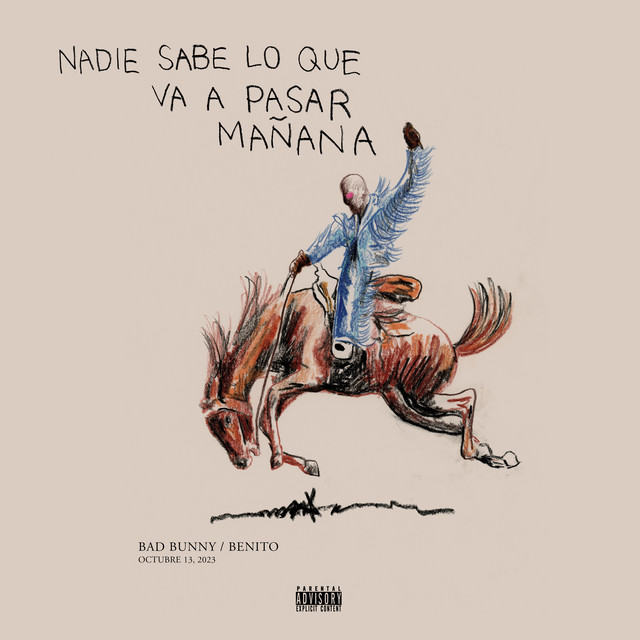
nadie sabe lo que va a pasar mañana
Bad Bunny
Trap Latino
Latin
Hip Hop
2023
4
/5
WHERE SHE GOES
Bad Bunny
Latin
Reggaeton
Urbano Latino
2022
5
/5
Un verano sin ti
Bad Bunny
Latin
Reggaeton
Urbano Latino
2021
4
/5
Yonaguni
Bad Bunny
Latin
Reggaeton
Urbano Latino
2020
5
/5
EL ÚLTIMO TOUR DEL MUNDO
Bad Bunny
Trap Latino
Bolero
Latin
2020
LAS QUE NO IBAN A SALIR
Bad Bunny
Electronic
Reggaeton
Trap Latino
2020
5
/5
YHLQMDLG
Bad Bunny
Latin
Reggaeton
Urbano Latino
2019
4
/5
Vete
Bad Bunny
Latin
Reggaeton
Urbano Latino
2019
OASIS
J Balvin & Bad Bunny
Hip Hop
Latin
Reggaeton
2018
5
/5
X 100PRE
Bad Bunny
Trap Latino
Latin
Alternative R&b
2018
4
/5
Dime si te acuerdas
Bad Bunny
Latin
Reggaeton
2018
4
/5
Amorfoda
Bad Bunny
Latin
Reggaeton
Urbano Latino
2017
4
/5
Chambea
Bad Bunny
Latin
2017
El conejo malo
DJ Sin-cero & Bad Bunny
Reggaeton
Trap Latino
2016
4
/5
Soy peor
Bad Bunny
Latin
Reggaeton
Urbano Latino
Similar artists
5
/5
KAROL G
Latin
Reggaeton
Trap Latino
5
/5
Farruko
Reggaeton
Latin
Trap Latino
5
/5
Rauw Alejandro
Reggaeton
Trap Latino
Latin
5
/5
Don Omar
Reggaeton
Latin Hip Hop
Electro Latino
5
/5
Feid
Colombian Pop
Reggaeton
Pop Reggaeton
5
/5
Wisin & Yandel
Reggaeton
Electro Latino
Latin
5
/5
Mora
Reggaeton
Trap Latino
Urbano Latino
4
/5
Becky G
Latin Rap
Latin Viral Pop
Latin
5
/5
Eladio Carrion
Trap Boricua
Trap Triste
Trap Latino
5
/5
Young Miko
Trap Latino
Trap Boricua
Neoperreo
Download our mobile app
Get the Melodigging app and start digging for new genres on the go
Download on the App Store
Get it on Google Play
© 2026 Melodigging
Give feedback
Legal
Melodding was created as a tribute to
Every Noise at Once
, which inspired us to help curious minds keep digging into music's ever-evolving genres.