Genres
Artists
Albums
Make Music
Sign in
Sign in
Albums
By Deutsches Symphonie-Orchester Berlin
Albums
By Deutsches Symphonie-Orchester Berlin
This Will Be Us
October 23, 2026
Listen
Genres
Musique Concrète Instrumentale
Musique concrète instrumentale is a compositional approach that transfers the ideas of musique concrète to the realm of purely acoustic instruments. Instead of manipulating recorded sound objects on tape or digitally, composers write for traditional instruments played with unconventional, extended techniques so that the instruments produce "concrete" sound-objects: breaths, frictions, scratches, resonances, and mechanical noises. Pitch and regular meter are de-centered in favor of the morphology of sounds—how they begin, sustain, and decay; their grain, spectrum, and energy; and the dramaturgy created by their transformation over time. The result is a highly tactile, timbre-driven music that treats the instrument as a source of material rather than as a vehicle for themes or harmonic progressions.
Discover
Listen
Darmstadt School
The Darmstadt School refers to the post–World War II circle of composers who gathered around the Internationale Ferienkurse für Neue Musik (International Summer Courses for New Music) in Darmstadt, West Germany. Characterized by rigorous serial and post-serial techniques, extreme control of musical parameters (pitch, rhythm, dynamics, timbre), and a rejection of tonal and romantic idioms, the style prized structural clarity, pointillist textures, and an ascetic, laboratory-like approach to sound. While aesthetically diverse, its core ethos was a modernist drive toward formal innovation, often engaging electronic media and advanced notation, and deeply influenced by the Second Viennese School—especially Webern’s concise, atomized writing.
Discover
Listen
Cantata
A cantata is a multi-movement vocal composition with instrumental accompaniment, typically written for one or more soloists, choir, and a continuo or small orchestra. It may be sacred (for liturgical use) or secular (for courtly or domestic performance). Emerging in early 17th-century Italy, the cantata adopts the expressive recitative–aria contrast of opera on a smaller scale. Baroque church cantatas—especially in the German Lutheran tradition—often weave congregational chorales, contrapuntal choruses, and solo arias into a coherent cycle tied to the liturgical calendar. Stylistically, cantatas use tonal Baroque harmony, basso continuo, and movement types such as recitativo secco/accompagnato, da capo arias, choruses, and sinfonias. The genre later broadened into concert and scenic cantatas in the 19th and 20th centuries.
Discover
Listen
Similar albums
1995
Carmina Burana
Carl Orff
2019
Membra Jesu nostri
Dietrich Buxtehude
2000
Cantates pour alto
Johann Sebastian Bach
1988
Carmina Burana
Carl Orff
2000
Actus tragicus: Cantates BWV 4, 12, 106 & 196
Johann Sebastian Bach / Cantus Cölln / Konrad Junghänel
1992
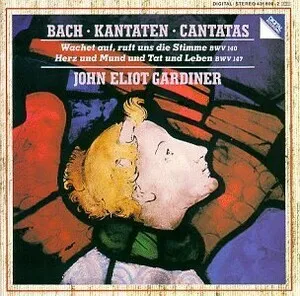
Kantaten: Wachet auf, ruft uns die Stimme BWV 140; Herz und Mund und Tat und Leben BWV 147
Johann Sebastian Bach / John Eliot Gardiner
1997
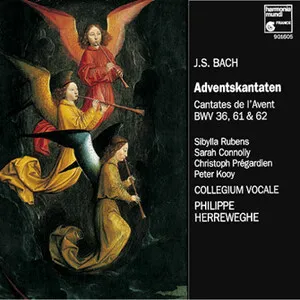
Adventskantaten BWV 36, 61 & 62
Johann Sebastian Bach
1996
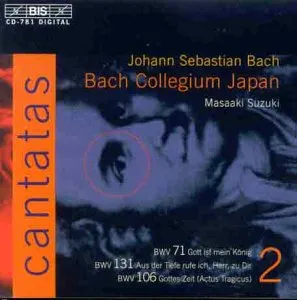
Cantatas Vol. 2
Johann Sebastian Bach / Bach Collegium Japan / Masaaki Suzuki
2005
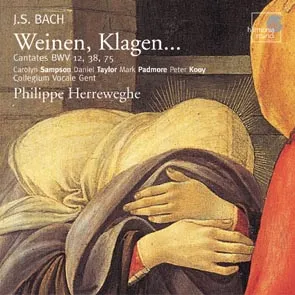
Weinen, Klagen... Cantates BWV 12, 38, 75
Johann Sebastian Bach
2007
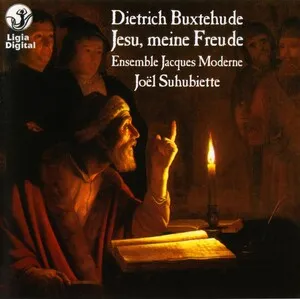
Jesu, meine Freude
Dietrich Buxtehude / Ensemble Jacques Moderne / Joël Suhubiette
Download our mobile app
Get the Melodigging app and start digging for new genres on the go
Download on the App Store
Get it on Google Play
© 2026 Melodigging
Give feedback
Legal
Melodding was created as a tribute to
Every Noise at Once
, which inspired us to help curious minds keep digging into music's ever-evolving genres.