Genres
Artists
Albums
Make Music
Sign in
Sign in
Record label
Jube Classic
Related genres
Baroque
Baroque is a period and style of Western art music spanning roughly 1600–1750. It is characterized by the birth of functional tonality, the widespread use of basso continuo (figured bass), and a love of contrast—between soloist and ensemble, loud and soft, and different timbres. Hallmark genres and forms of the era include opera, cantata, oratorio, concerto (especially the concerto grosso), dance suite, sonata, and fugue. Textures range from expressive monody to intricate counterpoint, and melodies are richly ornamented with trills, mordents, and appoggiaturas. Baroque music flourished in churches, courts, and theaters across Europe, with regional styles (Italian, French, German, English) shaping distinctive approaches to rhythm, dance, harmony, and ornamentation.
Discover
Listen
Classical
Classical music is the notated art-music tradition of Europe and its global descendants, characterized by durable forms, carefully codified harmony and counterpoint, and a literate score-based practice. The term “classical” can refer broadly to the entire Western art-music lineage from the Medieval era to today, not just the Classical period (c. 1750s–1820s). It privileges long-form structures (such as symphonies, sonatas, concertos, masses, and operas), functional or modal harmony, thematic development, and timbral nuance across ensembles ranging from solo instruments to full orchestras and choirs. Across centuries, the style evolved from chant and modal polyphony to tonal harmony, and later to post-tonal idioms, while maintaining a shared emphasis on written notation, performance practice, and craft.
Discover
Listen
Concerto
A concerto is a large-scale composition that sets one or more solo instruments in dynamic dialogue with an orchestra. Its core idea is contrast—between soloist and tutti—and the dramatic negotiation of power, color, and thematic responsibility. While Baroque concertos often relied on ritornello form, the Classical era standardized a three-movement plan (fast–slow–fast) with sonata principles in the opening movement. The Romantic period emphasized virtuosity and expressive foregrounding of the soloist, and the 20th–21st centuries broadened the palette with new instruments, harmonies, and formats. Across eras, the concerto remains a showcase for instrumental character, technical brilliance, and the art of orchestral conversation.
Discover
Listen
Western Classical
Western classical is the notated art-music tradition that developed in Europe from medieval Christian chant into the large-scale secular and sacred forms of the Baroque, Classical, Romantic, and modern eras. It is characterized by staff notation, evolving systems of modality and tonality, and forms such as symphony, sonata, concerto, mass, opera, and chamber music. Across its history, Western classical established an extensive theory of harmony and counterpoint, refined orchestration across strings, winds, brass, and percussion, and cultivated performance practices from a cappella chant to full symphonic and operatic forces. Its repertoire, pedagogy, and institutions (conservatories, orchestras, opera houses) made it a global reference point for compositional craft and instrumental technique.
Discover
Listen
Vocal Music
Vocal music is music in which one or more singers carry the primary musical line, whether accompanied by instruments or sung a cappella (without any non‑vocal instrumental accompaniment). If singing is present but not featured prominently, the piece is typically treated as instrumental music. By contrast, vocal music foregrounds the human voice—its words, melody, timbre, and expressive nuance—across an enormous range of styles from chant and folk song to opera, pop, and hip hop.
Discover
Listen
Albums
Ballet Music and Symphonic Showpieces
Philharmonia Orchestra, Herbert von Karajan
L’Oiseau de feu / Le Chant du rossignol: Lorin Maazel Conducts Stravinsky (Remastered 2016)
Igor Stravinsky; Rundfunk‐Sinfonieorchester Berlin & Lorin Maazel
Wilhelm Furtwängler, Vol. 2
Beethoven, Mendelssohn; Yehudi Menuhin, Berliner Philharmoniker, Wilhelm Furtwä…
Sinfonietta flamenca
Les Concerts de Paris Symphony Orchestra, Carlos Surinach
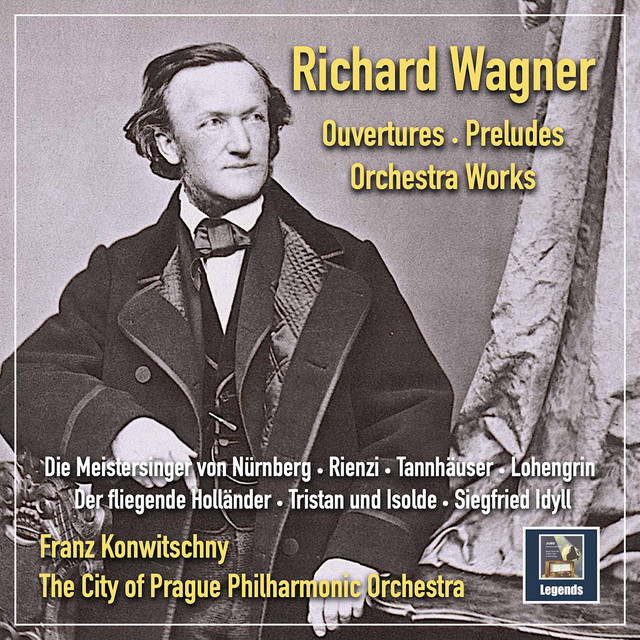
Ouvertures, Preludes & Orchestral Works
Richard Wagner; The City of Prague Philharmonic Orchestra & Franz Konwitschny
Franz Konwitschny Conducts Beethoven (Remastered 2018)
Ludwig van Beethoven; Gewandhausorchester & Franz Konwitschny
Charity Concert for the Rebuilding of the Munich National Theatre, 20th March 1955
Hans Knappertsbusch
Rachmaninoff: Concerto for Piano and Orchestra no. 1 in F-sharp minor, op. 1 / Liszt: Totentanz / Moussorgsky: Tableaux…
Rachmaninoff, Franz Liszt, Moussorgsky; Byron Janis, Chicago Symphony Orchestra…
Symphonies Nos. 4 & 6 (2018 Remaster)
Pyotr Ilyich Tchaikovsky; St. Petersburg Philharmonic Orchestra & Yevgeny Mravi…
Hans Schmidt‐Isserstedt Conducts Franz Berwald
Franz Berwald; Stockholm Symphony Orchestra & Hans Schmidt‐Isserstedt
Show more
Artists
Herbert von Karajan
Ludwig van Beethoven
Wolfgang Amadeus Mozart
Benjamin Britten
Leonard Bernstein
Claude Debussy
BBC Symphony Orchestra
Frankfurt Radio Symphony Orchestra
Orchestre de la Société des Concerts du Conservatoire
Johann Sebastian Bach
Nikolai Rimsky-Korsakov
Georges Bizet
Wiener Philharmoniker
Wiener Singverein
London Philharmonic Orchestra
London Symphony Orchestra
Czech Philharmonic
Chicago Symphony Orchestra
The City of Prague Philharmonic Orchestra
Maurice Ravel
Gabriel Fauré
New York Philharmonic
Franz Schubert
Gustav Holst
Karl Richter
Carl Maria von Weber
Leopold Stokowski
Gewandhausorchester
Franz Liszt
Edvard Grieg
Lorin Maazel
Jules Massenet
Heitor Villa-Lobos
Bamberg Symphony
Berliner Philharmoniker
Pyotr Ilyich Tchaikovsky
Camille Saint-Saëns
Orchestre de la Suisse Romande
Dmitri Shostakovich
Alexander Borodin
Yehudi Menuhin
Boston Pops Orchestra
Boston Symphony Orchestra
Johannes Brahms
Dietrich Fischer-Dieskau
Eugen Jochum
Giovanni Gabrieli
Léo Delibes
Jean Sibelius
Royal Concertgebouw Orchestra
Antonín Dvořák
Felix Mendelssohn
Evgeny Mravinsky
Robert Schumann
Sergei Rachmaninoff
Igor Stravinsky
Sergei Prokofiev
Richard Strauss
Johann Strauss II
Modest Mussorgsky
Rafael Kubelík
Israel Philharmonic Orchestra
César Franck
Elisabeth Schwarzkopf
Arthur Fiedler
Béla Bartók
Josef Suk
Paul Dukas
Walter Gieseking
Philharmonia Orchestra
Richard Wagner
André Cluytens
Anton Bruckner
Adolphe Adam
Ferenc Fricsay
Sir Malcolm Sargent
Deutsches Symphonie-Orchester Berlin
Emil Gilels
Ernest Ansermet
Arthur Honegger
Antal Doráti
Hans Hotter
Hans Knappertsbusch
Hans Schmidt-Isserstedt
Charles Münch
Michael Tippett
Jean Martinon
Fritz Reiner
Staatskapelle Berlin
Philharmonia Hungarica
Robert Stolz
Erich Kleiber
Carl Schuricht
Willi Boskovsky
Felix Slatkin
Zoltán Kodály
Rundfunk-Sinfonieorchester Berlin
Hans Rosbaud
Wilhelm Furtwängler
Ferde Grofé
Saint Petersburg Philharmonic Orchestra
Franz Konwitschny
Rolf Liebermann
William Schuman
Rudolf Kempe
Peter Pears
Sergiu Celibidache
Otto Ackermann
Carlos Surinach
Clemens Krauss
Philharmonisches Staatsorchester Hamburg
Südwestfunk Baden-Baden
Orchestre des Concerts de Paris
Berwald
Byron Janis
Willem Mengelberg
Tommasini
Das große Wiener Rundfunkorchester
Siegfried Borries
The Hollywood Bowl Symphony Orchestra
Max von Schillings
Stockholm Symphony Orchestra
Bachwoche Ansbach Festival Orchestra
Großes Unterhaltungsorchester
The Concert Arts Cello Ensemble
Johannes Zuther
Max Schönherr
Download our mobile app
Get the Melodigging app and start digging for new genres on the go
Download on the App Store
Get it on Google Play
© 2026 Melodigging
Give feedback
Legal
Melodding was created as a tribute to
Every Noise at Once
, which inspired us to help curious minds keep digging into music's ever-evolving genres.