Your digging level
Description
Trouvère is the monophonic courtly song tradition of northern France in the High Middle Ages. Written in Old French (langue d’oïl), its repertory centers on refined lyrical poetry about love, chivalry, crusade, debate, and pastoral scenes.
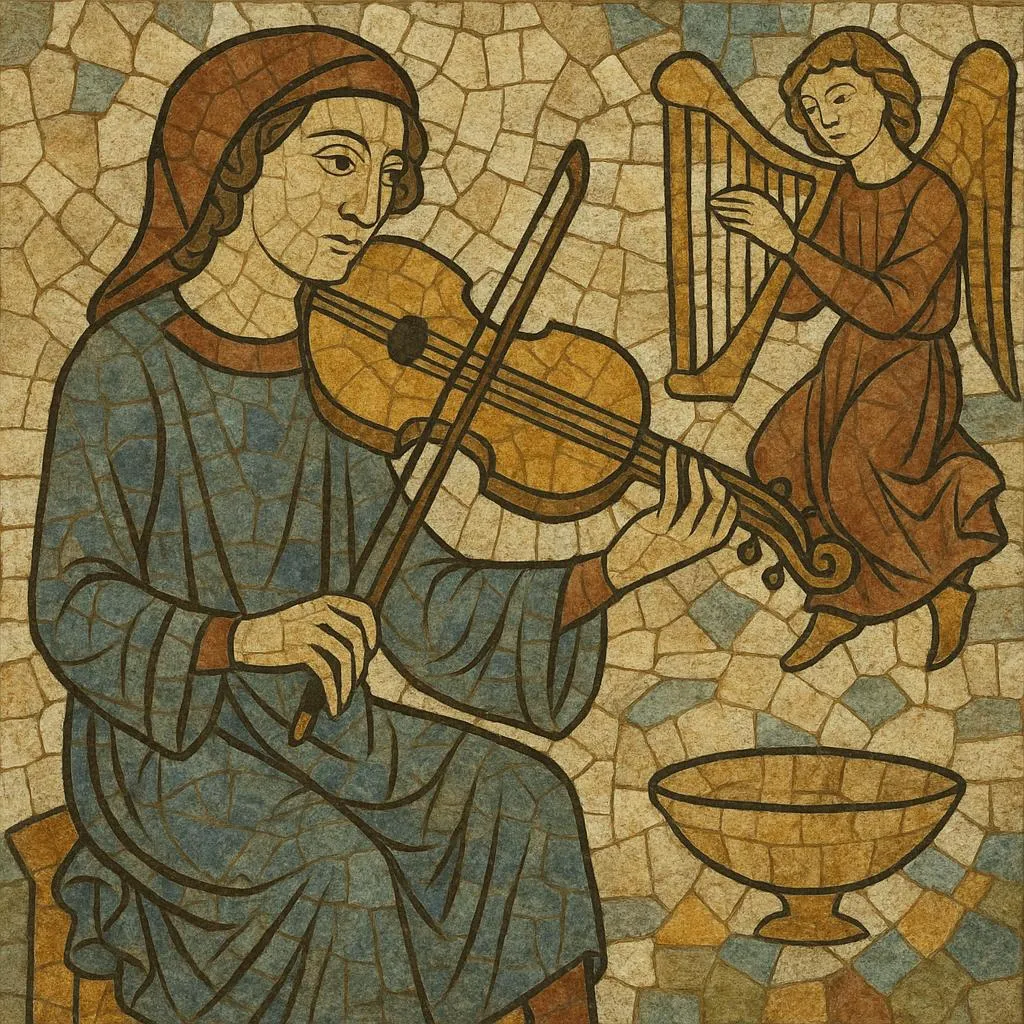
Songs are primarily strophic and syllabic, designed so that the natural accents of the text shape the melodic line. While notated as single vocal lines, performance often featured a solo singer with optional accompaniment—vielle (fiddle), harp, psaltery, or flute—adding drones, simple borduns, or heterophonic doubling.
Trouvère practice codified genres such as the chanson courtoise (courtly love song), pastourelle, chanson de croisade, jeu-parti (debate song), and serventois. Its melodic style draws on medieval modal practice and poetic meter rather than strict measured rhythm, though later pieces show awareness of rhythmic modes.
History
Trouvère song arose in northern France soon after the emergence of the southern troubadour tradition, adapting the courtly-love ethos to the langue d’oïl. By the mid‑12th century, aristocratic poet‑composers (often knights or clerics) cultivated secular monophonic song for courtly entertainment and literary display.
The tradition blossomed across Picardy, Artois, Champagne, and Normandy. Poet‑composers formalized genres—chanson courtoise, pastourelle, chanson de croisade, jeu‑parti—and transmitted repertory via chansonniers (songbooks). Notation captured contours and modes but left rhythm largely to poetic meter and performance practice; by the later 13th century, some songs reflect modal rhythmic awareness from the Parisian (Notre‑Dame) ars antiqua milieu.
Although written as monophony, performances often employed instruments for drones, punctuating interludes, or parallel/heterophonic lines. Professional jongleurs/minstrels circulated repertory between courts and towns, helping fix melodies and texts while also encouraging local variants.
The trouvère ethos and genres fed directly into later French song traditions and shaped neighboring repertoires (German Minnesang, Iberian cantigas). As polyphony and the ars nova rose in the 14th century, monophonic courtly song gradually ceded prominence, but its poetic and melodic models informed later French chansons, lute songs, and the long arc of European art song.