Your digging level

For this genre
0/8
🏆
Sign in, then listen to this genre to level up

Description

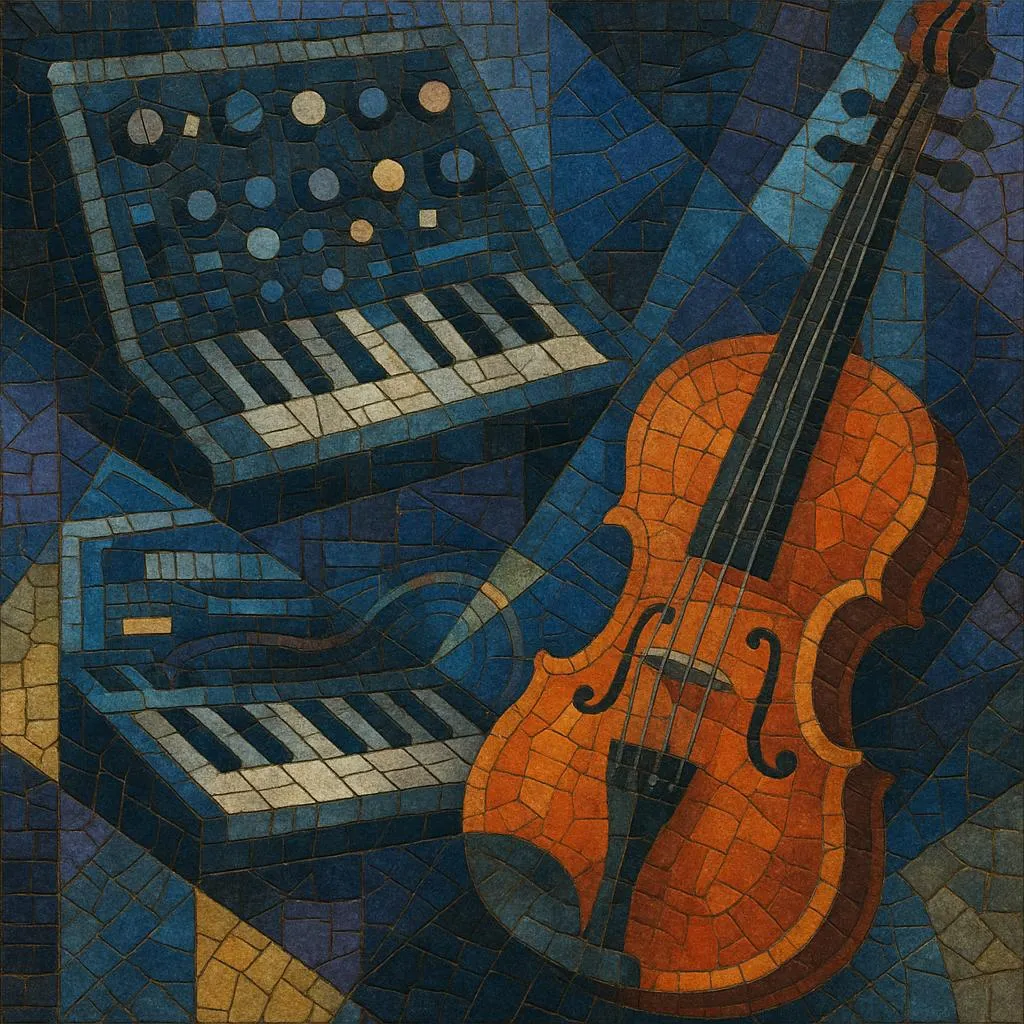
Synthetic classical is a style that presents Western classical repertoire (or original music in a classical idiom) using synthesizers and electronic production as the primary instrumentation.

Rather than employing a traditional orchestra, practitioners re-orchestrate scores on modular, analog, or software synths, samplers, and digital workstations. The aesthetic ranges from faithful, timbral "orchestral emulation" to boldly reimagined textures that foreground the unique color of electronics—filters, envelopes, and spectral processing—while preserving the counterpoint, harmony, and form of classical music.

It emerged alongside the late‑1960s Moog revolution, when early adopters demonstrated that historically acoustic repertoire could be convincingly (and sometimes provocatively) rendered on electronic instruments.


Sources: Spotify, Wikipedia, Discogs, Rate Your Music, MusicBrainz, and other online sources

History

Early experiments (1960s–1970s)

The genre’s roots trace to the rise of voltage‑controlled synthesis and multitrack recording. Artists began translating baroque and classical repertoire onto Moog and other analog systems, proving that a single synthesizer, layered with painstaking overdubs, could approximate or reinvent orchestral textures. These landmark releases popularized the idea of “classical on synths” and introduced a generation to the timbral possibilities of electronic sound design applied to canonical works.

Expansion and studio craft (1980s–1990s)

Digital synthesis, samplers, and MIDI sequencers made complex scores more accessible to solo producers. ROMplers and early orchestral libraries allowed hybrid approaches: synthetic pads supporting sampled strings, synthesized brass reinforcing counterpoint, and drum machines adding pulse to otherwise metrically flexible music. Film, television, and advertising began using electronic realizations of classical themes, further normalizing the sound.

Software orchestration and hybrid scoring (2000s–present)

High‑fidelity sample libraries and soft synths enabled detailed articulation, expressive automation, and convincing ensemble balance entirely in the box. Producers moved fluidly between faithful electronic renderings and more radical reimaginings that exploit synthesis (granular, additive, spectral) while retaining classical harmony and form. The approach has influenced soundtrack culture, video game scoring, classical crossover releases, and educational projects that introduce classical repertoire through modern electronic sound.

How to make a track in this genre

Materials and repertoire
•   Choose a classical source (a movement, aria, prelude, or a fugue) or write original music in a classical idiom (clear form, functional harmony, counterpoint). •   Decide your stance: faithful orchestral emulation with electronic means, or a timbral reimagining that leverages distinctly synthetic tones.
Instrumentation and sound design
•   Core tools: subtractive/analog‑style soft synths, FM or wavetable synths for color, and a palette of orchestral sample libraries for hybrid layering. •   Map orchestral choirs to synth families: strings → warm pads with slow attack; brass → layered saws with gentle saturation; woodwinds → formant‑filtered leads; percussion → synthesized mallet/impacts with envelopes shaped for realism. •   Use modulation (velocity, aftertouch, mod wheel) and MIDI CCs (expression, vibrato depth, dynamics) to phrase lines—long notes need life.
Harmony, counterpoint, and rhythm
•   Preserve voice‑leading: separate lines onto distinct timbres to keep counterpoint intelligible. •   Keep classical cadences and sequences intact; if reharmonizing, respect the original voice‑leading logic. •   If adding pulse, use subtle electronic grooves (side‑chained pads, soft synth bass ostinati) that support rather than dominate rubato passages.
Production and space
•   Stage the ensemble with contrasting reverbs (short rooms for clarity, plates/halls for blend) and careful EQ to avoid low‑end build‑up from layered pads. •   Humanize timing and dynamics slightly; perfect quantization can sound mechanical in contrapuntal textures. •   Automate filters and expression to mimic breath/bow, and employ stereo width judiciously so inner voices remain focused.
Workflow tips
•   Orchestrate on paper/piano first; assign timbres later to maintain musical clarity. •   Print stems by choir (pads/strings, leads/woodwinds, brass, bass, percussion) for mix control. •   Reference both acoustic recordings of the piece and seminal electronic realizations to calibrate phrasing and pace.

Top tracks

Locked
Share your favorite track to unlock other users’ top tracks
Influenced by
Has influenced
Challenges
Digger Battle
Let's see who can find the best track in this genre

Download our mobile app

Get the Melodigging app and start digging for new genres on the go
© 2026 Melodigging
Melodding was created as a tribute to Every Noise at Once, which inspired us to help curious minds keep digging into music's ever-evolving genres.
Buy me a coffee for Melodigging