Your digging level
Description
Sundanese traditional music is the indigenous musical art form of the Sundanese people from West Java, Indonesia. It encompasses a diverse range of styles, from the aristocratic sung poetry known as Tembang Sunda (or Cianjuran) to the folk-rooted Gamelan Degung and the intimate Kacapi Suling.
Distinct from the neighboring Javanese traditions, Sundanese music is characterized by its fluid, melismatic vocals, the prominent use of bamboo instruments (like the suling flute and angklung), and dynamic, complex drumming (kendang). The music often utilizes specific scales such as Pelog (Degung), Madenda (Sorog), and Salendro, creating moods that range from melancholic and yearning to lively and rhythmic.
History
The roots of Sundanese traditional music stretch back to the ancient Sunda Kingdom (Pakuan Pajajaran), with oral traditions like Pantun Sunda (epic storytelling) dating back centuries. However, the codified forms recognized today largely took shape during the colonial era.
19th Century: The Aristocratic Era
In the mid-19th century, the regents (bupati) of Cianjur developed Tembang Sunda (also called Cianjuran), a refined form of sung poetry accompanied by kacapi (zither) and suling (flute). This genre became the hallmark of Sundanese high culture, blending indigenous pantun recitation with Javanese musical concepts introduced during the Mataram influence.
Early 20th Century: Revival and Innovation
Gamelan Degung, originally a restricted court ensemble, was popularized and modernized in the early 20th century. Musicians like Daeng Soetigna also revolutionized the Angklung by tuning it to the Western diatonic scale in 1938, making it accessible for educational and nationalist purposes.
Mid-to-Late 20th Century: Modernization
Post-independence, composers like Mang Koko (Koko Koswara) injected new life into the tradition by creating Wanda Anyar (New Style), which added complex instrumental techniques and humor to the repertoire. In the 1970s, Gugum Gumbira synthesized traditional Ketuk Tilu folk music with martial arts elements to create Jaipongan, a dynamic dance music that swept the nation.
To compose in the Sundanese traditional style, one must master the specific tuning systems (laras). The most common are Salendro (equidistant pentatonic), Pelog Degung (hemitonic pentatonic, often associated with the Gamelan Degung), and Madenda or Sorog (often used for sad or romantic moods, similar to a minor scale with a raised fourth).
Instrumentation:
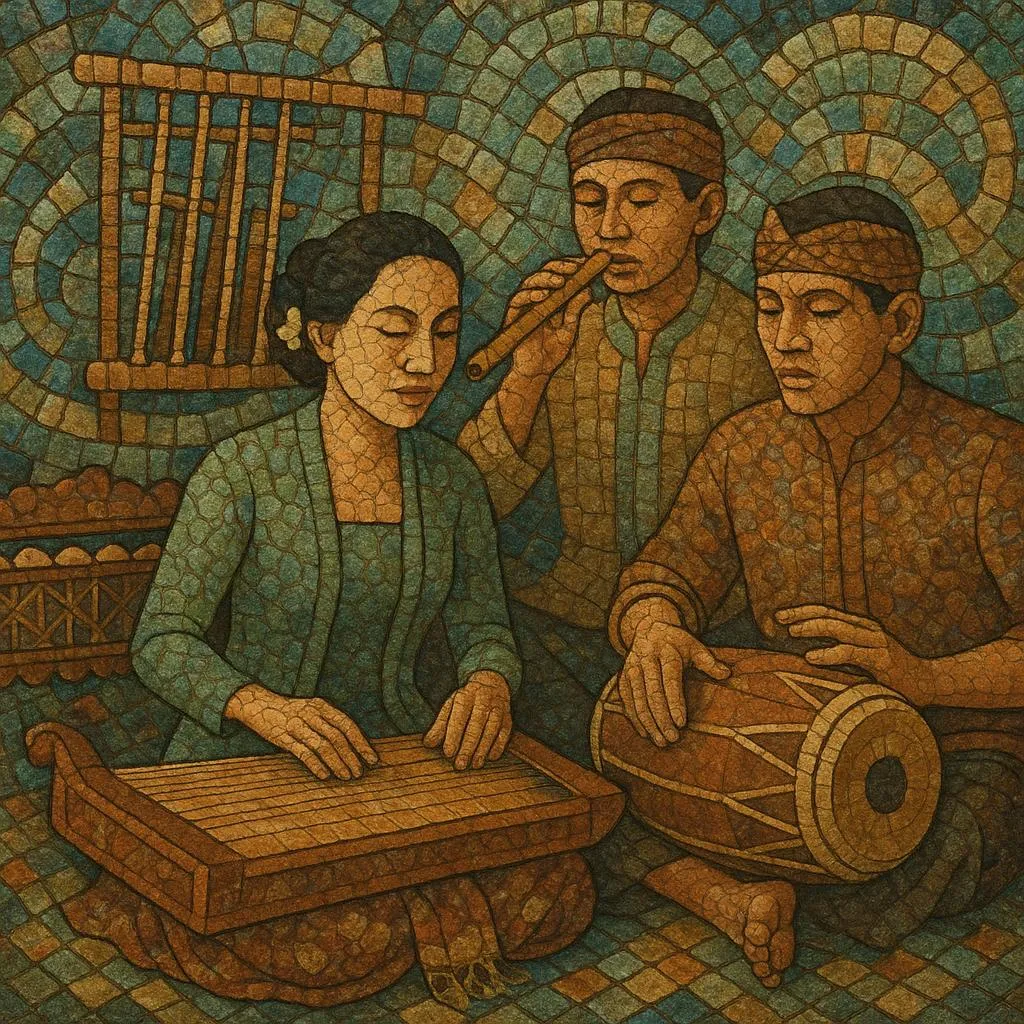
•Melody: Use the Suling (bamboo flute) for ornate, bird-like melodies with heavy vibrato and bending notes, or the Rebab (spike fiddle).
•Harmony/Rhythm: The Kacapi Indung (large zither) provides the structural bass and chords, while the Kacapi Rincik (small zither) plays interlocking filler patterns.
•Percussion: The Kendang (drum) is crucial for dynamics, using complex slap and dampening techniques to control the tempo (which is often elastic).
Structure:
Compositions often follow a colotomic structure marked by the Goong (gong). In Tembang Sunda, the rhythm is free-flowing (rubato) for the vocal sections (Mamaos), transitioning to a fixed meter for the instrumental outro (Panambih).