Description
Russian opera is the operatic scene associated with Russia and with composers of Russian origin, rather than a single style with a uniform sound. It encompasses works written or staged abroad by Russian composers as well as operas written for Russian stages by composers from elsewhere.
Russian is an important language of the repertoire, but not its only one: works have also been written in languages including Italian and French. Throughout its history, the scene has drawn on Italian, French and German operatic models while also exploring local subjects and melodies. Its range extends from comic opera and works using popular songs to historical drama, adaptations of literature and more experimental forms of music theatre.
History
Arrival and early development
Opera reached Russia in the 1730s through Italian performers. In 1731, Giovanni Alberto Ristori’s Calandro was performed in Moscow. Foreign composers subsequently worked for the imperial court: Francesco Araja’s Russian-language Tsefal i Prokris, with a libretto by Alexander Sumarokov, was staged in Saint Petersburg in 1755.
By the early 1770s, composers of Russian origin were beginning to write operas to Russian librettos. Early works could also incorporate familiar songs: Anyuta, performed in 1772, used popular songs specified in its libretto. Vasily Pashkevich’s comic opera The Miser combined Western formal features with Russian melodies.
National opera and the nineteenth century
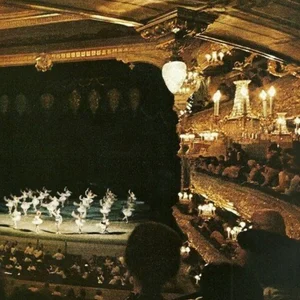
Mikhail Glinka’s A Life for the Tsar (1836) and Ruslan and Lyudmila (1842) helped inaugurate a new phase of national opera. The century brought a wide variety of major works, including Modest Mussorgsky’s Boris Godunov and Pyotr Tchaikovsky’s Eugene Onegin and The Queen of Spades. Nikolai Rimsky-Korsakov was another prolific opera composer. The growth of the scene was supported by theatres including Moscow’s Bolshoi Theatre and Saint Petersburg’s Mariinsky Theatre.
The twentieth century and after
Composers continued to work in varied forms, from Igor Stravinsky’s operas and music-theatre pieces to Sergei Prokofiev’s operas. Soviet cultural politics also affected the field. In 1929, the Russian Association of Proletarian Musicians criticized Dmitri Shostakovich’s The Nose as “formalist”; Soviet authorities later condemned his Lady Macbeth of the Mtsensk District after its successful 1934 performances.
New work continued into the twenty-first century. Leonid Desyatnikov’s The Children of Rosenthal, commissioned by the Bolshoi Theatre, premiered in 2005.
Choose a dramatic starting point
Begin with a story that can sustain sung drama. Historical subjects, literary adaptations and comic plots all offer models within the scene; you could also work from a folk-drama setting. Shape a libretto around conflicts and changes of situation rather than trying to reproduce a single supposed Russian-opera sound.
Develop the musical language
Consider the relationship between broader operatic conventions and local material. You could build melodies from a folk-like or popular-song idea, placing them within an operatic structure, or use such material selectively to distinguish a character or setting. The scene has also made room for works without an exclusively Russian-language text.
Write for the stage
A common operatic approach is to alternate more speech-like musical delivery with extended lyrical passages, ensembles and orchestral transitions. Let the vocal writing serve the words and the dramatic situation, and use the orchestra to establish atmosphere, underline conflicts or connect scenes. For a more experimental project, you could explore the boundary between opera and other forms of music theatre.