Your digging level

For this genre
0/8
🏆
Sign in, then listen to this genre to level up

Description

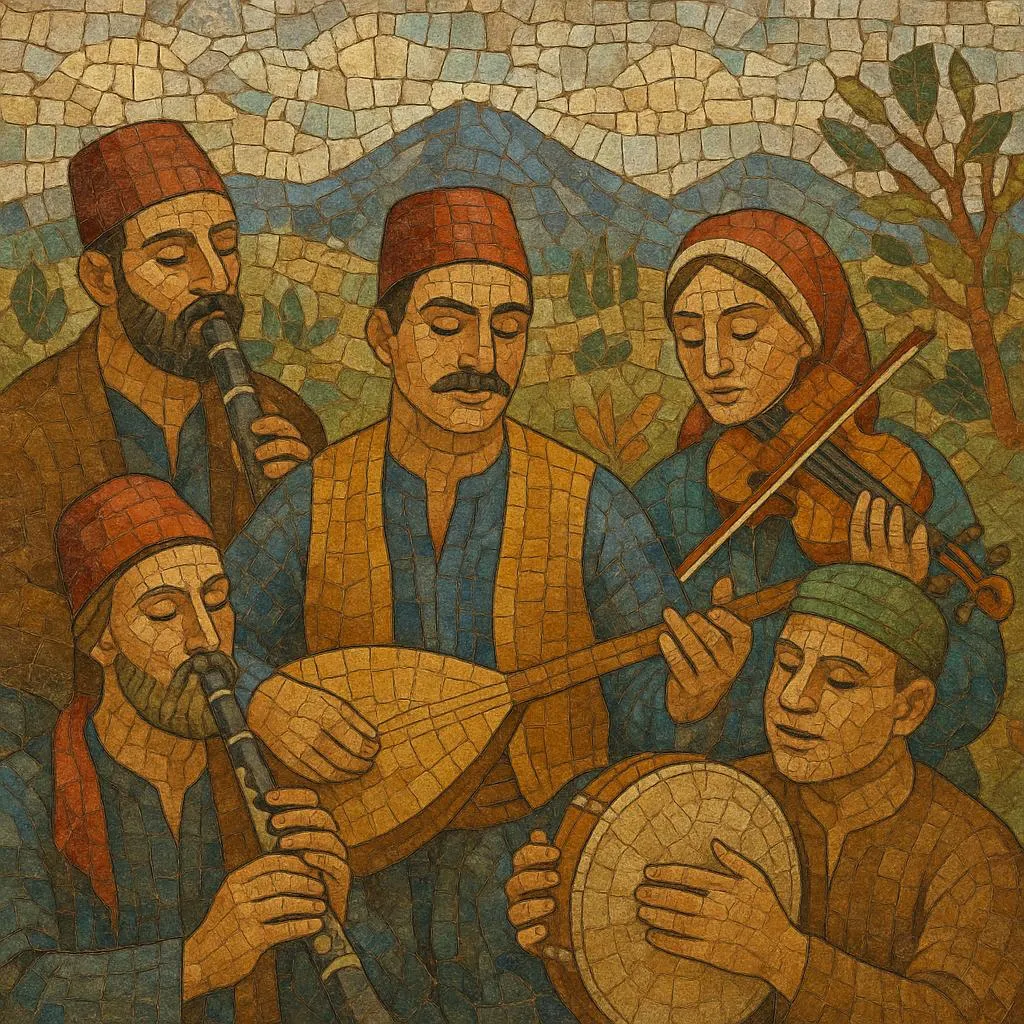
Rumeli türküleri are the Turkish-language folk songs of Rumelia (the Balkan lands of the former Ottoman Empire), carried and shaped by Turkish, Muslim, and multiethnic communities in today’s Greece (Western Thrace), North Macedonia, Bulgaria, Kosovo, Albania, Bosnia and beyond.

They fuse Ottoman/Turkish makams with distinctly Balkan dance rhythms (notably 9/8 karsilama and 7/8 meters), and are commonly performed with G-clarinet, violin, accordion, bağlama/saz, oud, kanun, and lively hand percussion (darbuka, davul). Lyrically they span love, longing and migration (gurbet), weddings, and playful banter, often reflecting the bittersweet memory of displacement from the Balkans to modern Turkey in the 19th–20th centuries.


Sources: Spotify, Wikipedia, Discogs, RYM, MB, user feedback and other online sources

History

Ottoman Rumelia and shared Balkan soundscapes

Rumeli türküleri arose in the European provinces of the Ottoman Empire, where Turkish-speaking and Muslim communities lived alongside Greek, Slavic, Albanian, Romani, Sephardic, and other populations. Urban hubs such as Salonika (Thessaloniki), Monastir (Bitola), Skopje, Prizren, and Sarajevo fostered a musical lingua franca that blended Ottoman makams with Balkan dance forms (karsilama, hora, çiftetelli), creating a repertoire instantly recognizable by its asymmetric (aksak) rhythms and ornamented melodies.

19th–early 20th century migrations

The Balkan Wars (1912–13), World War I, and the 1923 Greco–Turkish population exchange sparked large-scale migrations. Communities resettling in Istanbul, Thrace, Bursa, İzmir and beyond brought their songs and performance practice. In the Republican era, collectors, radio producers, and artists documented and popularized Rumelian pieces within the larger Turkish folk canon, where they became labeled as “Rumeli türküleri.”

Mid–late 20th century documentation and stage style

From the 1950s onward, field recordings, TRT radio/TV broadcasts, and urban nightclub circuits helped fix characteristic arrangements—G-clarinet and violin carrying Balkan-style ornaments over accordion and percussion grooves—while bağlama and Turkish art-music instruments anchored the makam sensibility.

Contemporary revivals and cross-border exchanges

Since the 1990s, world-music collaborations, diaspora projects, and festival circuits have refreshed the repertory. Modern Turkish folk, pop, jazz, and rock artists quote Rumeli melodies and meters; meanwhile, cross-border ensembles (in Greece, North Macedonia, Bulgaria, and Turkey) continue to circulate cognate tunes across languages, underscoring the repertoire’s shared Balkan heritage.

How to make a track in this genre

Tonality and melodic language (makam)
•   Base melodies on common Ottoman/Turkish makams frequently heard in the Balkans: Hicaz (Phrygian-dominant color), Hüseyni (Dorian-like), Nihavent (harmonic-minor color), Uşşak, Rast, and Saba. •   Use expressive ornaments: slides, quick turns, mordents, grace notes, and portamenti—especially in clarinet and voice. •   Allow occasional modulation to related makams for contrast, returning to the home makam for cadences.
Rhythm and form (usul and dance)
•   Favor asymmetric meters typical of Balkan dances: 9/8 (karsilama, e.g., 2+2+2+3), 7/8 (2+2+3 or 3+2+2), 5/8 (2+3 or 3+2), and lively 2/4 or 4/4 for çiftetelli. •   Structure strophic verses with refrains; call-and-response between a lead singer and chorus or between voice and clarinet/violin fills is idiomatic.
Instrumentation and texture
•   Core timbres: G-clarinet (Turkish/Albert system) and violin carrying the melody; accordion providing harmonic pads and rhythmic chug; bağlama/saz, oud, or kanun reinforcing the makam line. •   Percussion: darbuka, riq, and davul for groove; keep the davul articulations clear to signal the aksak subdivisions. •   Optional colors: cümbüş, zurna for outdoor/wedding settings.
Lyrics and themes
•   Write in colloquial Turkish with Rumelian dialect touches where appropriate; topics include love, weddings, teasing, and migration/longing (gurbet). •   Balance joy and wistfulness—many songs celebrate dance while hinting at nostalgia for old homelands.
Arrangement tips
•   Open with an instrumental taksim (improvised prelude) to outline the makam. •   Keep tempos danceable; accent the asymmetric grouping (e.g., in 9/8, slightly lift the final “3”). •   Let clarinet or violin answer vocal phrases with short improvised embellishments, then return to the refrain for communal singability.

Top tracks

Locked
Share your favorite track to unlock other users’ top tracks

Upcoming concerts

in this genre
Influenced by

Download our mobile app

Get the Melodigging app and start digging for new genres on the go
© 2026 Melodigging
Melodding was created as a tribute to Every Noise at Once, which inspired us to help curious minds keep digging into music's ever-evolving genres.
Buy me a coffee for Melodigging