Your digging level for this genre

0/8
🏆
Sign in, then listen to this genre to level up

Description

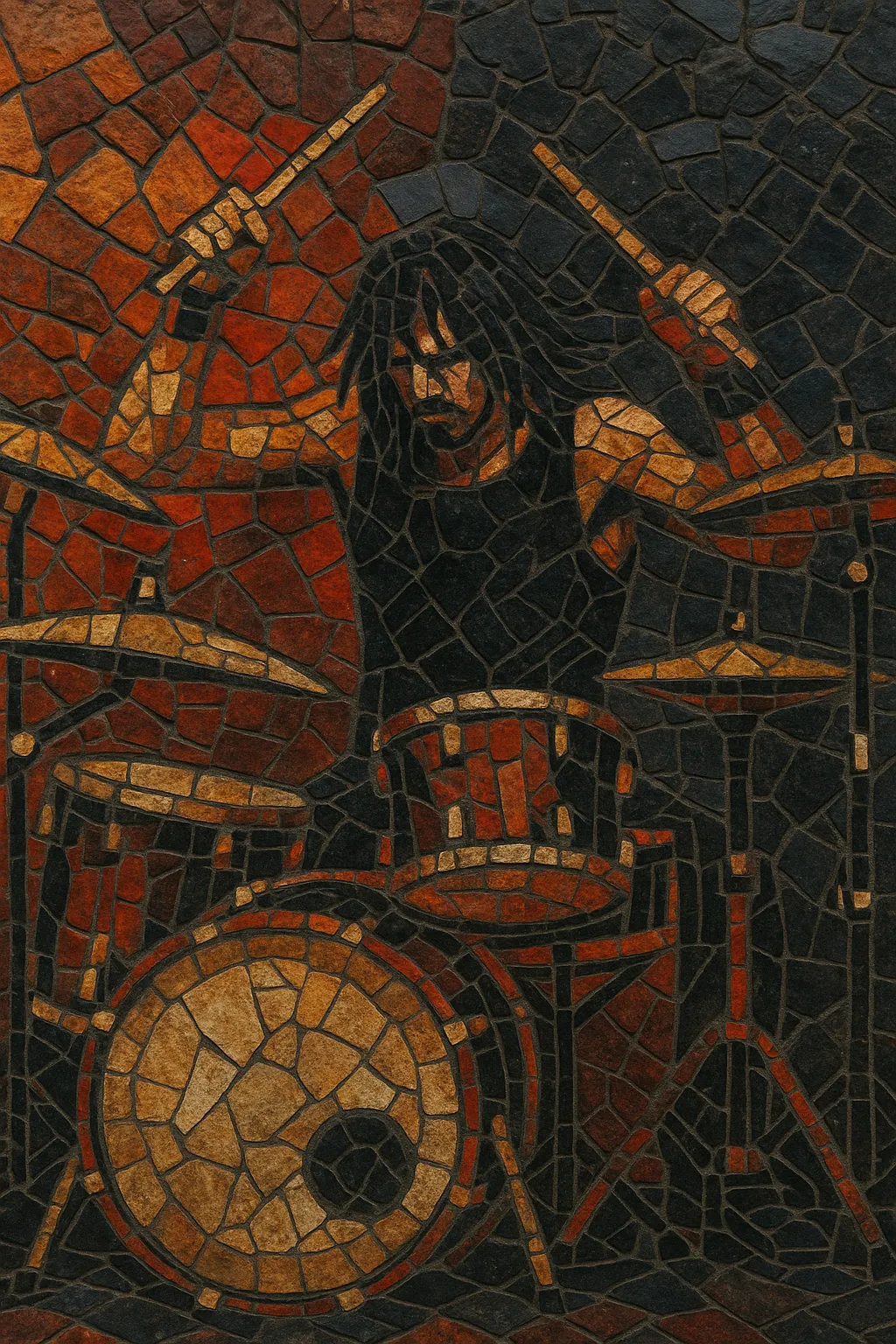
Rock drums refers to the drum set techniques, sounds, and rhythmic vocabulary that underpin rock and roll and its descendants.

Typically centered on a 4- or 5-piece kit (bass drum, snare, 1–2 toms, floor tom) with hi‑hats, ride, and crash cymbals, rock drumming prioritizes a strong backbeat on counts 2 and 4, driving straight eighths or sixteenths on hi‑hat or ride, and punchy bass‑drum figures that lock with the bass guitar. Common feels include straight, shuffle, half‑time, and train beats, with frequent use of rimshots, ghost notes, flams, paradiddles, and tom‑based fills.

Production aesthetics evolved from live mono and minimal miking to close‑miked, multi‑track, compressed and saturated sounds, including gated reverb in the 1980s and modern sample reinforcement. Across eras—from early rock’n’roll to hard rock, punk, metal, prog, grunge, and indie—rock drums shape the energy, transitions, and dynamics of the band.

History

Roots (1950s)

Rock drumming emerged alongside rock’n’roll in the 1950s, synthesizing the drum‑set language of swing and small‑group jazz with the backbeat emphasis of rhythm and blues and the groove of jump blues. Pioneering session greats like Earl Palmer established the crisp backbeat, shuffle feels, and tom‑driven fills that became foundational.

Expansion and Identity (1960s)

With the British Invasion, drummers such as Ringo Starr (The Beatles), Charlie Watts (The Rolling Stones), and Mitch Mitchell (The Jimi Hendrix Experience) cemented the rock kit’s role: clear 2‑and‑4 backbeats, creative fills, and song‑serving dynamics. Recording moved toward multi‑miking and stereo, giving engineers more control over punch and space.

Power and Virtuosity (1970s)

Hard rock and proto‑metal amplified drum tones (larger kits, heavier sticks, louder rooms). John Bonham (Led Zeppelin) and Keith Moon (The Who) embodied power, groove, and explosive tom orchestrations, while prog drummers (Bill Bruford, later Neil Peart) explored odd meters, extended forms, and expanded cymbal/tom arrays. Double‑kick techniques began to spread from hard rock into metal.

Production Signatures and Divergence (1980s)

Arena rock favored big, punchy drums; gated reverb became a hallmark. At the same time, punk and post‑punk championed economy and speed, while metal accelerated double‑bass work and precision. Studio practices normalized click tracks, sample layering, and more elaborate close/overhead/room mic blends.

Hybrids and Modern Practice (1990s–present)

Grunge and alt‑rock returned focus to feel and dynamics (e.g., Dave Grohl), while prog/alt‑metal and math rock explored polymeters and dense orchestrations. Gospel‑chops phrasing, advanced linear patterns, and hybrid acoustic‑electronic setups entered mainstream rock. Today, rock drummers balance human feel with tight production, using triggers or samples tastefully while preserving the live energy central to the style.

How to make a track in this genre

Groove foundations
•   Start with a solid backbeat: accented snare on 2 and 4, steady eighths on hi‑hat or ride, and bass‑drum patterns that support the bass guitar. •   Core feels: straight eighths, shuffle/swing, half‑time (snare on 3), train beat (brushed or sticked), and four‑on‑the‑floor for driving sections. •   Typical tempos range from ~80–180 BPM; choose tempo to match song energy and lyric density.
Kit and sound
•   A versatile setup: kick (22" or 24"), snare (5"–6.5" depth), rack tom, floor tom, hi‑hats (14"), ride (20"–22"), 1–2 crashes. Add double pedal, splashes/Chinas, or cowbell as needed. •   Tune kick for punch and minimal overring; snare with enough crack for backbeat plus sensitivity for ghost notes; toms tuned to musical intervals for melodic fills.
Patterns and phrasing
•   Keep grooves in 2–4 bar phrases; place fills at phrase ends to set up transitions. •   Use ghost notes between backbeats to create motion; vary hi‑hat openings on off‑beats for lift. •   Develop vocabulary: paradiddles, doubles, flams, linear patterns (e.g., kick–snare–hat), and tom ostinatos. Practice shuffles (Texas, Purdy) and straight feels.
Arrangement and dynamics
•   Shape verses with lighter touch and tighter hats; open up choruses with crash on downbeats and louder backbeats. •   Employ half‑time bridges/breakdowns for contrast; drop to kick/hat only to spotlight vocals or guitar. •   Lock with bass guitar: agree on kick placements for hooks and riffs.
Recording and production
•   Mic recipe: kick in/out, snare top/bottom, tom mics, stereo overheads, and at least one room mic; phase‑align sources. •   Processing: moderate compression on close mics, bus compression (1–3 dB GR) for glue, EQ to carve cymbal harshness and add low‑end punch. Use room/plate reverb for size; avoid over‑gating unless stylistically intended. •   For modern tightness: record to click, comp best takes, and layer subtle samples for consistency while preserving transient “crack.”
Advanced variations
•   Double‑kick for hard rock/metal sections; odd meters (5/4, 7/8) or metric modulations for prog flavors. •   Hybrid kits: triggers or pads for auxiliary sounds; parallel compression (“New York”) on drum bus for energy without killing dynamics.

Top tracks

Locked
Share your favorite track to unlock other users’ top tracks
Influenced by
Has influenced
Challenges
Digger Battle
Let's see who can find the best track in this genre
© 2025 Melodigging
Melodding was created as a tribute to Every Noise at Once, which inspired us to help curious minds keep digging into music's ever-evolving genres.
Buy me a coffee for Melodigging