Your digging level

For this genre
0/8
🏆
Sign in, then listen to this genre to level up

Description

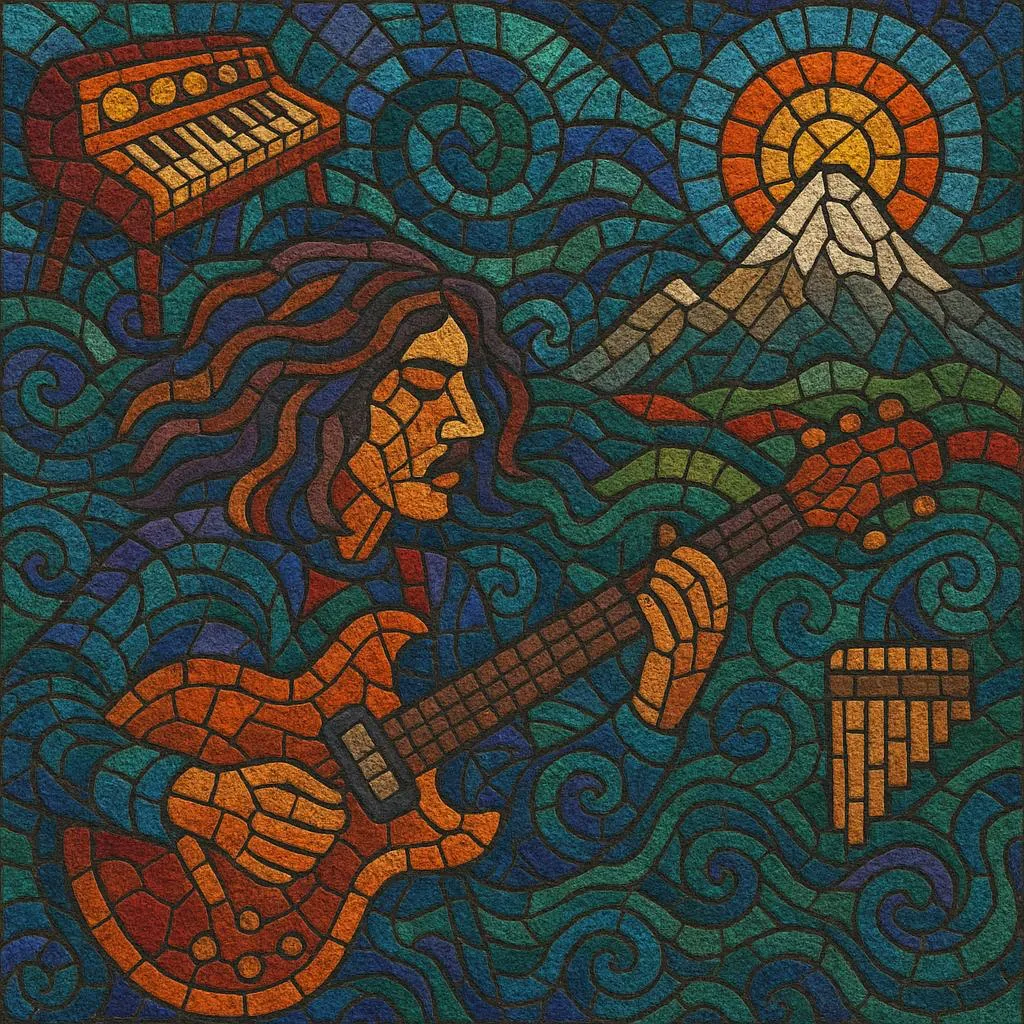
Psicodelia chilena (Chilean psychedelia) is the national inflection of 1960s psychedelic rock filtered through local folk traditions, Andean timbres, and the social imagination of Chile. It blends fuzzed‑out guitars, Farfisa or Hammond organs, tape and echo experiments, and modal harmonies with rhythms and instruments tied to cueca, huayno, and other regional currents.

Lyrically it moves from cosmic or surrealist imagery to socially aware and poetically coded texts. Across its classic era and modern revivals, the style pivots between concise, garage‑leaning songs and extended trance‑like jams, often embracing hypnotic grooves, drones, and spacious production that evoke desert expanses and Pacific horizons.


Sources: Spotify, Wikipedia, Discogs, Rate Your Music, MusicBrainz, and other online sources

History

Origins (1960s)

Chile’s psychedelic sound emerged in the late 1960s as local rock groups absorbed Anglo‑American psych, garage, and blues while anchoring their music in Spanish‑language lyrics and Chilean/Andean modalities. Early bands expanded the palette with fuzz, reverb, backwards tape, and kaleidoscopic organ lines, while the peña and university circuits connected rock musicians with folk currents.

Upheaval, underground, and fusion (1970s–1980s)

Following the 1973 coup, performance spaces contracted and many artists went underground or into exile. The scene’s psychedelic vocabulary survived by merging with nueva canción and regional folk practices—charango, quena, zampoña—helping catalyze a distinct Andean‑psych and psych‑prog lineage within Chilean rock. Diasporic communities kept the repertoire circulating abroad.

Reemergence and revivals (1990s–2010s)

Democratic reopening sparked archival reissues and new bands who reinterpreted classic psych with shoegaze haze, kraut‑motorik pulse, and dub‑soaked ambience. Independent labels and small venues in Santiago and Valparaíso nurtured a thriving neo‑psych ecosystem that toured Europe and the Americas, re‑situating Chile as a regional psych hub.

Today

Contemporary psicodelia chilena is plural: concise psych‑pop, expansive desert jams, kraut‑inflected minimalism, and Andean‑psych hybrids coexist. Boutique studios favor analog warmth; festivals and collectives link Chile’s coastal and mountain geographies to a global psychedelic network while maintaining a distinctly local color and cadence.

How to make a track in this genre

Harmony & Melody
•   Favor modal centers (Dorian, Mixolydian, Aeolian) and pentatonic or Andean‑leaning scales. Pedal tones and drones help generate trance. •   Use vamping two‑chord cycles (e.g., i–VII, I–bVII) or circular progressions with suspended 2/4 colors. Add parallel organ lines and call‑and‑response guitar motifs.
Rhythm
•   Alternate straight 4/4 psych grooves with folkloric impulses: cueca’s sesquiáltera (3:2 cross‑feel), huayno‑like accents, or tom‑led polyrhythms. Keep tempos mid to slightly up for momentum; lock bass and kick into ostinatos.
Instrumentation & Sound
•   Core: fuzz/overdriven electric guitars, organ (Farfisa/Hammond), bass, drums, and Spanish‑language vocals. •   Color: charango, quena/zampoña, hand percussion (bombo legüero, güiro), analog synth pads, delay‑drenched leads. •   Effects: spring reverb, tape echo, phaser, tremolo, reverse tape bits, stereo pans. Let ambience and decay be part of the arrangement.
Song Forms
•   Two approaches work well: (1) concise verse‑chorus psych‑pop with strong hooks; (2) long‑form jams that evolve through texture and dynamics (introduce riffs one by one, open a middle drone, peak, release).
Production & Mixing
•   Track live basics to capture interplay; overdub textures later. Favor ribbon/condensor mics on amps and room mics on drums for roomy depth. •   Bus saturation, tape emulation, and gentle analog compression add warmth. Use delay throws on vocal phrases; carve space with EQ to let drones and flutes sit without masking.
Lyric Themes
•   Blend surreal/visionary imagery with landscape (cordillera, desierto, mar) and introspective or subtly social narratives. Keep phrasing melodic and percussive so Spanish prosody flows with the groove.
Practice Template
    •   

    Build a modal vamp and a complementary bass ostinato.

    •   

    Layer organ pad, then a fuzz lead with melodic fragments.

    •   

    Add a folkloric instrument (charango or quena) doubling or counter‑melodizing the hook.

    •   

    Open a middle section for improvisation over a sustained drone.

    •   

    Return to the hook with thicker harmonies; end with a tape‑echo wash.

Top tracks

Locked
Share your favorite track to unlock other users’ top tracks
Influenced by
Has influenced
Challenges
Digger Battle
Let's see who can find the best track in this genre

Download our mobile app

Get the Melodigging app and start digging for new genres on the go
© 2026 Melodigging
Melodding was created as a tribute to Every Noise at Once, which inspired us to help curious minds keep digging into music's ever-evolving genres.
Buy me a coffee for Melodigging