Your digging level

For this genre
0/8
🏆
Sign in, then listen to this genre to level up

Description

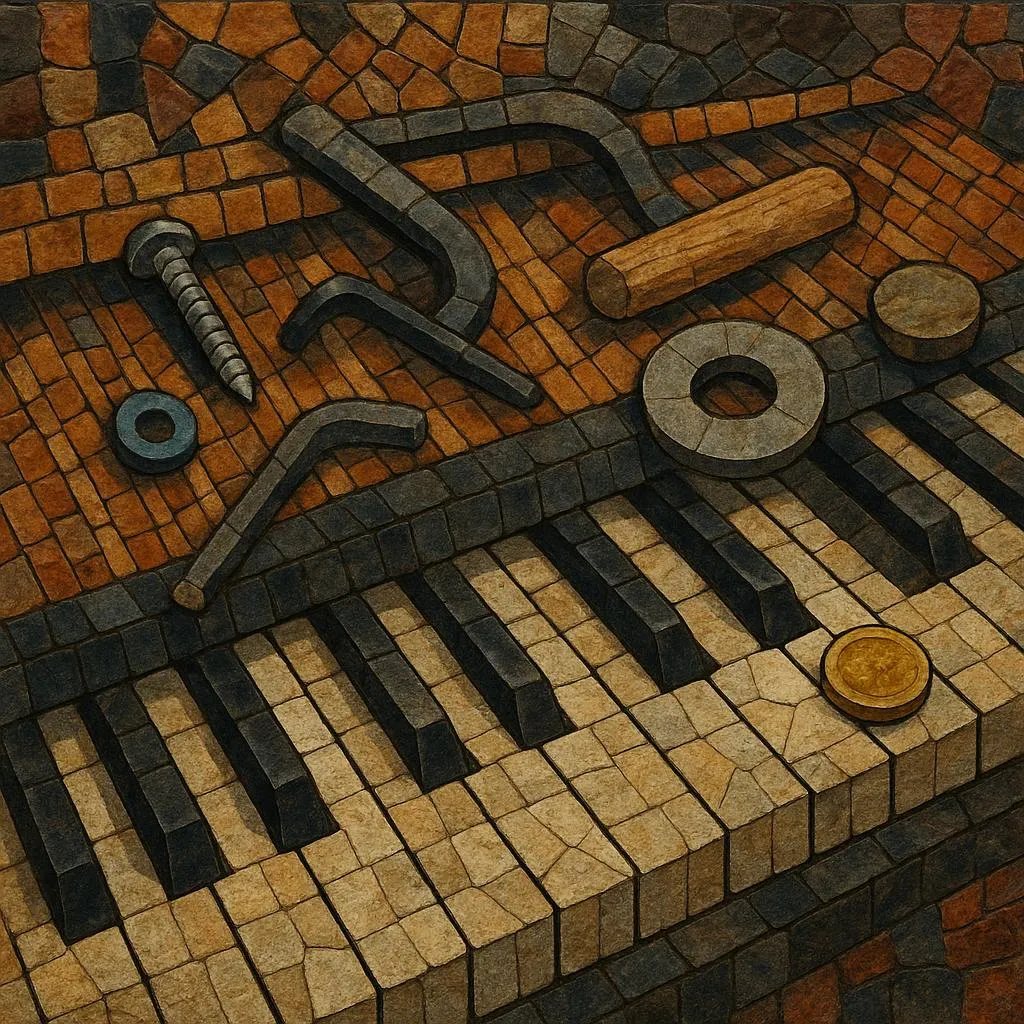
Prepared piano is a performance technique and repertoire in which an acoustic piano is altered by placing objects ("preparations") such as screws, bolts, erasers, rubber, paper, wood, or coins on or between the strings, hammers, or dampers. These additions transform the instrument’s timbre, producing sounds that resemble drums, gongs, bells, muted plucks, rattles, or metallic chimes.

While the piano remains the sound source, the result is a compact percussion orchestra with a pitched framework. Composers notate detailed preparation charts specifying the materials and their exact string locations, and performers balance conventional keyboard playing with inside-the-piano gestures and pedaling control. The music ranges from meditative and bell-like to motoric and intensely percussive, and it occupies a pivotal place in 20th- and 21st-century experimental and contemporary classical practice.


Sources: Spotify, Wikipedia, Discogs, RYM, MB, user feedback and other online sources

History

Origins (1940s)

Prepared piano crystallized in the United States in the 1940s, most iconically through John Cage, who sought a practical way to obtain a percussion ensemble’s coloristic range using a single instrument for stage and dance works. Cage’s solution—altering a piano with specific objects—was preceded in spirit by Henry Cowell’s earlier "string piano" techniques (plucking, strumming, and muting) in the 1920s–30s. Cage formalized a method: detailed preparation charts, exact string placements, and repeatable timbral results. His cycle "Sonatas and Interludes" (1946–48) became a landmark, showing the approach’s subtlety and structural rigor.

Expansion (1950s–1970s)

After Cage, American experimentalists and West Coast composers (including Lou Harrison) explored prepared timbres, integrating non-Western percussive sensibilities and tuning ideas. In Europe and the Americas, the technique was absorbed into the broader avant-garde, where extended techniques on all instruments became a common language. Meanwhile, contemporary classical pianists developed performance practices—cataloging reliable preparations, standardizing materials, and refining notational conventions.

Cross-Pollination with Jazz and Improvisation (1980s–2000s)

Improvisers and jazz-adjacent musicians adopted preparation as a flexible color source, bringing tactile, percussive sonorities to small ensembles and solo settings. Recording technology encouraged close-miking and amplification, revealing granular articulations and micro-resonances that were difficult to hear in large halls. Composers also began hybridizing with electronics, live processing, and alternative tunings.

Contemporary Practice (2000s–present)

Prepared piano remains vital in concert music, experimental jazz, and indie classical spheres. Composers integrate preparations alongside inside-piano techniques (fingertip dampings, harmonic nodes, bows, and eBows), and performers document setups with high-resolution photos and precise measurements for reproducibility. The technique’s influence has spread to film, installation, and cross-genre collaborations, where its distinctive palette serves both rhythmic drive and contemplative atmosphere.

How to make a track in this genre

Instruments and Materials
•   Use a well-maintained grand or upright piano. Secure permission before preparing any instrument and avoid valuable concert grands unless a rehearsal technician approves. •   Typical materials: screws, bolts, nuts, rubber, erasers, weather stripping, felt, cork, paper, wood, adhesive putty, and (with care) coins or light clips. Avoid anything that can cut strings or shed abrasive residue. •   Create a preparation chart: list note names, string number (left/middle/right in a trichord), precise placement (distance from the damper/bridge), material type, and intended effect.
Sound Design, Tuning, and Pedaling
•   Test each preparation for pitch drift, buzz length, and overtone profile. Some objects mute pitch; others yield bell-like partials or sitar-like rattles. •   Balance una corda/sostenuto/sustain pedals to sculpt resonance and separation of prepared vs. unprepared registers. •   Consider modal/limited-pitch cells where muted or inharmonic notes function as percussive members of a scale.
Rhythm, Texture, and Form
•   Treat the keyboard as a percussion array: use ostinato patterns, polyrhythms, and interlocking figures between prepared and unprepared zones. •   Exploit registral contrasts (e.g., unprepared bass as drone, prepared midrange as rhythmic engine, high treble as bell choir). •   Combine inside-piano techniques (plucks, strums, harmonic touch, gentle pizzicati) with key strikes for layered textures. •   Structure pieces around timbral modules: introduce one color at a time, then layer, vary, and rotate them like sections of a percussion ensemble score.
Notation and Performance Practice
•   Provide: (1) a preparation map (with photos/diagrams), (2) setup time estimates, (3) alternative materials if originals are unavailable, (4) clear cues for switching techniques mid-piece. •   Indicate exact pedaling, dynamics for key vs. string contact, and whether to play on the key, directly on the string, or both. •   Allow rehearsal time to stabilize preparations and calibrate microphones.
Recording and Amplification
•   Close-mic prepared strings to capture attacks and rattles; add room mics for bloom. Consider contact mics for subtle surface sounds. •   Light EQ can separate noisy preparations from pitched tones; gentle compression helps articulate low-level details.
Safety and Care
•   Never force objects under high tension. Use non-marring materials where possible. Remove all items after performance and inspect for residue or displacement. •   Document any piano-specific adjustments so the setup can be restored reliably in future performances.

Top tracks

Locked
Share your favorite track to unlock other users’ top tracks

Related labels

Upcoming concerts

in this genre
Influenced by
Has influenced

Download our mobile app

Get the Melodigging app and start digging for new genres on the go
© 2026 Melodigging
Melodding was created as a tribute to Every Noise at Once, which inspired us to help curious minds keep digging into music's ever-evolving genres.
Buy me a coffee for Melodigging