Your digging level
Description
Partido alto is a subgenre of samba from Rio de Janeiro marked by a distinct percussion pattern, a medium-to-fast 2/4 groove, and a performance practice that foregrounds call-and-response and improvisation.
Within a roda de samba, partido alto often signals the moment for "disputas" (friendly verse duels) in which a soloist (partideiro/partideira) improvises quatrains over a fixed refrain that the chorus answers. The style encourages audience participation and singalong, creating a communal, festive atmosphere.
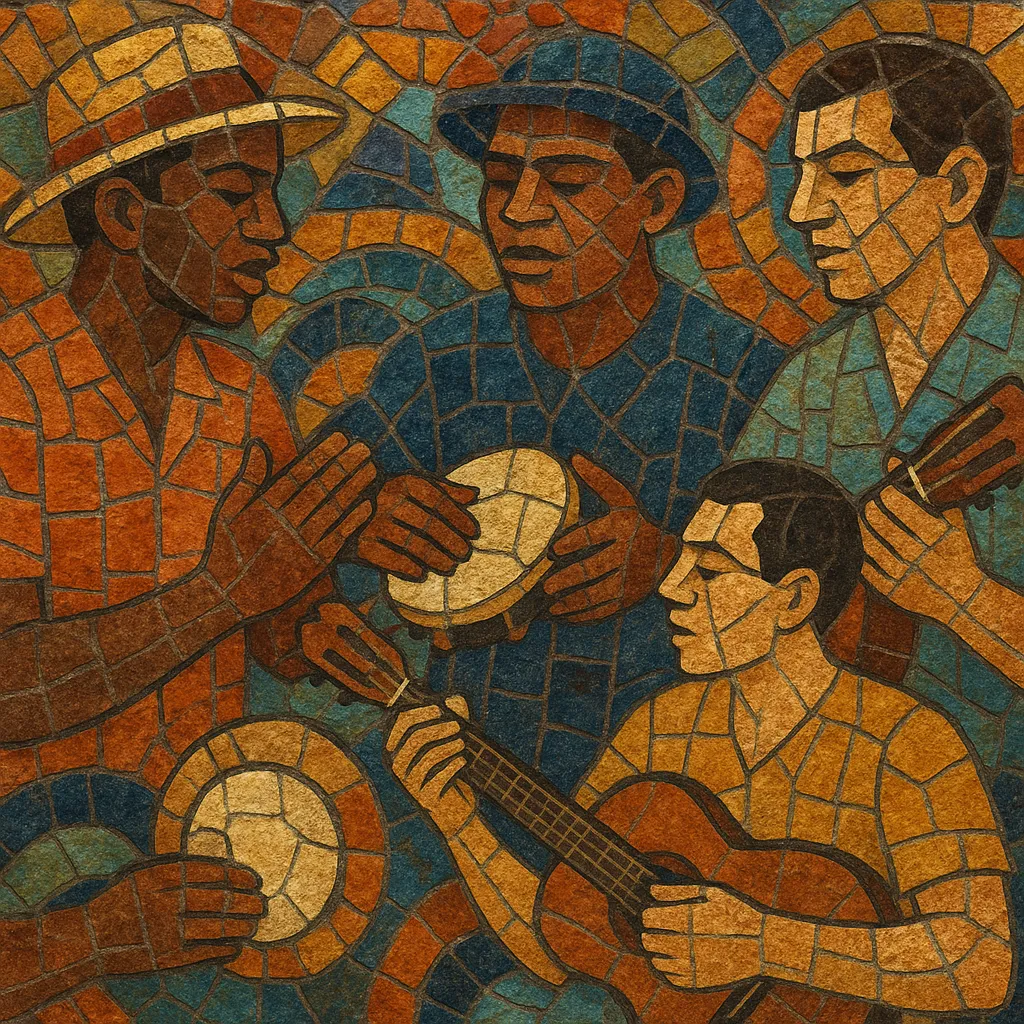
Rhythmically it features a characteristic pandeiro approach with alternating open tones, slaps, and heel–toe strokes that "break" the groove (often described as "partir o couro"), supported by surdo, tantã or hand percussion, tamborim, reco-reco, and agogô. Harmony is typically rooted in samba’s tonal language (I–IV–V with colorful secondary dominants and chromatic passing chords), played by cavaquinho and 6- or 7‑string guitar.
History
Partido alto emerged in Rio de Janeiro in the early 1900s as a particularly danceable samba variant. Its foundations lie in Afro-Brazilian circle practices and the urbanization of samba, drawing rhythmic vocabulary from Bahia’s samba de roda and from older forms such as lundu and maxixe, while adopting choro’s string instrumentation and harmonic fluency. In its formative phase, the style could be largely percussive and dance-oriented, with minimal or no vocals.
As samba gatherings (rodas) crystallized in Rio’s neighborhoods, partido alto became associated with communal participation: a fixed refrain sung by the group and improvised verses delivered by a rotating soloist. These friendly duels—"disputas de partido-alto"—valued wit, topical humor, social commentary, and verbal dexterity. The pandeiro’s hallmark "partido" pattern and driving surdo anchored the groove while cavaquinho and violão supported call-and-response.
Across the mid-century, partido alto was cultivated by sambistas connected to Rio’s escolas de samba and community rodas. By the 1960s–70s, notable composers and performers helped codify the form on records and on stage, emphasizing its improvisatory structure (refrain + improvised stanzas) and the participatory ethos that made it a staple of neighborhood samba.
The late 1970s and 1980s roda culture around places like Cacique de Ramos brought a renewed prominence to partido alto’s groove and verse practice. New ensembles and interpreters popularized its feel for broader audiences and radio, and its rhythmic DNA directly informed the rise of pagode, which adapted partido alto’s swing, instrumentation, and chorus-driven singalongs for contemporary charts.
Today partido alto remains a living tradition in rodas de samba across Brazil and abroad. It thrives as a participatory, improvisation-friendly moment within samba sets, continues to inform newer hybrids (including samba-rap moments), and stands as a touchstone of Afro-Brazilian musical sociability and poetic expression.