Music Of The Central African Republic
Your digging level
Description
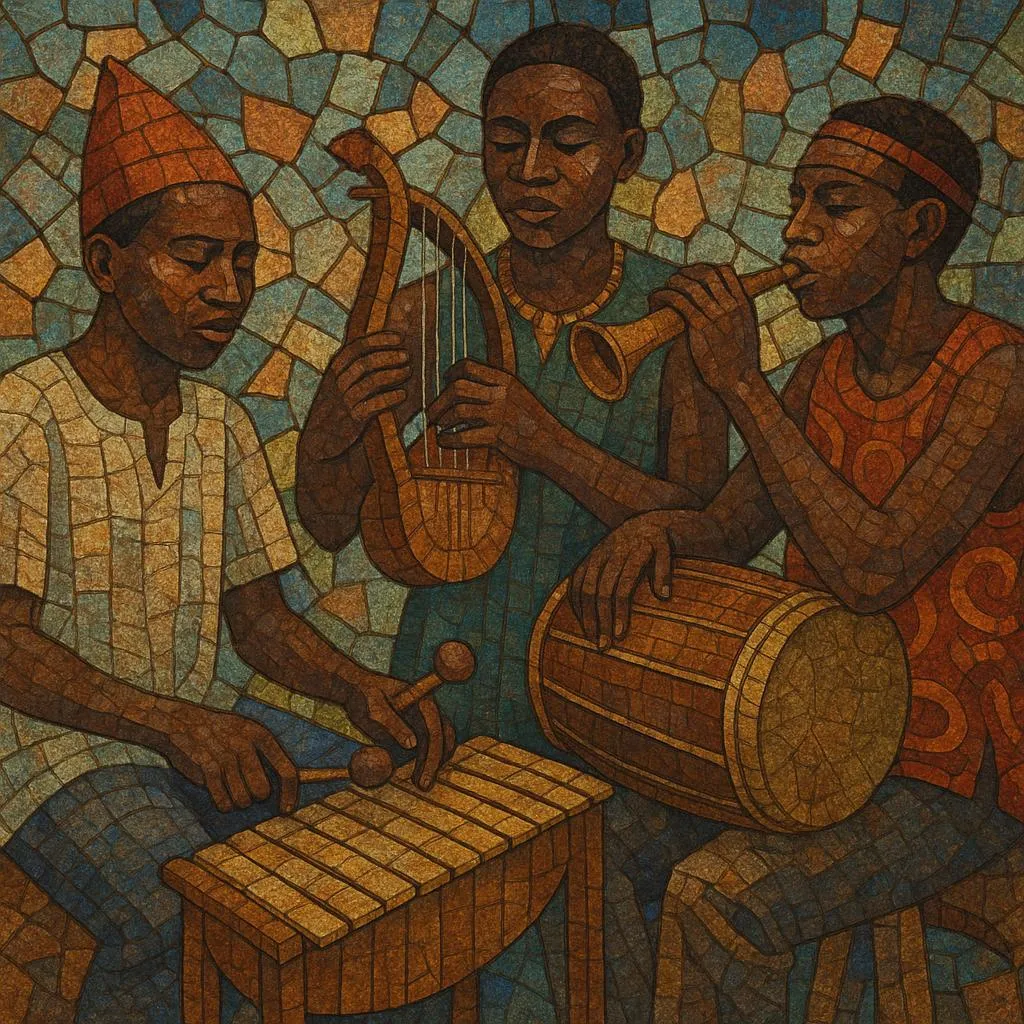
Music of the Central African Republic (CAR) encompasses a spectrum that runs from the polyphonic vocal traditions of forest communities to urban dance bands drawing on regional Congolese styles. Core traditional sounds include interlocking vocal parts, antiphonal singing, polyrhythms on drums, and the distinctive timbre of the sanza (thumb piano), kundi (harp), slit drums, wooden trumpets, and whistle and horn ensembles.
In the post‑colonial era, urban musicians in Bangui absorbed and localized currents from neighboring Congo—soukous, rumba, and ndombolo—as well as Afrobeat and later global pop and hip hop. The result is a music culture where forest polyphony and ceremonial ensembles coexist with guitar‑driven dance bands and studio‑based popular styles.
History
The territory of today’s Central African Republic is home to diverse groups (including Aka/BaBenzélé forest communities, Gbaya, Banda, M’Baka, and others) whose music centers on cyclical rhythm, responsorial structures, and dense, interlocking textures. Hallmarks include multi‑part yodeling and counterpointed lines in forest polyphony, the sanza (thumb piano) for melodic ostinati, and ceremonial ensembles such as Banda‑Linda wooden horn orchestras, slit‑drum choirs, and xylophone groups.
From the 1950s through independence (1960), radio and urban dance venues in Bangui amplified local bands while importing Congolese rumba and, later, soukous and ndombolo. Guitar bands adapted CAR rhythmic cells (often sanza‑derived ostinati) to electric instrumentation. Regional touring circuits and recording exchanges with Congo‑Brazzaville and DRC reinforced these shared aesthetics.
By the 1970s–1990s, popular groups mixed local rhythms with soukous’ fluid lead guitar and Afrobeat‑style horn vamps. Parallel to this, field recordings and scholarship (notably documentation of Aka/Banda musics and horn ensembles) drew global attention to CAR’s sophisticated polyphony and polyrhythm, feeding back into international world‑music and jazz scenes.
Contemporary CAR music continues along two main lines: (1) traditional ensembles sustaining ritual and community functions, and (2) urban artists fusing soukous/ndombolo with Afrobeat, hip hop, and electronic production. The sanza remains emblematic, and forest polyphony retains global prestige for its intricate counterpoint and cyclical structure.