

Your digging level

For this genre
0/8
🏆
Sign in, then listen to this genre to level up

Description

Music of Equatorial Guinea encompasses the traditional and popular music of the country’s main cultural groups—Fang (mainland), Bubi (Bioko), Ndowe/Combe (coastal groups) and the Creole community of Annobón—together with Spanish colonial-era influences and contemporary urban styles.

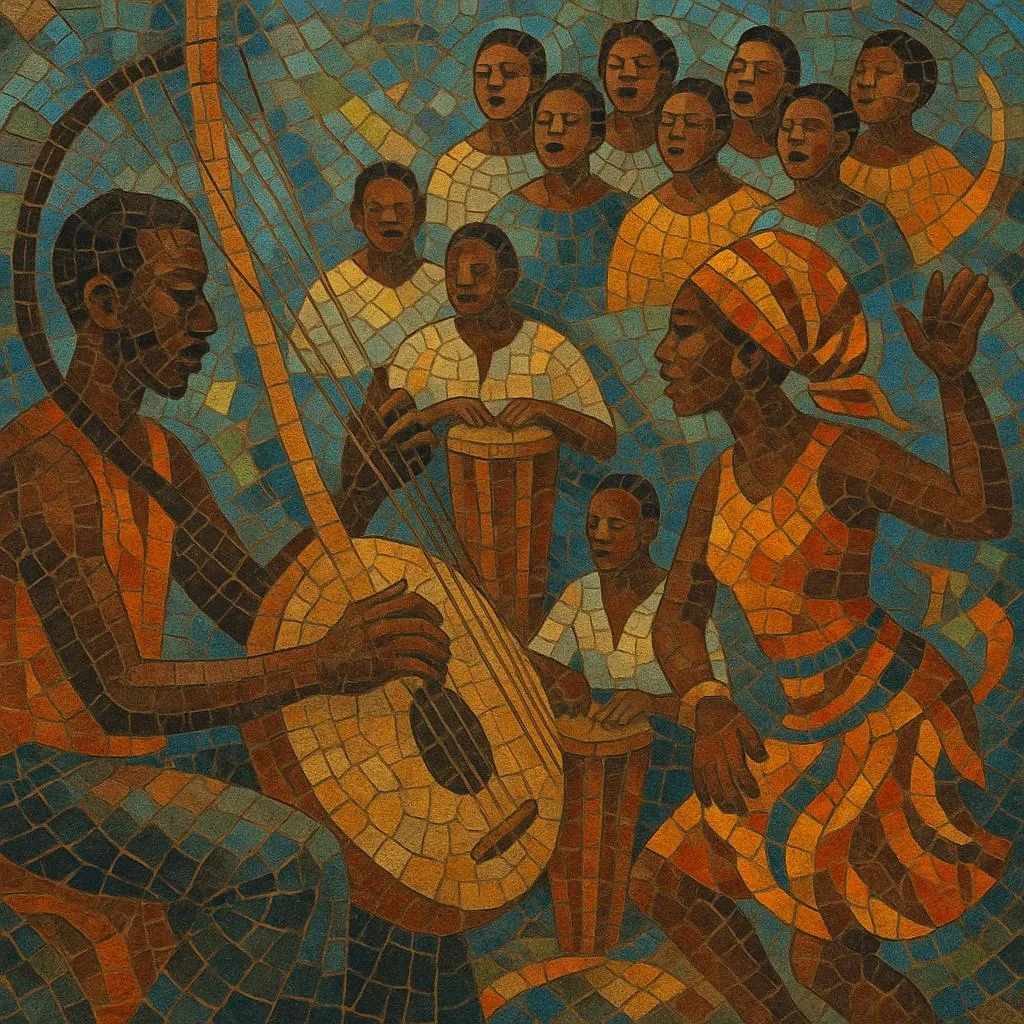
Traditional repertoires center on the Fang mvet (a harp‑zither used by bardic storytellers), antiphonal choral singing, handclapping, slit drums, and polyrhythmic dance music. On the islands, Bubi polyphonic chorus traditions and Annobonese Creole songs (linked culturally to São Tomé/Portuguese Atlantic) are common.

In the late 20th century, urban popular sounds integrated neighboring Central African guitar styles (soukous/ndombolo), Cameroonian makossa and bikutsi, as well as Spanish- and Cuban-derived genres (bolero, son). Because the country’s culture has been less documented than most African nations, commercial recordings are comparatively scarce, and much of the repertoire is transmitted orally.


Sources: Spotify, Wikipedia, Discogs, RYM, MB, user feedback and other online sources

History

Precolonial and Community Roots

Equatorial Guinea’s traditional music developed in village and clan settings, with the Fang, Bubi, and Ndowe/Combe peoples cultivating distinct repertoires. The Fang mvet (harp‑zither) accompanied epic recitation and moral storytelling, while ensembles used slit drums, rattles, and call‑and‑response choruses. Bubi island communities cultivated multipart singing and women’s chorus traditions, and Annobón’s Creole culture preserved Atlantic Portuguese influences.

Spanish Colonial Era and Mission Influence (19th–mid‑20th c.)

Mission schools and church life introduced European hymnody and choral discipline. Spanish rule also brought exposure to Iberian song forms; through colonial and maritime routes, Cuban/Latin genres (bolero, son) circulated as prestige dance music in towns.

Urban Popular Synthesis (late 20th c.)

Post‑independence migration to Malabo and Bata fostered urban scenes that blended local rhythms with Central African guitar music (soukous/ndombolo), Cameroonian makossa and bikutsi, and pan‑African pop. Spanish-language songwriting and code-switching with Fang, Bubi, and Ndowe languages became common.

Documentation and Diaspora

Compared to many African countries, Equatorial Guinea’s musical life has been less documented, and commercial releases are scarce. Much knowledge persists through oral tradition, live ceremonies, and diaspora artists in Spain who record and tour, helping to archive and modernize local idioms.


How to make a track in this genre

Core Timbres and Instruments
•   Feature the Fang mvet (harp‑zither) as a narrative lead, supported by slit drums, hand drums, shakers, and handclaps. •   For coastal/island textures, write multipart vocal lines for mixed or women’s chorus, using call‑and‑response and parallel harmonies.
Rhythm and Groove
•   Build interlocking polyrhythms in 12/8 or 6/8, layering a steady bell/shaker timeline with syncopated drum accents and responsive handclaps. •   For urban fusions, add a soukous/makossa‑style guitar ostinato (clean tone, palm‑muted, highlife‑like arpeggios) and a light, danceable bass line.
Melody, Harmony, and Language
•   Favor short, memorable melodic cells that repeat and vary over ostinatos; use pentatonic or hexatonic shapes as a base. •   Alternate a lead voice (soloist or griot‑style reciter) with a chorus response. Employ languages such as Fang, Bubi, Ndowe, Annobonese Creole (Fa d’Ambô), and Spanish, often code‑switching within songs.
Form and Performance Practice
•   Structure pieces around cyclical grooves with gradual textural build: start with a bell or mvet pattern, add percussion and chorus, then introduce dance breaks. •   In sacred or ceremonial pieces, set hymnlike refrains over local rhythms; in popular dance tracks, include a mid‑song break for extended percussion or guitar “sebene.”
Production Tips (Modern Context)
•   Keep percussion forward and natural; prioritize room mics and stereo imaging for choirs. •   Blend acoustic mvet/voices with subtle electric guitar and bass for cross‑over appeal; avoid over‑quantization to retain communal feel.

Top tracks

Locked
Share your favorite track to unlock other users’ top tracks

Upcoming concerts

in this genre
Influenced by
Has influenced
No genres found

Download our mobile app

Get the Melodigging app and start digging for new genres on the go
© 2026 Melodigging
Melodding was created as a tribute to Every Noise at Once, which inspired us to help curious minds keep digging into music's ever-evolving genres.
Buy me a coffee for Melodigging
