Your digging level
Description
Mappila (also called Mappila pattu) is a Muslim song tradition from Kerala, India, sung primarily in Malayalam enriched with Arabic (and occasionally Tamil/Urdu) vocabulary. The repertory spans devotional praise (mala), narrative and historical ballads (padappattu), romantic songs, and festive dance songs associated with wedding customs such as oppana.
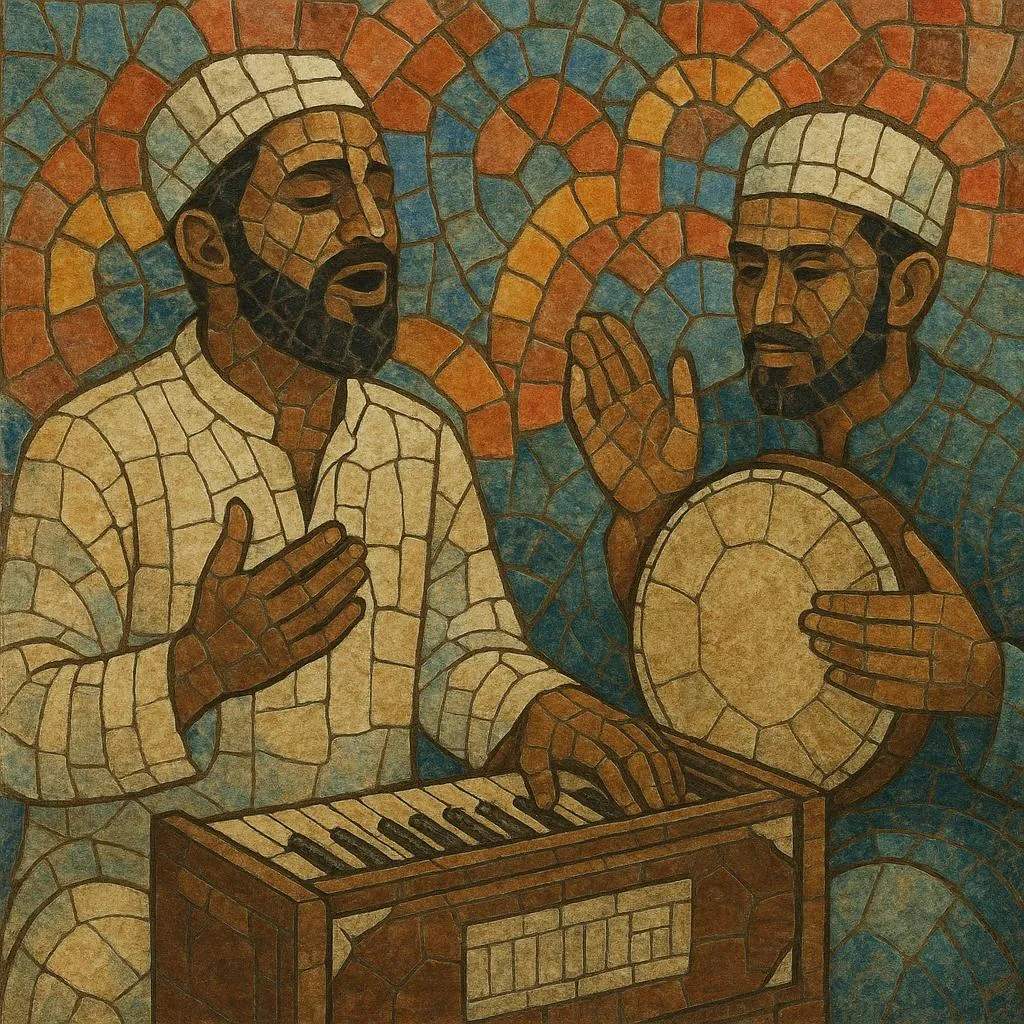
Musically, Mappila songs blend Arabic/Persian melodic color (notably maqam-like inflections such as Hijaz and Bayati with their characteristic augmented seconds) with South Indian (Carnatic) ornamentation and local folk rhythms. The vocal style favors melismatic lines, free ornamental turns, and call-and-response performance. Core accompaniment historically centers on frame-drums (duff/daff) and hand-clapping, with harmonium and tabla entering modern practice. Lyrics were long written in Arabi-Malayalam (Malayalam written in Arabic script), underscoring the genre’s historic Arab–Malayali cultural interface.
History
The Mappila community of Kerala traces sustained contact with Arab traders to the medieval period. This exchange fostered religious verse and panegyric in Arabi‑Malayalam, with early mala texts like "Muhyidheen Mala" attributed to Qadi Muhammad circulating by the 17th century. These devotional poems were sung in congregational and domestic contexts, leaning toward maqam-like contours and Qur’anic recitative influence.
In the 19th century, Mappila pattu matured as a distinct song tradition. Poets such as Mahakavi Moyinkutty Vaidyar and Pulikkottil Hyder expanded form and theme—composing elaborate narrative ballads (padappattu) and lyrical pieces that codified melodic types (ishal) and performance practice. Frame-drum genres like duffmuttu and social dances like oppana anchored the music in communal life.
With print culture and gramophone recordings, Mappila songs moved from local gatherings to wider Malayali audiences. Arabi‑Malayalam literacy waned in the mid‑20th century, but Malayalam orthography and film-adjacent performance helped sustain the repertory. Harmonium and tabla became common alongside duff, and concert artists and radio broadcasts popularized classic texts.
Post‑1970s, stage programs and cassettes/VCDs propelled star singers (e.g., Eranholi Moosa, Vilayil Faseela). Themes diversified—romance, migration and Gulf diaspora nostalgia, and social commentary—while retaining devotional cores. In the 21st century, Mappila idioms surface in Malayalam film songs, indie projects, and even hip‑hop fusions, with characteristic Hijaz-like turns, duff-driven grooves, and Arabic loanwords signaling the style’s identity.
Mappila music embodies Kerala’s maritime cosmopolitanism—an Arab–Malayali synthesis audible in language, melody, and rhythm. It remains central to Mappila weddings (oppana), festivals, and devotional gatherings, while also contributing distinctive colors to modern Malayalam popular and film music.