Your digging level
Description
Lo-fi latino is a niche within lo-fi beat culture that blends the warm, imperfect aesthetics of lo-fi production (tape hiss, vinyl crackle, softened transients, and “bedroom” mixing) with Latin musical signifiers.
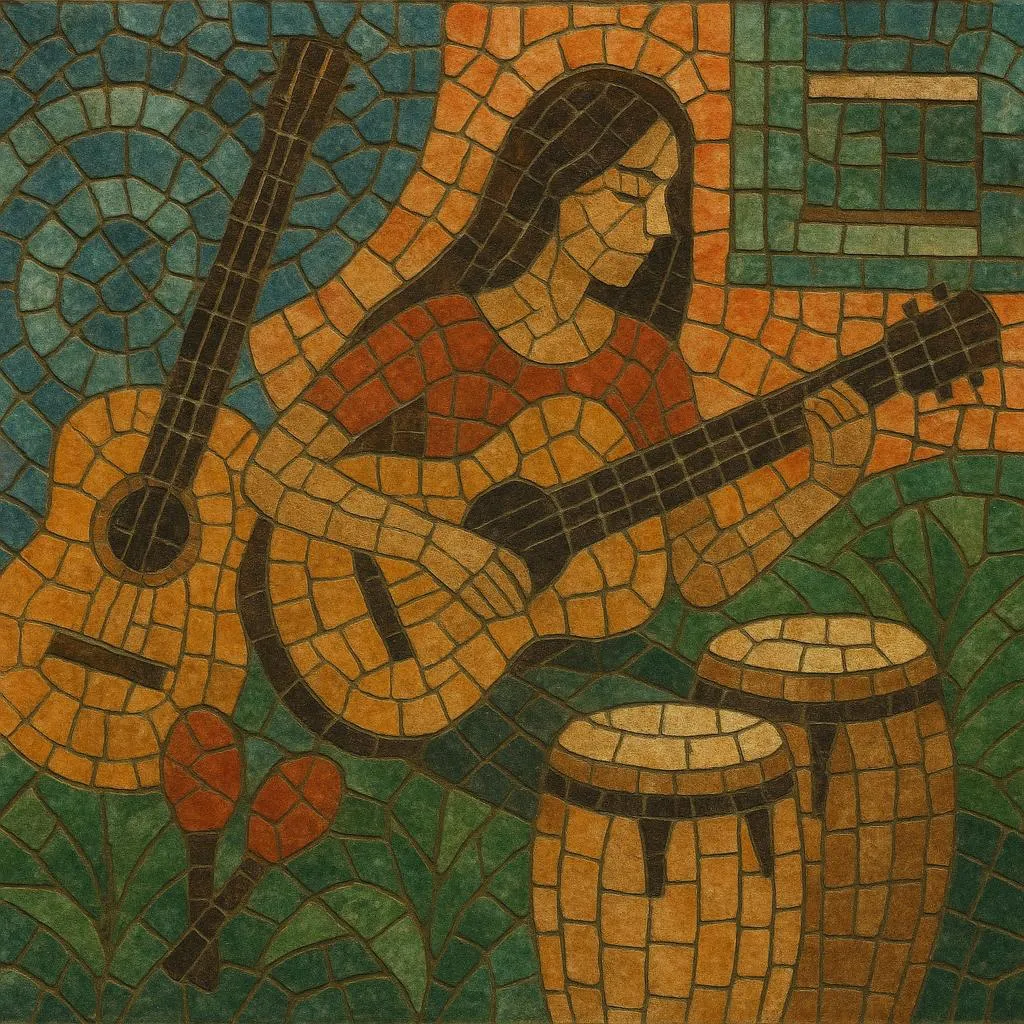
It commonly features Latin percussion patterns (e.g., clave-derived syncopations), acoustic guitars, piano montunos, bolero/bossa-inspired harmonies, and samples or melodic motifs associated with Latin popular and Afro-Latin traditions.
The genre is largely internet-native, built for background listening (study, late-night, cafes), while still retaining subtle groove and dance ancestry from Latin rhythms.
History
Lo-fi latino grows out of two parallel lineages: (1) the online lo-fi/“chill beats” ecosystem shaped by hip-hop beatmaking, and (2) the long history of Latin and Afro-Latin rhythmic vocabulary (clave-based phrasing, syncopation, and percussion-first arranging).
During the 2010s, streaming playlists, 24/7 “beats” channels, and social-media micro-scenes encouraged producers to create mood-forward instrumentals optimized for continuous listening. Latin-flavored harmony (lush extended chords, guitar voicings) and percussion (shakers, congas/bongos, rim-clicks, clave-like accents) became a recognizable palette inside lo-fi production.
In the 2020s, the sound diversified: some tracks leaned toward bossa/bolero harmonic language and acoustic timbres, while others emphasized Afro-Caribbean grooves (dembow-adjacent feel, salsa/son-style percussion layers) but kept lo-fi’s soft-edged mixing and relaxed tempos. The genre remains decentralized and playlist-driven rather than defined by a single local scene.
Favor warm extended harmony: maj7, min7, 9ths, 11ths, 13ths; use chromatic passing chords for a sentimental feel.
•Common devices:
•Descending minor-key progressions with added 7ths/9ths.
•Bossa/bolero-style guitar or piano voicings.
•Short call-and-response motifs between guitar/piano and a lead (flute, muted trumpet synth, bell-like keys).
•Keep melodies singable but understated—often 1–4 bar motifs that repeat with small variations.
Staples: nylon-string or clean electric guitar, electric piano, upright-piano timbre, soft pads, subtle bass (often rounded/sine-like).
•Use “age” as an aesthetic tool:
•Gentle saturation, wow/flutter, and vinyl noise (low in the mix).
•Low-pass filtering to soften brightness.
•Slight detuning or chorus on melodic instruments.
Keep it minimal and loop-friendly:
•Intro (4–8 bars): texture + chords.
•Main loop (16–32 bars): full groove + motif.
•Bridge (8–16 bars): drop drums or switch chord color.
•Return: add a small new counter-melody or percussion flourish.
•Micro-variation is key: automate filter cutoff, swap one drum hit every 4 bars, or add a brief fill at phrase boundaries.
Prioritize warmth and comfort over punch:
•Roll off excessive sub-bass rumble; keep bass audible on small speakers.
•Tame harshness around 2–6 kHz on hats and noisy samples.
•Use gentle bus compression and soft clipping to glue, not to crush.
•Leave headroom; overly loud masters can undermine the relaxed, “roomy” lo-fi character.