Your digging level
Description
Karadeniz türküleri are traditional folk songs from Türkiye’s Black Sea coast, especially the eastern provinces of Trabzon, Rize, Giresun, and Artvin.
They are distinguished by driving dance rhythms (notably for the horon), odd meters such as 7/16, 5/8, and 9/8, and a bright, agile vocal style rich in ornamentation.
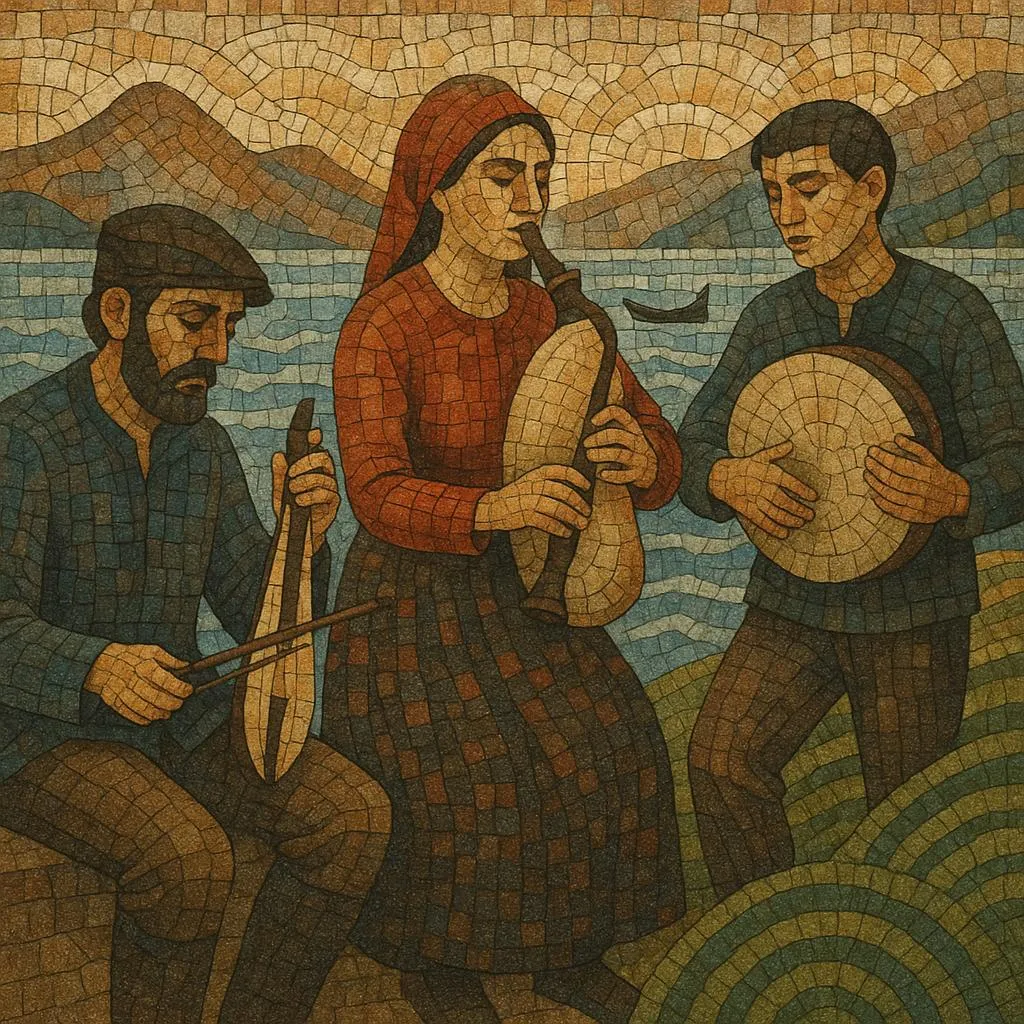
Core timbres come from the Black Sea kemençe (a bowed lyra) and the tulum (a local bagpipe), often joined by bağlama/cura, koltuk davulu or davul–zurna, and frame drums. Melodically they are modal (makam-informed), with drones and microtonal inflections that reflect both Turkish folk and older Pontic/Caucasian layers.
Lyrically, songs celebrate seafaring life, mountain villages, love and courtship, migration, teasing humor, and local identity. While most are in Turkish, regional languages such as Lazuri and Hemşince (and historically, Romeika/Pontic Greek) appear in the tradition, underscoring the region’s cultural mosaic.
History
The musical language of Karadeniz türküleri coalesced in the Ottoman era, but its roots reach further back through coastal trade and highland village life. The Black Sea kemençe and tulum define the region’s soundscape, accompanying circle-dances and communal singing. Modal practice (makam), heterophony, and drones were shaped by shared Anatolian and Caucasian aesthetics, while the horon dance codified the brisk, elastic meters (often 7/16) that later came to symbolize the region.
In the early–mid 1900s, state and private collectors documented regional repertory; urban ensembles adapted village songs for radio and early records. As internal migration increased after the 1950s, Black Sea communities carried their songs to cities like Istanbul and Ankara, fostering new performance circuits in hemşehri (hometown) associations and clubs.
From the 1980s onward, a wave of revivalists and folk-rock artists kept Karadeniz repertory visible, putting kemençe and tulum beside drum set, electric bass, and guitars. Stage arrangements preserved asymmetric meters and modal contours while adding modern harmony and production. The 2000s saw a strong renaissance of regionally conscious singer-songwriters and ensembles, renewed documentation of Laz/Hemşin variants, and international touring, which collectively cemented Karadeniz türküleri as a dynamic, living tradition.
Contemporary performers balance archival authenticity with fresh songwriting. Dance-led forms (horon, sıksara, kolbastı variants) thrive at weddings and festivals, while studio recordings experiment with textures ranging from acoustic chamber-folk to folk-rock and even pop inflections—yet the core identity remains: fast feet, agile voices, kemençe lines, and sea–mountain imagery.