Your digging level
Description
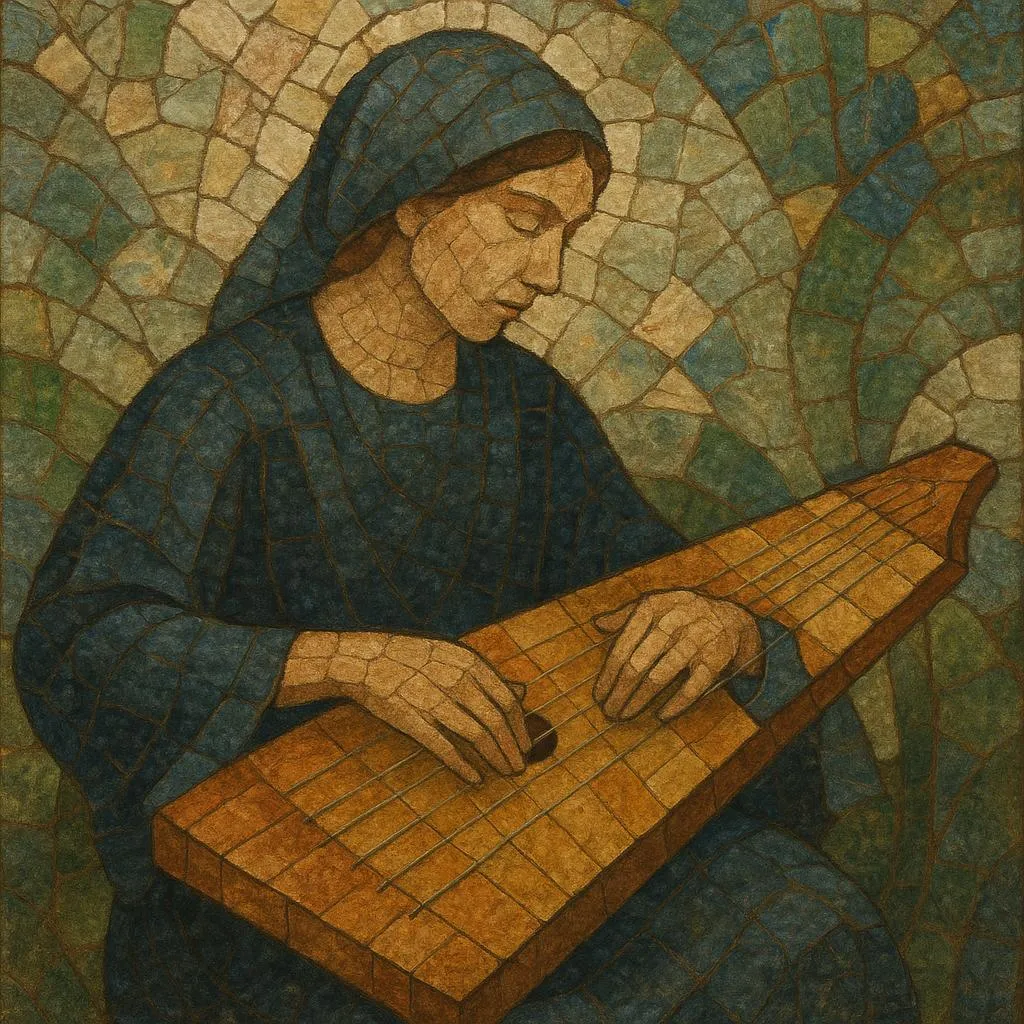
Kantele music is centered on the Finnish kantele, a Baltic-Finnic plucked zither with a bright, bell-like timbre and long, ringing sustain.
In traditional settings it is closely tied to runo-song aesthetics: steady, speech-like melodic flow, narrow modal pitch sets, and an intimate, storytelling-oriented sound.
In modern practice, kantele appears in contemporary folk, chamber-folk, and crossover contexts where it can function as a harmonic bed (drone and broken-chord patterns), a melodic lead instrument, or a shimmering texture layer alongside voice, strings, and electronic ambience.
History
The kantele is one of the emblematic instruments of Finland and the wider Baltic-Finnic area. While precise dating is difficult, archaeological and comparative evidence points to medieval-era roots for bowed and plucked zithers in the region, with the kantele developing distinctive local forms and playing techniques.
In the 19th century, the rise of Finnish national romanticism and the collection of oral poetry (notably the Kalevala tradition) helped elevate the kantele as a symbol of Finnish identity. This period encouraged documentation of repertories, playing styles, and instrument-building practices, which in turn supported transmission beyond purely local contexts.
Across the 20th century, the instrument moved increasingly into staged folk performance, education, and recording. Craft traditions expanded, and larger chromatic and concert kanteles were developed, enabling more complex harmony and modulation and facilitating ensemble writing.
In recent decades, kantele has broadened into contemporary folk, chamber-folk, film/TV scoring, and experimental and ambient-adjacent work. Amplification, effects, and modern arranging approaches have made it viable in louder ensembles and studio-heavy productions while still retaining its recognizable ringing tone.
Modal centers: Use Dorian/Aeolian-like colors, pentatonic subsets, and drone-based tonality. Keep a strong tonal center with a sustained tonic or tonic–dominant drone.
•Harmony style:
•Traditional-leaning: sparse two-note dyads, open fifths, and parallel motion.
•Contemporary: add gentle extensions (2/9, 6, sus2/sus4) while avoiding dense voicings that blur the kantele’s resonance.
•Voicing tip: Spread chord tones across strings and let the sustain do the “glue,” rather than relying on thick block chords.
Pulse: Many pieces work well with an even, walking pulse or free-rubato phrasing that follows the melody’s speech-like contour.
•Groove options:
•Steady ostinato patterns (broken chords) under a slow melodic line.
•Light dance meters (2/4, 3/4, 6/8) with simple repeating bass-note anchors.
•Articulation: Use damping selectively to create contrast between shimmering resonance and crisp, rhythmic clarity.