Your digging level for this genre

0/8
🏆
Sign in, then listen to this genre to level up

Description

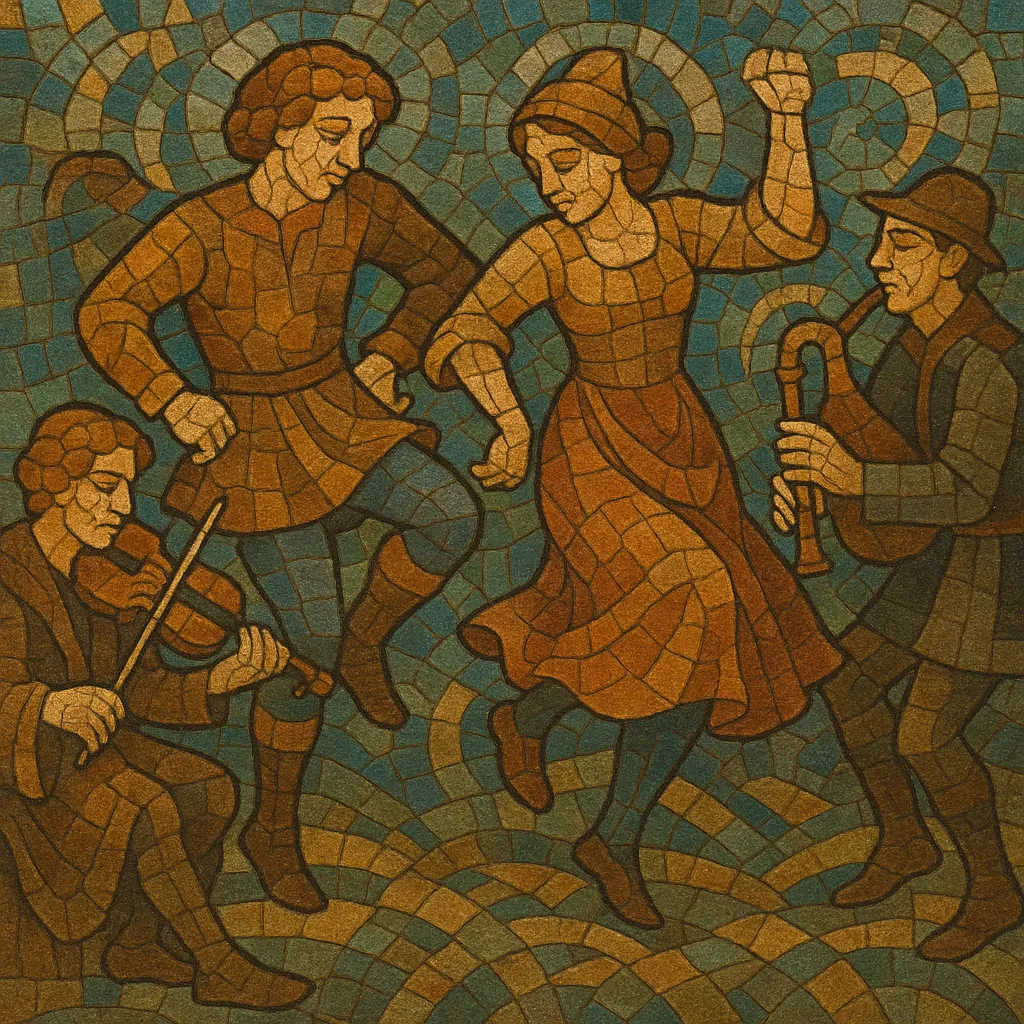
Jigg is an early English term for the lively jig dance-tune type that crystallized in the late Renaissance and spread across the British Isles.

It is typically in compound meters (6/8, 12/8, or 9/8 for slip forms), uses a strong lilting pulse, and favors quick stepwise motion and arpeggiated figures. In folk practice it was played on fiddles, flutes, pipes, and later concertinas; in art music it evolved into the Baroque "gigue," often the exuberant final movement of instrumental suites.

Formal designs range from simple binary (AABB) in dance settings to more contrapuntal, fugal treatments in the French-influenced gigue. Though widely associated today with Irish and Scottish traditional music, the term "jigg" appears in 16th–17th‑century England for both stage afterpieces and instrumental dances, before diversifying regionally and stylistically.

History

Origins (late Renaissance England)

The word "jigg" (or "jigge/jig") appears in late 16th‑century English sources to denote a brisk dance and, at times, comic afterpieces performed after plays. Musically, the jigg’s driving compound meter and binary dance layout converged with vernacular dance practices. Printed and manuscript collections from the period, as well as references in Elizabethan and Jacobean theatre, document its popularity.

Diffusion across the British Isles

By the 17th century, jigg repertory circulated widely. John Playford’s The Dancing Master (first issued 1651) helped codify steps and tunes, while fiddlers and pipers in Ireland and Scotland localized the style, generating tune families and variants (double jigs in 6/8, slip jigs in 9/8, and hop jigs). The lilting accentuation and brisk tempos made jigg forms central to social dancing.

Transformation into the Baroque gigue

Continental composers absorbed the English/Irish/Scottish dance impulse into the instrumental suite as the "gigue." French gigues often employ fugal openings and dotted or triplet figuration; Italian gigues favor rapid scalar or arpeggiated motion. In both cases, the binary plan with repeats and lively compound meters remained a hallmark.

Modern legacy

In traditional music circles, jigs remain core dance tunes, while the historical "jigg" survives in early‑music performance and Baroque suites. The patterning of strong–weak–weak groupings in compound meter, driving eighth-note motion, and AABB phrase structures continue to inform contra dance, Celtic revival, and early‑music practice.

How to make a track in this genre

Meter, tempo, and groove
•   Use compound meters: 6/8 or 12/8 for most jigs; 9/8 for slip jigs. Aim for a lilting, danceable pulse with clear two- or four-bar hypermeter. •   Typical tempos are lively but controlled (roughly 110–140 BPM felt as dotted-quarter beats in 6/8).
Form and phrase
•   Favor binary AABB form with 8‑bar strains (A then B), each repeated. Build contrast by changing register or melodic contour between A and B. •   In a Baroque-influenced “gigue,” open with imitative entries (quasi‑fugal subject) and maintain continuous eighth-note motion.
Melody and harmony
•   Write bright, modal-tinged tunes (major, Mixolydian, or Dorian are common) with stepwise motion, arpeggios of I/V, and occasional modal leading tones. •   Harmonize diatonically with I–IV–V; add secondary dominants sparingly. For early‑music style, use figured-bass thinking and cadence clearly at phrase ends.
Rhythm and articulation
•   Emphasize the first eighth of each dotted beat group to create lift. Use slurs across pairs of eighths for wind/strings and light, separated strokes for dance clarity.
Instrumentation
•   Folk setting: fiddle, flute/whistle, uilleann pipes or border pipes, concertina, with guitar/bouzouki or piano for rhythm; bodhrán for light percussion. •   Baroque setting: solo harpsichord or lute (gigue movement in a suite) or chamber strings/continuo, articulating lively, buoyant textures.
Ornaments and variations
•   Add cuts, rolls, and grace notes (folk) or trills/mordents (Baroque) at cadences and repeated phrases. On repeats, vary endings or insert idiomatic runs while preserving the dance pulse.

Top tracks

Locked
Share your favorite track to unlock other users’ top tracks
Influenced by
Has influenced
Challenges
Digger Battle
Let's see who can find the best track in this genre
© 2025 Melodigging
Melodding was created as a tribute to Every Noise at Once, which inspired us to help curious minds keep digging into music's ever-evolving genres.
Buy me a coffee for Melodigging