Your digging level
Description
Gascon folk music is the traditional music of Gascony, a cultural area in southwestern France (including Béarn, Landes, Gers and parts of the Pyrenees) where the Gascon variety of Occitan is spoken. It features lively communal dance tunes and narrative songs transmitted orally, often performed at village festivities and modern "bal gascon" dance gatherings.
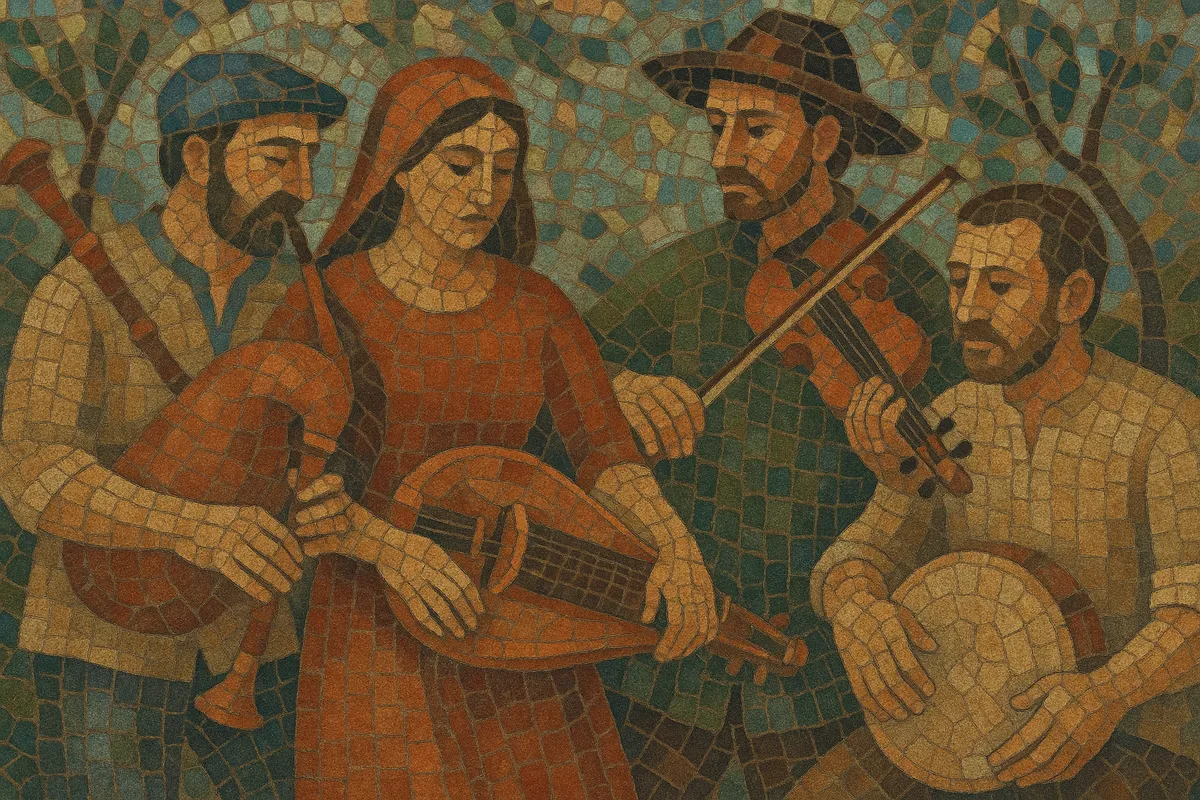
Its sound is defined by drones and modal melodies (often Mixolydian or Dorian), led by the boha (the distinctive Gascon bagpipe), diatonic accordion, hurdy-gurdy (viela/vielle à roue), fiddle, oboe-like reeds (hautbois landais), flutes, and frame or tabor-like percussion. Core dances include the rondeu (in circle or in couples), the sautèuse, the congo, and regional variants of polka, mazurka, scottish and pas d’été, all adapted to local step patterns and phrasing.
Songs in Gascon (Occitan) range from work and pastoral repertoires to love songs, drinking rounds and satirical couplets. Contemporary artists blend the tradition with folk-rock, experimental textures and polyphonic vocals, while staying anchored in danceable rhythms and call-and-response forms.
History
Gascon folk music grew from rural and pastoral life in Gascony, with dances and songs shared at communal events and seasonal transhumance. While its roots are older, many of the first notated references and collectors’ accounts date from the 19th century (1800s), when scholars and local erudites began to transcribe melodies and lyrics. Figures like Félix Arnaudin in the Landes documented songs, tales and customs, offering an invaluable snapshot of repertoire and performance contexts.
Through the early to mid‑20th century, village dance practices continued alongside the spread of accordions, brass bands and popular European couple dances (polka, mazurka, scottish). Urbanization and changing social life reduced everyday use, but local fêtes, bandas traditions (notably in the Landes) and regional ensembles kept a public space for Gascon dance tunes and songs. Ethnochoreologists (e.g., Jean‑Michel Guilcher) studied forms such as the rondeu, helping to stabilize step vocabularies and musical phrasing for teaching and revival.
From the late 1960s and 1970s, the broader Occitan cultural revival energized Gascon music. Groups formed to perform in Gascon (Occitan) on stage, to organize bals and to build or restore traditional instruments like the boha. This period saw the emergence of landmark bands (e.g., Nadau) and a renewed pride in Gascon language and identity through song.
Since the 1990s, a dynamic "néo‑trad" and bal folk circuit has fostered stylistic cross‑pollination: traditional dance grooves coexist with folk‑rock, experimental drones, polyphonic chant and global influences. Artists from the Aranese Valley (where Aranese Gascon is spoken) connect Pyrenean repertoires to broader Occitan and Iberian currents. Today, workshops, festivals and local associations (including boha players’ collectives) sustain transmission, while recordings and pedagogy standardize tune variants and step patterns without stifling regional nuance.