Your digging level
Description
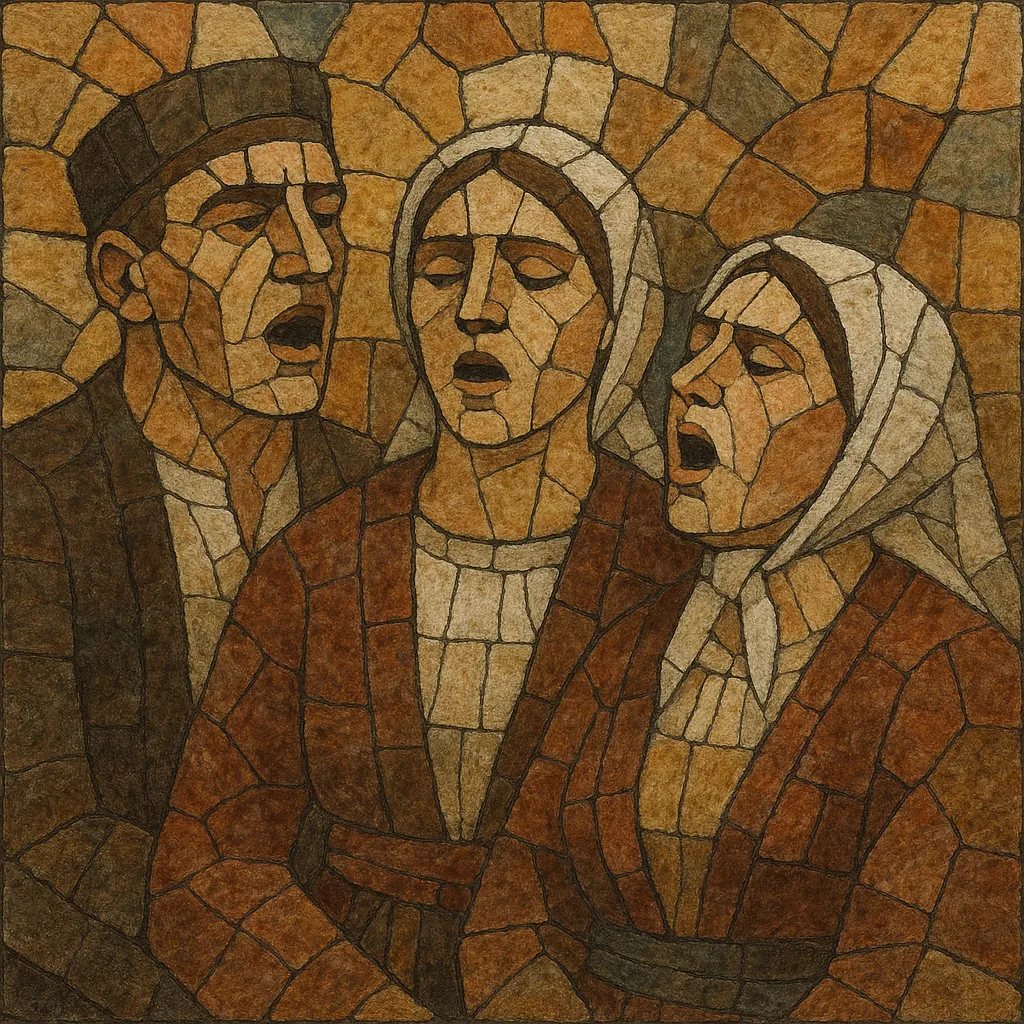
Ganga is a rural polyphonic vocal tradition from the Dinaric highlands (especially western Herzegovina and the Dalmatian Zagora) characterized by powerful, chest‑voice singing in very tight harmonies.
A typical performance begins with a lead singer intoning a short line, after which the rest of the group joins on a sustained syllable (often “oj” or similar vocables), forming a dense, dissonant cluster—frequently in seconds—that creates its recognizable, piercing sonority. The music is unaccompanied, largely free of strict meter, and projects over long distances, reflecting its outdoor, pastoral roots.
Lyrics are brief and direct: couplets that comment on love, hardship, landscape, pride, and communal life. While historically associated with male groups, female ganga (gangašice) is also practiced, and mixed groups occur. The result is an intense, communal outpouring that functions as both music and social dialogue.
History
Ganga likely coalesced in the Dinaric highlands during the 19th century, although its foundations are older. Its sonic profile—unison breaks into close seconds, strong projection, and vocables—reflects the needs of pastoral and agrarian communities who sang outdoors in mountainous terrain. The practice is deeply embedded in local customs around gatherings, fieldwork pauses, and festivities.
By the late 1800s and early 1900s, local variants became identifiable across western Herzegovina and the Dalmatian hinterland (Imotska krajina, Trilj, Runovići, Cista Provo). Communities developed distinctive entries, timbres, and favored intervals. Men’s ensembles predominated, but women’s ganga also flourished, often with slightly softer attack yet the same hallmark dissonances and antiphonal responses.
With the advent of field recording and radio, ganga was documented by folklorists and broadcast on regional programs, which helped codify terminology (e.g., lead vs. response) and text types. Urbanization after mid‑century reduced everyday pastoral use, yet festivals and cultural associations preserved the tradition. From the 1990s onward, diaspora communities and ethno‑music projects renewed interest, and selective fusion experiments brought ganga timbres into contemporary contexts.
Today, ganga continues at local festivals and community events in Bosnia and Herzegovina and neighboring regions. Cultural NGOs and heritage initiatives work on documentation, transmission to younger singers, and ethical fusion projects that maintain the vocal technique, the communal format, and the poetic directness that define the genre.