Your digging level
Description
Folclore de Castilla y León refers to the traditional music and dance practices of Spain’s north‑central autonomous community of Castilla y León. It encompasses a rich repertoire of songs (romances, mayos, villancicos), dance forms (notably the jota castellana, charrada, corrido maragato, and rondas), and instrumental traditions centered on rustic reed, bagpipe, and string timbres.
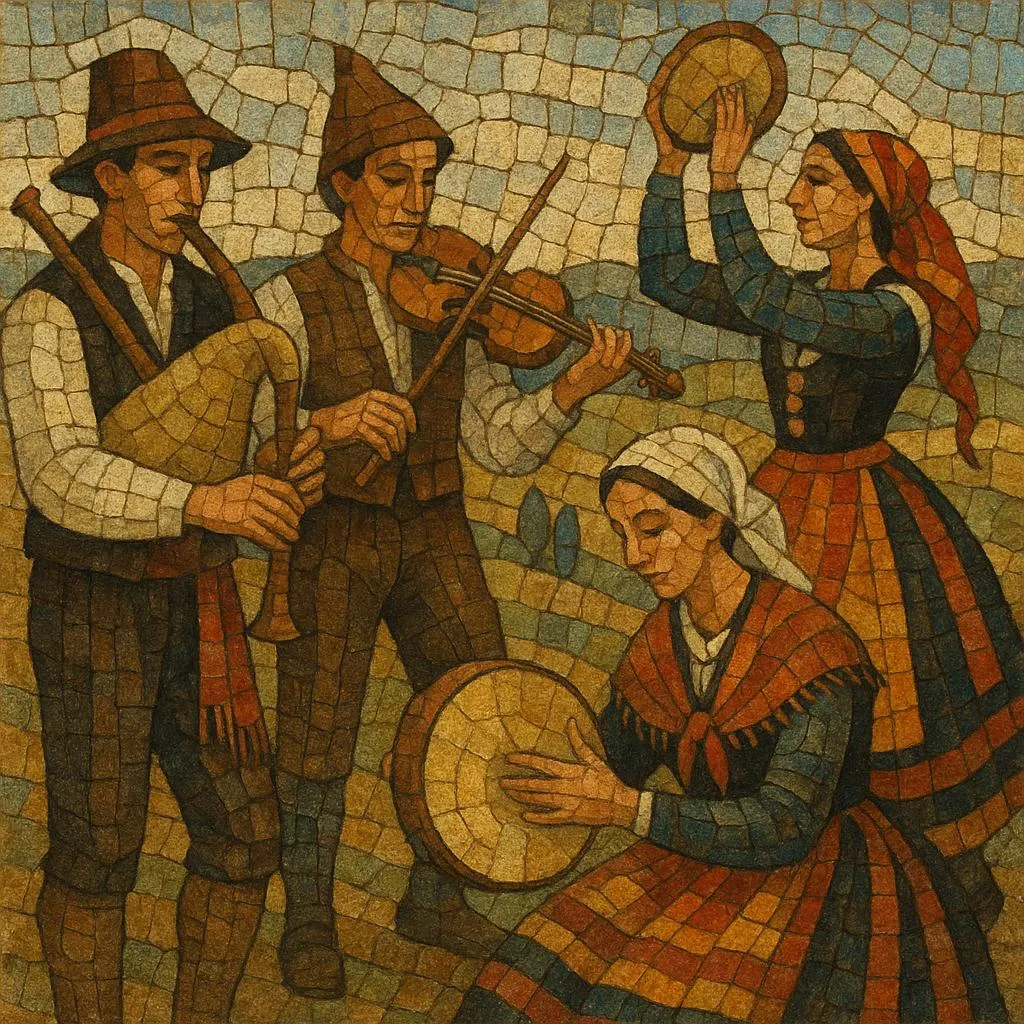
Core instruments include the dulzaina (a piercing double‑reed shawm) with tamboril, various gaitas (especially the gaita charra in Salamanca and Zamora), the rabel (bowed folk fiddle), zanfona or hurdy‑gurdy, guitar, bandurria/laúd, frame drums, and panderetas. Rhythmic profiles move between ternary (3/4 or 6/8) and lively duple meters, often featuring hemiolas and hand‑clap patterns that drive circle and couple dances.
Stylistically, the song language is Castilian, with texts drawing from rural life, courtship, work and ritual cycles, and historical balladry. The modern revival (20th century onward) preserved archival repertories while adapting them for stage ensembles and contemporary audiences.
History
Medieval and early‑modern Castilla saw a continuous exchange between courtly and rural repertoires. Narrative romances and seasonal songs circulated orally, while local dance tunes for festivities—played on dulzaina, tamboril, rabel, and bagpipes—became hallmarks of village identity. Over centuries, distinct sub‑areas (Maragatería, Aliste, Sayago, Tierra de Campos, La Ribera, La Montaña leonesa, etc.) cultivated recognizable variants of jotas, charradas, and rondas.
During the 1800s and early 1900s, repertories increasingly crystallized into recognizable dance‑song forms linked to specific towns and comarcas. Local musicians and dulzaineros developed durable dance band line‑ups (dulzaina + tamboril), while folklorists and early collectors began notating and archiving melodies, texts, and performance practices.
The mid‑20th‑century folk revival in Spain brought systematic fieldwork, anthology publications, and staged ensembles. Prominent Castilian performers and researchers recorded and taught dulzaina technique, hurdy‑gurdy practice, and regional dances. Urban folk groups formed around archival songbooks, arranging traditional tunes for concert stages and recordings, helping popularize the jota castellana, corrido maragato, and charrada well beyond the region.
Today, Castilla y León’s folklore thrives through festivals, dance schools, and new ensembles. Young musicians blend archival melodies with modern instrumentation, folk‑rock textures, and acoustic innovation while maintaining community functions (romerías, patronal feasts, and seasonal rites).