Your digging level
Description
Fado antigo is the early, pre-commercial form of Portuguese fado that crystallized in Lisbon (especially Alfama and Mouraria) and, to a lesser extent, Coimbra, during the 19th and early 20th centuries.
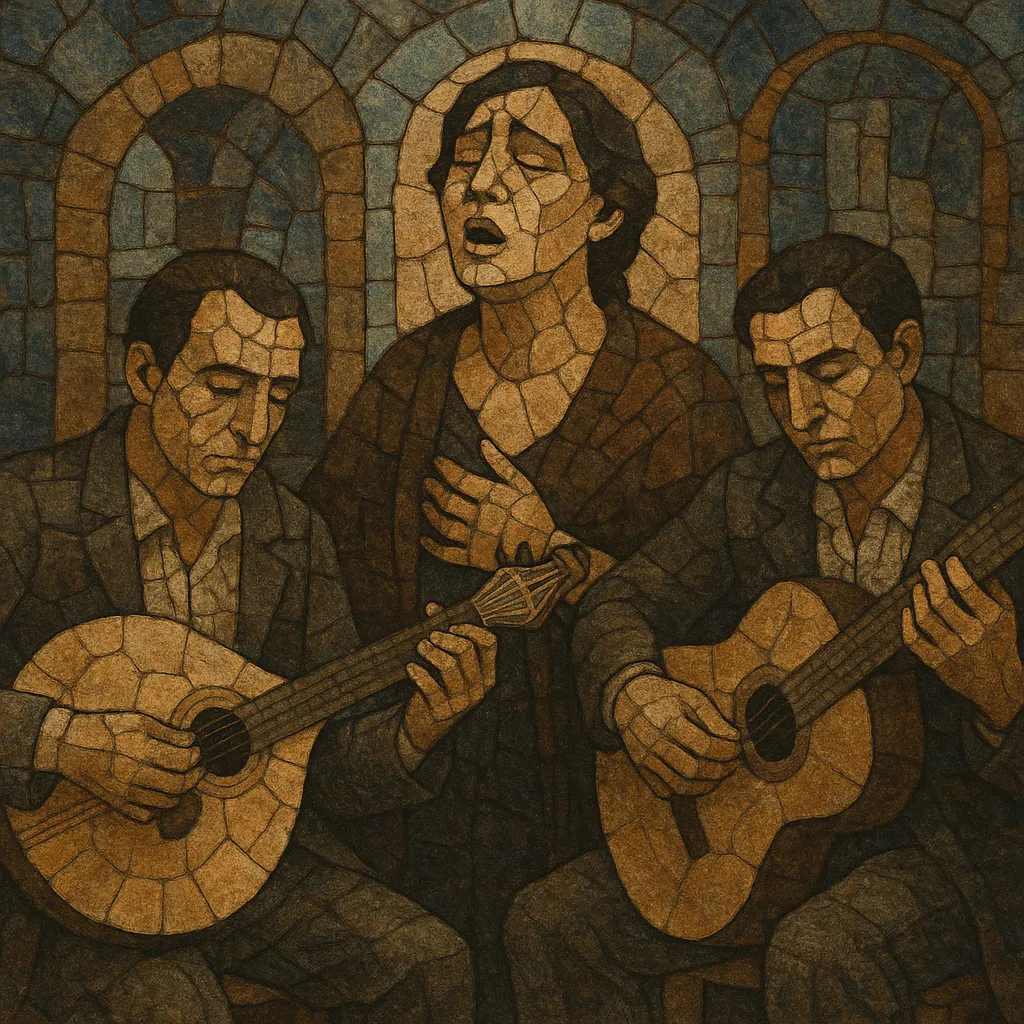
It is characterized by raw, declamatory singing that foregrounds saudade—an emotion of longing and bittersweet memory—supported by a small acoustic ensemble centered on the guitarra portuguesa (Portuguese 12‑string guitar) and the viola (classical guitar), often with a bass (viola baixo). Repertoire revolves around fixed melodic models (fado menor, fado maior, fado corrido, fado Mouraria, etc.) over archetypal harmonic cycles, flexible rubato phrasing, and intimate call‑and‑response between voice and guitar.
Compared with modern, post‑war fado, fado antigo retains a more folkloric, tavern‑born directness: lyrics in quatrains, topical storytelling, and neighborhood identities, performed in casas de fado and informal gatherings before the genre’s later professionalization and internationalization.
History
Fado antigo emerged in Lisbon’s popular quarters—Alfama, Mouraria, Bairro Alto—in the 1820s–1840s, where sailors, artisans, and bohemians mingled in taverns and patios. Early fadistas such as Maria Severa (c. 1820–1846) became legendary for a style that blended Afro‑Brazilian dance song (lundu), salon romance (modinha), and local Portuguese song traditions. The guitarra portuguesa took on its distinctive role as a melodic, ornamenting partner to the voice.
By the late 1800s the practice coalesced around recurrent “fados” (melodic models) like fado menor (lamenting, minor), fado maior (affirming, major), fado corrido (livelier, in 2/4), and fado Mouraria. Performances followed a shared code: a free, guitar‑led introdução, the singer’s entrance with rubato freedom, and interludes where the guitarra answered and embellished the line. Quatrain poetry, street characters, and Lisbon’s neighborhoods supplied much of the subject matter.
Acoustic recordings in the 1910s–1920s and urban stages expanded the reach of fado antigo. The first Portuguese sound film, “A Severa” (1931), codified fado’s mythical origins. Under the Estado Novo regime (1930s–40s), fado was regulated yet promoted; casas de fado flourished, and canonical performers such as Alfredo Marceneiro, Ercília Costa, and Hermínia Silva defined the classic sound.
From the 1940s onward, larger venues, amplifiers, and star vocalists (e.g., Amália Rodrigues, though representing a more modern phase) shifted the style toward a sleeker, international form. Nevertheless, the roots of modern and Coimbra fado—and related Lusophone genres like Cape Verdean morna—rest firmly on the aesthetics and repertoire of fado antigo.
Work from traditional models:
•Fado menor: minor mode with the Andalusian‑type descent (i–VII–VI–V; e.g., Am–G–F–E), cadencing strongly on V (E) before returning to i.
•Fado maior: major mode using I–IV–V cycles and secondary dominants for lift.
•Fado corrido and fado Mouraria: livelier patterns with simple I–V or i–V pivots and ornamental passing chords.
•Keep harmonies transparent; guitars should articulate bass motion and inner voices without overcrowding the vocal space.