Your digging level
Description
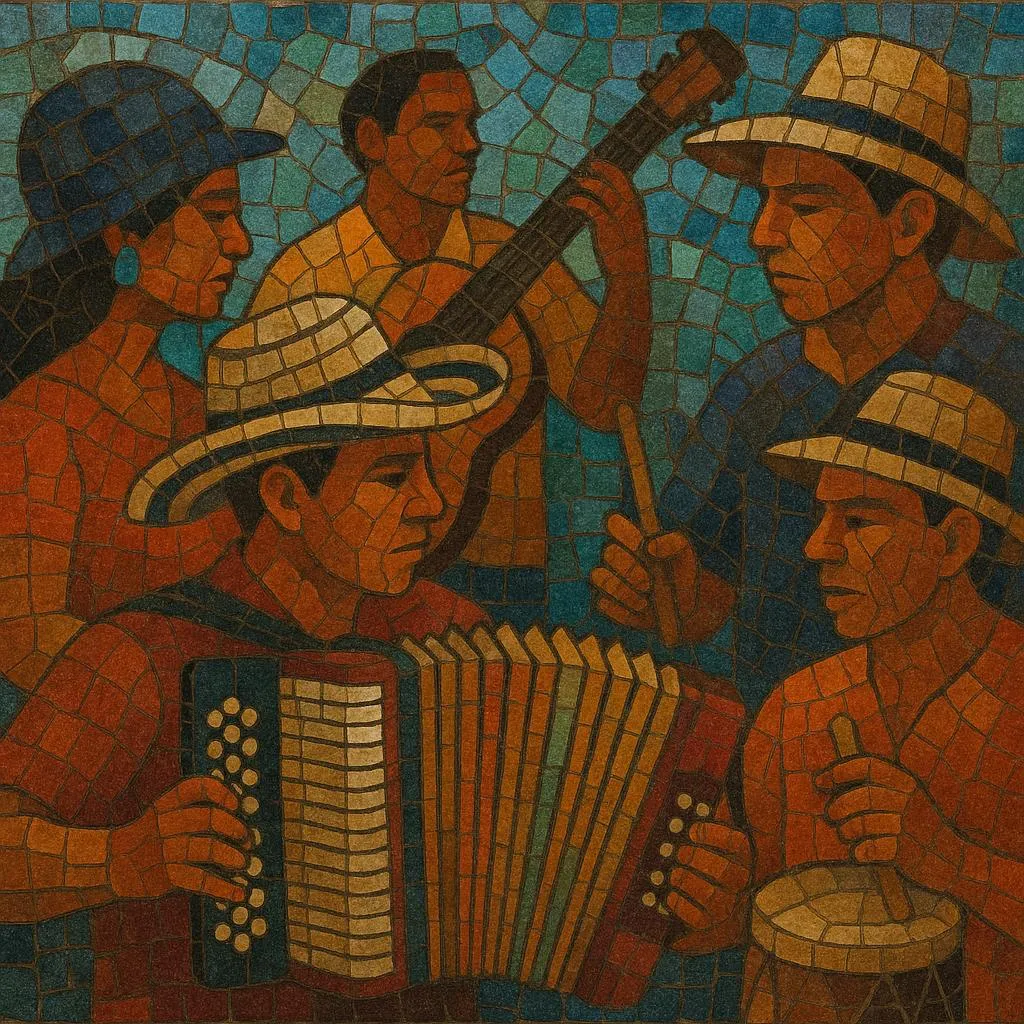
Cumbia colombiana regia is the Monterrey (Nuevo León) take on Colombian cumbia and vallenato, performed by northern Mexican bands with accordion up front, bustling hand percussion, and lyrics steeped in barrio romance and everyday life.
“Regia” signals its regiomontano roots: the music arrived through imported Colombian records and touring ensembles, then was adopted by local groups who kept the Colombian accordion vocabulary and guacharaca-style scraping while framing it in Mexican dance‑hall arrangements. In Monterrey it often coexists with the rebajada practice (slowing recordings down), which deepens the groove and turns the dance into a swaying, collective ritual.
Compared with Mexico City’s sonidera scene or the sax‑driven cumbia from the northeast, cumbia colombiana regia stays close to Colombian accordion phrasing and rhythms, yet bears a distinctly northern Mexican timbre and attitude.



History
Imported LPs and cassettes of Colombian cumbia and vallenato began circulating widely in Monterrey’s mercados and neighborhood dances. Working‑class youth and mobile sound systems fell in love with the accordion‑led Colombian sound and made it their own. Local musicians formed groups that adopted Colombian repertoire and style but performed with a regiomontano sensibility—amplified dance‑band formats, Mexican vocal delivery, and neighborhood shout‑outs.
By the 1990s, Monterrey had a vibrant ecosystem of bands, DJs, and dancers that identified with “la Colombia” as a musical and cultural identity. Some DJs popularized cumbia rebajada (playing 45‑rpm records at slower speeds), a practice that blended seamlessly with the regia scene’s love for heavy bass, echo, and lingering grooves. Bands kept tempos moderate to slow, foregrounding accordion riffs recognizable from Colombian styles while embracing Mexican romantic and narrative lyrics.
Cumbia colombiana regia reached broader audiences as Monterrey artists collaborated with rock, hip‑hop, and alternative acts, bringing the accordion groove to festivals and national media. At the same time, archival reissues and digital platforms exposed new listeners to the core bands that defined the style in neighborhood dances, extending the music’s influence well beyond northern Mexico.
The genre remains a living dance tradition in the north of Mexico. Young groups continue to cover Colombian standards and write new songs in the regia mold, alternating between straight performance and slowed (rebajada‑influenced) aesthetics. Its sound—accordion hooks, scraping percussion, tumbao‑like bass lines, and sentimental storytelling—has become a signature of Monterrey’s musical identity.



Top albums