Your digging level

For this genre
0/8
🏆
Sign in, then listen to this genre to level up

Description

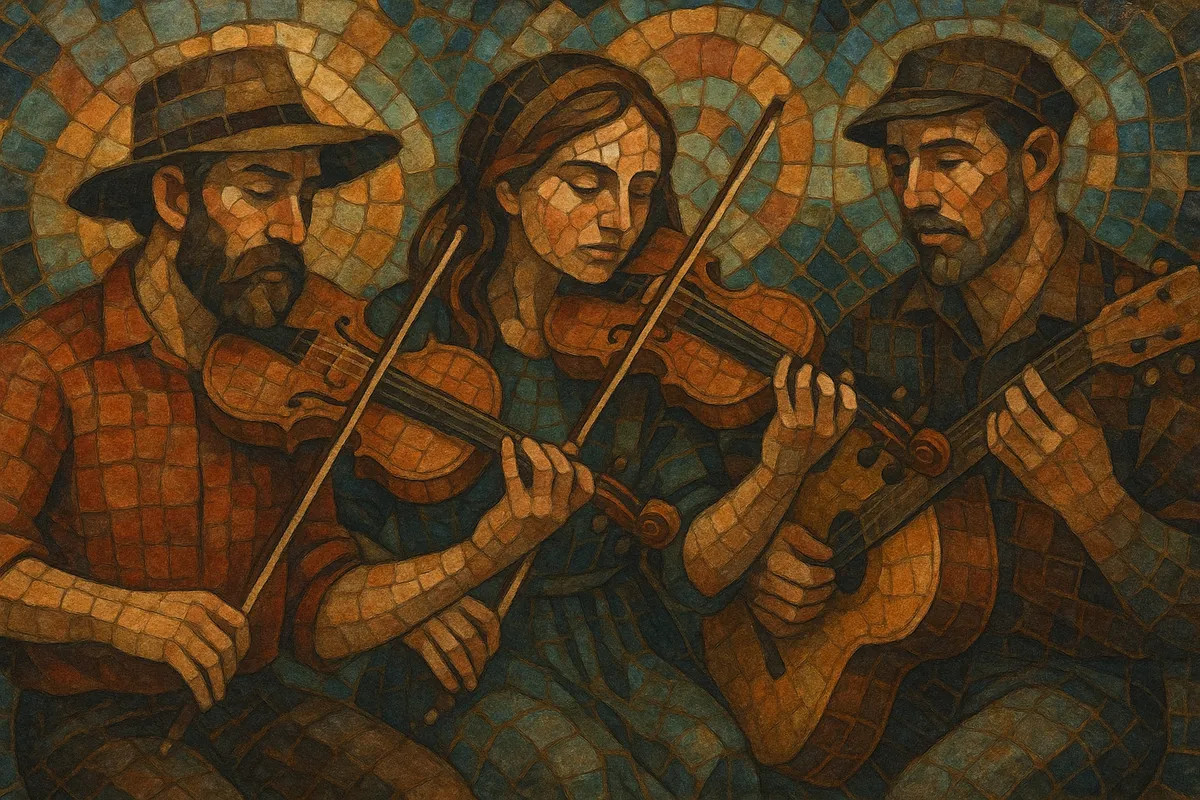
Contra is dance music created to accompany contra dances—longways set dances in which couples face each other in two lines and progress up and down the set.

Built on Anglo‑Celtic fiddle traditions that crossed the Atlantic to New England, contra music emphasizes square, clearly phrased melodies in reels (4/4) and jigs (6/8), with strong eight‑bar phrases that match the figures of the dance. Bands typically center on fiddle and piano, with guitar, mandolin, flute/whistle, accordion, and hammered dulcimer common, and a driving “boom‑chuck” rhythm that gives dancers lift and momentum.

While rooted in 18th–19th‑century American country‑dance repertoire, modern contra bands blend Irish/Scottish, French, and old‑time tune styles, often arranged in energetic medleys that ramp intensity for the floor. The feel is joyful, communal, and purpose‑built for continuous dancing.


Sources: Spotify, Wikipedia, Discogs, RYM, MB, user feedback and other online sources

History

Origins (17th–18th centuries)

Contra dance descends from English country dance, Scottish country dance, and French longways dances that circulated widely in the 17th century. As these forms took hold in colonial New England, local musicians adapted reels, jigs, hornpipes, and marches into a distinctive regional dance‑music practice led by fiddles and supported by chordal instruments (notably piano by the 19th century).

19th–early 20th centuries

Through the 1800s, contra coexisted with quadrilles, waltzes, and other social‑dance fashions. Bands standardized clear 8‑bar phrases and 32‑bar AABB tune forms to mirror figures called by the dance leader. In the early 20th century, urban ballroom styles and later recorded entertainment reduced the prevalence of community contra dancing, though strongholds in New England and Appalachia kept the tradition alive.

Preservation and revival (mid‑20th century–1970s)

Organizers, callers, and musicians—particularly in New England—maintained contra through local halls and festivals. Figures such as Ralph Page and, later, Dudley Laufman championed live dance bands, codified repertoire, and mentored new players. By the 1960s–70s folk revival, college towns and community groups rekindled interest, and the music gained new audiences across North America.

Contemporary scene (1980s–present)

From the 1980s onward, touring bands, camps, and organizations like CDSS helped spread contra dancing across the U.S., Canada, and other Anglophone countries. Musically, the core sound—fiddle‑driven reels and jigs with piano/guitar rhythm—remains, but arrangements have grown more dynamic: medleys, key changes, modal tunes, and grooves borrowed from Celtic, old‑time, swing, and even light jazz textures. The emphasis stays constant: crisp phrasing, reliable tempo (~110–120 BPM for reels), and a buoyant lift that serves the dance.

How to make a track in this genre

Core form and phrasing
•   Write or select squarely phrased reels (4/4) and jigs (6/8), typically in 32 bars AABB (each part 8 bars). The eight‑bar phrase boundaries must be crystal‑clear so dancers complete figures exactly on phrase ends. •   Plan medleys of 2–3 tunes in related keys/modes to build energy across a 6–10 minute dance. Common paths: D major → G major → A mixolydian, or E dorian → D major.
Tempo and groove
•   Aim for ~110–120 BPM for reels and ~108–114 BPM for jigs (local norms vary). Stability matters more than speed. •   Provide a dependable lift: piano or guitar supplies a "boom‑chuck" (bass on 1 & 3, chords on 2 & 4) or a strong backbeat chop; bass, foot percussion, or bodhrán can reinforce but should never obscure phrasing.
Melody, mode, and harmony
•   Melodies favor major, mixolydian, and dorian modes; classic contra tunes are diatonic with memorable hooks. •   Harmonies are functional and supportive: I–IV–V progressions, with tasteful secondary dominants and modal color (e.g., bVII in mixolydian). Keep changes aligned to 2‑ or 4‑bar cells to cue dancers subconsciously.
Instrumentation and arrangement
•   Typical band: fiddle(s) + piano and/or guitar; mandolin/tenor banjo, flute/whistle, accordion, hammered dulcimer common. •   Arrange dynamics to match figures: thin textures for balances/allemandes; full band for long lines and swings. Use short intros (4 or 8 bars) so the caller can launch the dance cleanly. •   Ornaments (cuts, rolls, grace notes) should add lift without rhythmically smearing the beat.
Working with the dance
•   Coordinate with the caller: confirm the dance length (usually 8–10 times through the 32‑bar tune), desired energy arc, and any moments that benefit from breaks or tag endings. •   Keep transitions between tunes seamless and on phrase boundaries; signal changes with pickup licks, register shifts, or brief dynamic dips that re‑announce the groove.
Rehearsal tips
•   Practice with a metronome emphasizing phrase ticks every 8 bars. •   Record run‑throughs while walking the figures; if your phrasing makes the walking intuitive, you’re doing it right.

Top tracks

Locked
Share your favorite track to unlock other users’ top tracks

Upcoming concerts

in this genre
Influenced by
Has influenced

Download our mobile app

Get the Melodigging app and start digging for new genres on the go
© 2026 Melodigging
Melodding was created as a tribute to Every Noise at Once, which inspired us to help curious minds keep digging into music's ever-evolving genres.
Buy me a coffee for Melodigging