Your digging level

For this genre
0/8
🏆
Sign in, then listen to this genre to level up

Description

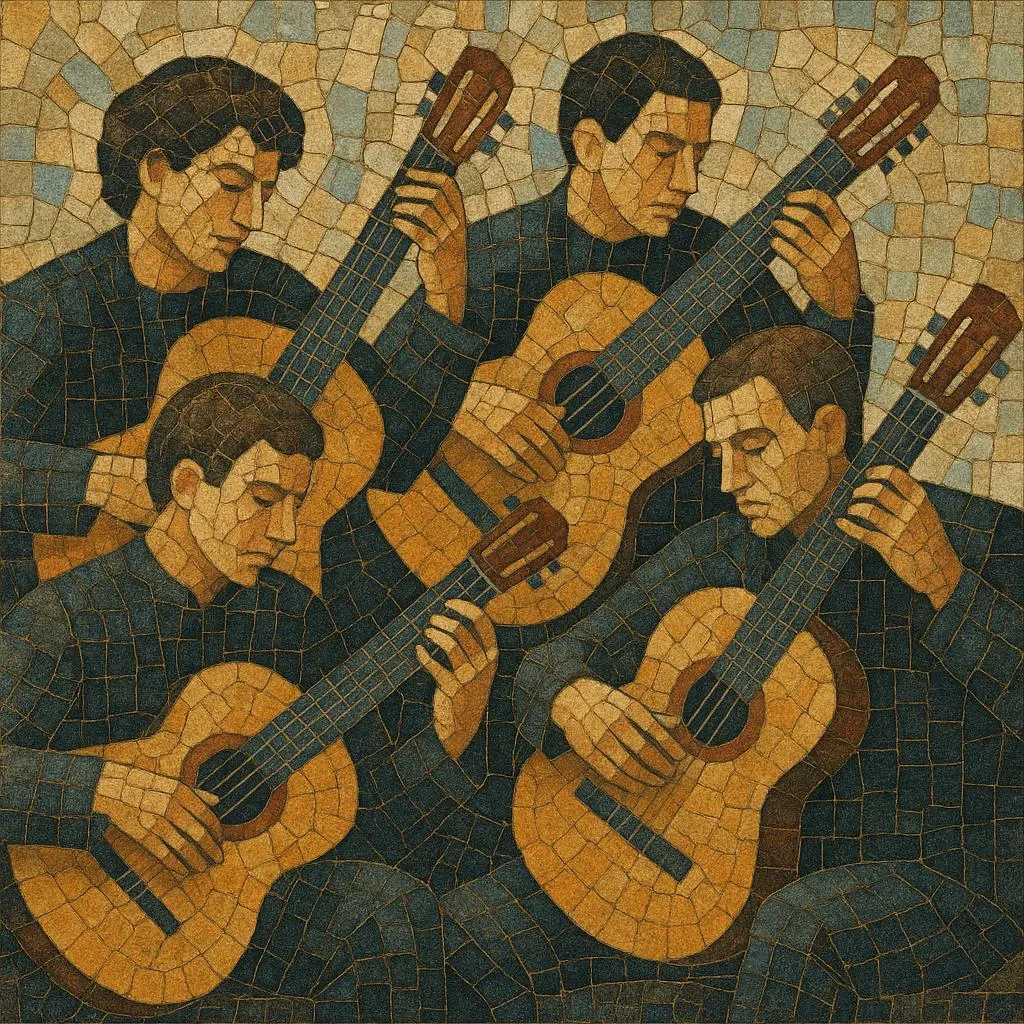
Classical guitar quartet is a chamber-music format scored for four nylon‑string (classical) guitars. It blends the intimate color palette of solo classical guitar with the contrapuntal clarity and dynamic breadth of a string quartet, distributing melody, inner counterpoint, and bass across four matched instruments.

Repertoire spans original works written expressly for four guitars and a large body of transcriptions—from Renaissance and Baroque keyboard or consort music to Classical and Romantic orchestral pieces, as well as 20th‑ and 21st‑century concert works. Ensembles exploit idiomatic techniques (rasgueado, tremolo, harmonics, tambora, pizzicato, campanella) to expand timbre and articulation beyond what a single guitar can achieve.

As a modern ensemble type it matured in the mid‑20th century, when dedicated quartets began commissioning new scores and touring internationally, establishing a distinct practice within the broader classical guitar tradition.


Sources: Spotify, Wikipedia, Discogs, RYM, MB, user feedback and other online sources

History

Early roots

Arrangements for multiple guitars appeared sporadically in the 19th and early 20th centuries, usually as ad hoc gatherings or mixed chamber settings. The idea of distributing contrapuntal lines among equal, plucked, nylon‑string instruments was attractive for transcribing keyboard and orchestral textures, but it lacked a stable ensemble tradition.

Formation of the modern quartet (1960s–1970s)

A durable concert practice crystallized in the 1960s, when family- and conservatory‑based groups began programming full-length recitals for four classical guitars. These ensembles adopted chamber‑music discipline (blend, balance, cueing, rehearsal methods) and pursued commissions, launching a dedicated repertoire rather than relying only on transcriptions.

Expansion and commissioning (1980s–2000s)

From the 1980s onward, professional quartets toured globally, recorded extensively, and worked closely with contemporary composers. Important contributors such as Leo Brouwer, Roland Dyens, Máximo Diego Pujol, Ian Krouse, Dusan Bogdanović, and John W. Duarte enriched the literature with works that treat the four guitars like a mini‑orchestra, exploring polyrhythm, extended techniques, and multi‑movement architectures.

Twenty‑first century presence

Today, guitar quartets occupy a recognized niche in the chamber circuit and at guitar festivals. Their programs fluidly combine original works with historically informed transcriptions, world‑music inflections, and new music aesthetics. Conservatories train dedicated ensembles, and competitions often include quartet categories, ensuring a continual flow of new repertoire and performers.

How to make a track in this genre

Ensemble setup and roles
•   Use four nylon‑string guitars in standard tuning (E–A–D–G–B–E). Assign parts roughly like a string quartet: Gtr. 1 (soprano/melody), Gtr. 2–3 (inner voices/counterpoint), Gtr. 4 (bass and rhythmic foundation). •   Balance is paramount: write/shape dynamics so melody projects without overpowering accompaniment.
Texture, counterpoint, and harmony
•   Exploit imitative counterpoint and antiphony between pairs (e.g., 1–2 vs. 3–4). Stagger entrances to maintain clarity. •   Harmonically, traditional common‑practice writing works well, but quartets can sustain richer sonorities: close-position clusters, added‑tone chords, and parallel planing are effective if carefully voiced to avoid muddiness below middle C.
Idiomatic techniques and color
•   Vary timbre with ponticello vs. tasto, apoyando vs. tirando, natural/artificial harmonics, and coloristic effects (tambora, pizzicato, golpe, Bartók pizz.). •   Reserve rasgueado for rhythmic drive; coordinate patterns among parts to simulate a larger plucked orchestra without masking lines.
Rhythm and groove
•   Keep bass figures clean and articulate; avoid dense low-register stacks. Use interlocking arpeggios, hocketing, and metric layering for momentum. •   For dance-derived movements, distribute offbeats and syncopations among inner guitars to preserve air around the melody.
Notation and rehearsal
•   Prefer standard notation; indicate string/fingerings only when color or position is critical. Cue important entrances across parts. •   Rehearse like a string quartet: agree on articulations, vibrato width, and release lengths; use breathing/cueing body language; record run‑throughs to refine balance.
Arranging tips
•   When transcribing keyboard/orchestral music, map bass to Gtr. 4, principal melody to Gtr. 1, and inner contrapuntal strands to Gtr. 2–3; redistribute lines during climaxes to prevent fatigue and ensure projection. •   Consider occasional scordatura or capos for color, but keep changes practical for concert flow.

Top tracks

Locked
Share your favorite track to unlock other users’ top tracks

Upcoming concerts

in this genre
Influenced by
Has influenced

Download our mobile app

Get the Melodigging app and start digging for new genres on the go
© 2026 Melodigging
Melodding was created as a tribute to Every Noise at Once, which inspired us to help curious minds keep digging into music's ever-evolving genres.
Buy me a coffee for Melodigging