Your digging level

For this genre
0/8
🏆
Sign in, then listen to this genre to level up

Description

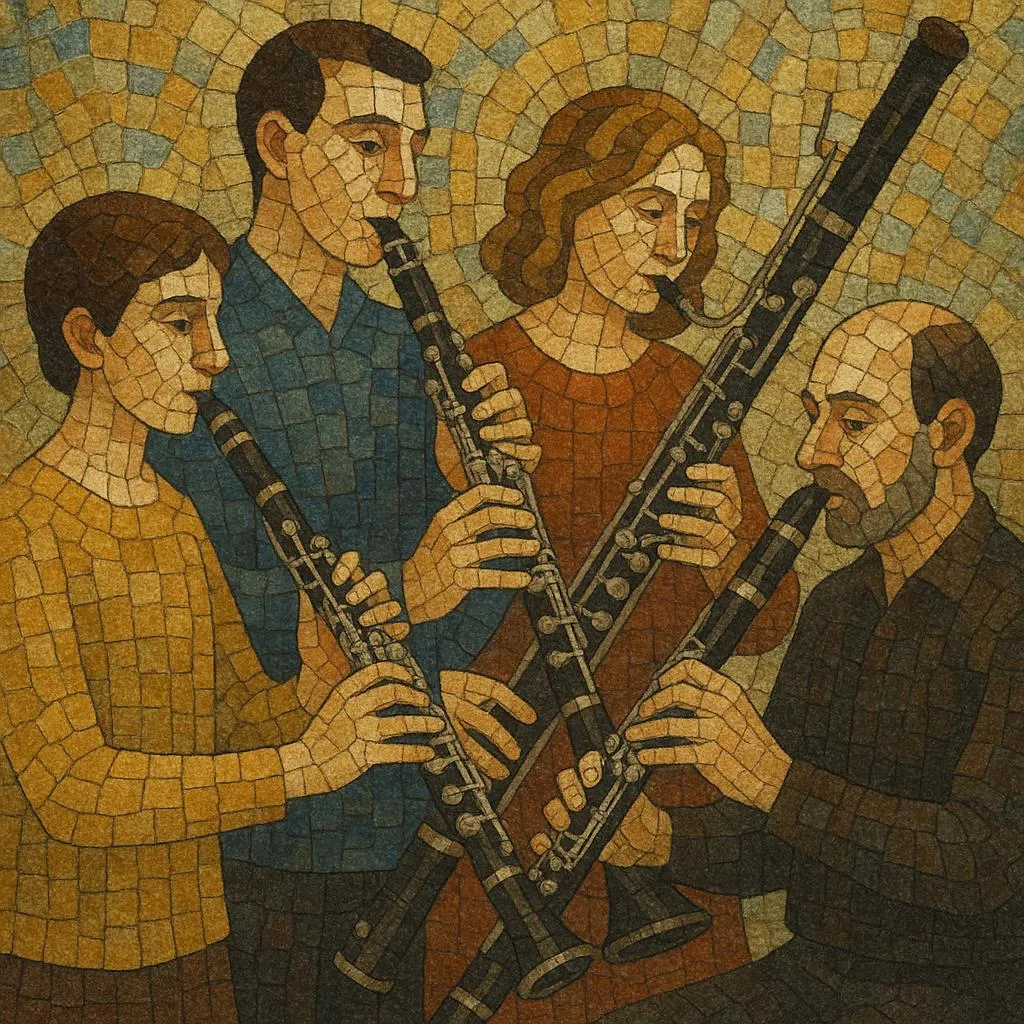
Clarinet ensemble (often called a clarinet choir when it includes the full family) is a chamber/wind format built entirely from clarinets across the instrument’s range—typically E♭ (piccolo), B♭/A soprano, basset horn or alto clarinet, bass clarinet, and contrabass clarinet.

Its signature sound is a warm, vocal, organ-like blend with exceptional agility and homogeneous timbre. Repertoire spans arrangements of orchestral and operatic music, wind-band literature refashioned for clarinets, jazz-tinged originals, and a growing body of contemporary works written specifically for clarinet quartet/choir.

Beyond concert stages, clarinet ensembles serve as pedagogical laboratories in universities and festivals, sharpening players’ blend, intonation, articulation alignment, and low-register support while showcasing the clarinet’s full coloristic spectrum.


Sources: Spotify, Wikipedia, Discogs, Rate Your Music, MusicBrainz, and other online sources

History

Origins (early–mid 20th century)

The clarinet ensemble coalesced in the early 20th century as clarinetists and educators explored stacked voicings of the clarinet family. The format drew on the long-established European classical and chamber traditions, but its consolidation into choirs/quartets was catalyzed by pedagogues and band programs—especially in the United States—who recognized how well the family’s matched timbres could emulate choral/organ textures.

Post‑war growth and new repertoire

After World War II, university studios, military bands, and civic groups formalized clarinet choirs and quartets. Composers began contributing original works and educational suites, while arrangers adapted symphonic and operatic staples. By mid-century, the clarinet quartet/choir was a staple at conservatories and music festivals, with parts spanning E♭ to contrabass to create SATB-like voicings.

Global expansion and stylistic breadth

In the late 20th and 21st centuries, the format spread worldwide. Professional quartets and large choirs commissioned new music ranging from neoclassical and minimalist idioms to jazz-inflected concert pieces. Contemporary composers exploit extended techniques (slap tongue, flutter tongue, multiphonics) and bass/contrabass clarinets for cinematic depth, while educational ensembles keep the tradition vibrant through arrangements that introduce players to blend, balance, and ensemble discipline.

Today

Today, clarinet ensembles appear in concert halls, universities, festivals, and community settings. Their repertoire spans Baroque transcriptions, Romantic overtures, wind-band classics reimagined, and brand-new works, cementing the ensemble as both a pedagogical cornerstone and a distinctive concert genre.

How to make a track in this genre

Instrumentation and voicing
•   Typical forces: E♭ clarinet (soprano color), B♭/A clarinets (core body), basset horn or alto clarinet (inner warmth), bass clarinet (foundation + lyric solos), contrabass clarinet (pedal and weight). Quartets often use 3 B♭ + bass, or E♭ + 2 B♭ + bass. •   Think SATB: place melodies in the clarion register of B♭/A clarinets; use E♭ for brilliance and color interjections; reserve bass/contrabass for grounding and counter-lines.
Range, register, and blend
•   Exploit the clarinet’s three main registers: chalumeau (dark, woody), clarion (singing, focused), altissimo (brilliant, penetrating). For blend, avoid clustering many voices in the same chalumeau octave for long stretches—alternate inner voices across basset horn/alto and Bb clarinets. •   Balance E♭ and bass/contrabass carefully—both project strongly; write them with dynamic nuance and rests to prevent timbral dominance.
Harmony and texture
•   Homophonic “choral” writing showcases the organ-like sonority; slow, consonant voicings with staggered crescendos work well. •   For clarity in dense textures, space low voices (10ths/12ths) and avoid parallel mid-low thirds for long spans. Use arpeggiated inner figures (broken chords, alberti-like patterns) to keep harmony mobile without cluttering.
Rhythm, articulation, and idioms
•   Clarinet articulation is flexible; mixed staccato/tenuto patterns are crisp. Use off-beat accents and dovetailed tonguing to keep long lines buoyant. •   Idiomatic gestures: chromatic neighbor figures, scale runs, trills, grace-note turns, wide chalumeau-to-clarion leaps (written with breath marks and dynamic ramps to help ensemble coordination).
Color and extended techniques (optional)
•   Slap tongue and flutter tongue add percussive or shimmering effects; multiphonics and key clicks offer contemporary color (use sparingly and provide fingerings or alternatives). •   Bass clarinet can cover lyrical solos or bass ostinati; contrabass clarinet is excellent for pedal points, cluster swells, or quasi-organ pedals.
Form and arranging tips
•   Mini-suites, overture transcriptions, dances, and theme-and-variations fit the medium well. •   When arranging orchestral music, redistribute string inner lines to basset horn/alto and 2nd–3rd B♭ parts; translate brass fanfares to antiphonal E♭/B♭ voicings, with bass clarinet reinforcing low horns/trombones.
Practical notation and rehearsal
•   Provide detailed dynamics and balance cues (e.g., “inner voices sotto voce”). •   Mark breath placements and divisi in long tutti lines; stagger breathing to maintain legato carpets. •   Include cue-sized alternatives if contrabass or basset horn may be unavailable, ensuring playable reductions.

Top tracks

Locked
Share your favorite track to unlock other users’ top tracks
Influenced by
Has influenced
Challenges
Digger Battle
Let's see who can find the best track in this genre

Download our mobile app

Get the Melodigging app and start digging for new genres on the go
© 2026 Melodigging
Melodding was created as a tribute to Every Noise at Once, which inspired us to help curious minds keep digging into music's ever-evolving genres.
Buy me a coffee for Melodigging