

Your digging level
Description
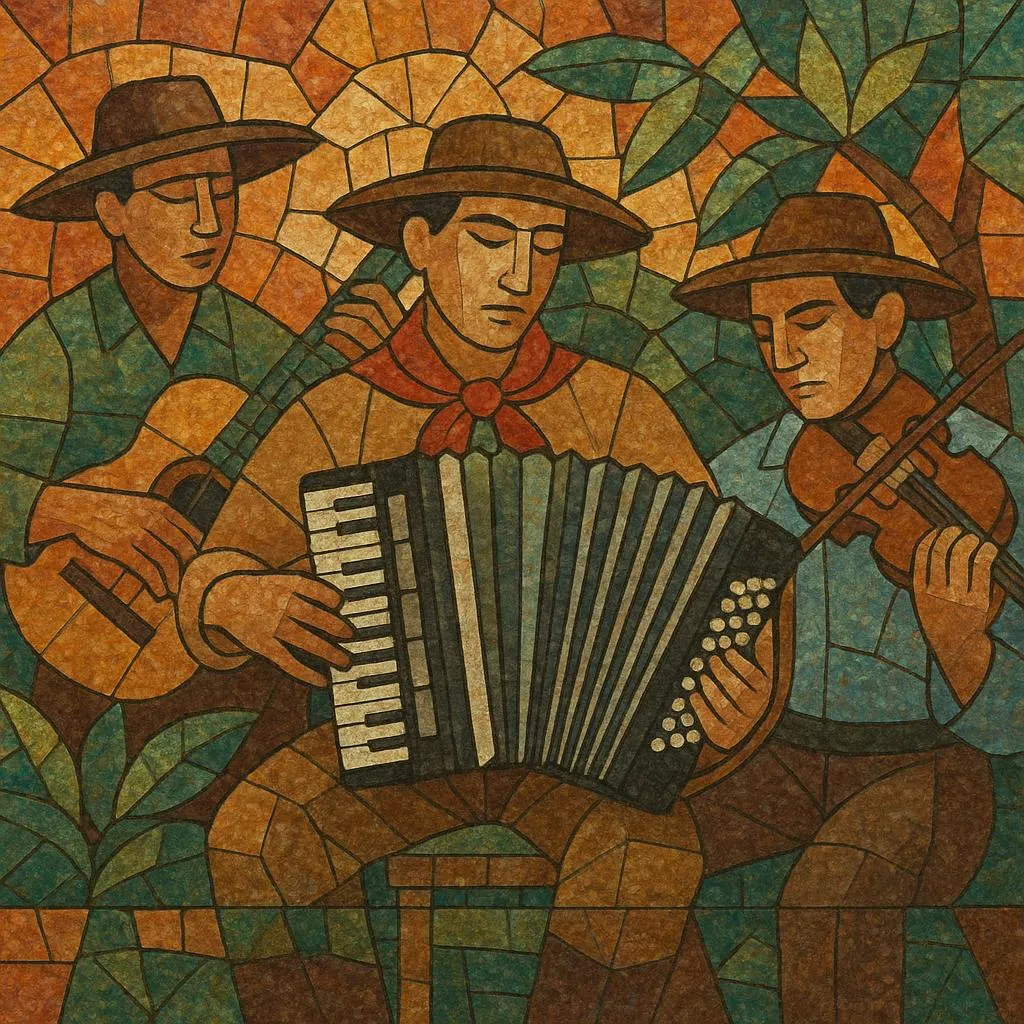
Chamamé brasilero (chamamé brasileiro) is the Brazilian regional take on the chamamé tradition that emerged along the Argentina–Paraguay–Brazil border and took strong root especially in Mato Grosso do Sul and Rio Grande do Sul. While it retains the core dance pulse and accordion-led melodies of the Corrientes chamamé, the Brazilian variant emphasizes local timbres such as the diatonic button accordion (gaita-ponto) and blends seamlessly with gaucho festival circuits and borderland repertoire.
As with the broader chamamé culture, its musical DNA bears Guarani and Jesuit-barroque elements filtered through European couple dances (notably polka) and later popular instrumentation (accordion, guitar, violin). In Brazil it became emblematic enough that Campo Grande (MS) was legally titled Brazil’s “Capital Nacional do Chamamé” in 2022, while UNESCO inscribed chamamé itself on the Representative List of the Intangible Cultural Heritage of Humanity in 2020.
History
Chamamé began in Corrientes (Argentina), mixing Guarani musical practices and mission-era baroque with European couple dances (schottische/polka) and the accordion and guitar; by the early 20th century it was already recorded and named as such.
Through border circulation, the style flourished in southern and center‑western Brazil, notably Rio Grande do Sul and Mato Grosso do Sul. Migration tied to the yerba‑mate cycle and ranch work helped spread records and dance repertoires; in MS the genre’s popularity surged after the 1950s.
A distinctive MS performance school formed around accordionists such as Zé Corrêa ("Rei do Chamamé") and, later, Dino Rocha; local players codified the “estilo duetado” (a two‑hand accordion approach) within instrumental chamamé practice in Campo Grande.
In Rio Grande do Sul, chamamé entered nativist/gaucho circuits and the repertoire of gaita‑ponto virtuosos—e.g., Renato Borghetti and Luiz Carlos Borges—and of Argentine‑born masters who settled in Brazil, such as Lúcio Yanel; seven‑string guitarist Yamandu Costa also helped project a Brazilian chamamé language internationally. Contemporary groups like Yangos recorded the album “Chamamé,” earning a Latin Grammy nomination and strengthening a modern, instrumental reading of the style.
Brazil formalized its chamamé hubs and memory: Campo Grande received the federal title of Capital Nacional do Chamamé in 2022, and Mato Grosso do Sul registered chamamé as state intangible cultural heritage in 2021. At the supranational level, UNESCO recognized chamamé in 2020, underscoring its transboundary cultural sphere spanning Argentina, Paraguay, Uruguay, and Brazil.
Write for a lilting ternary groove (often 6/8 felt against 3/4 hemiolas), with a danceable sway that alternates between smooth, legato phrases and accented off‑beats. Keep tempos in a moderate dance range; use rubato only as ornamental lead‑in or cadential flourish.
Lead with accordion—preferably diatonic gaita‑ponto in the southern (gaúcho) approach—or piano accordion/bandoneon in border settings; double or answer phrases with 6‑ or 7‑string guitar, and enrich with violin or double bass. In Mato Grosso do Sul, explore the “estilo duetado” technique (independent right‑hand melody with left‑hand counter‑voice/ostinato) to evoke the local instrumental school.
Favor diatonic major/minor with occasional modal color (borrowed II or V/V; parallel minor turns). Melodies are singable, often periodized in 8‑bar phrases with call‑and‑response between accordion and guitar; ornament with mordents, grace‑notes, and glissandi on bellows changes.
Common forms are binary (A–B) with reprises or A–B–A. For dance repertoire, maintain clear cadences and 2–3 thematic cycles; instrumental interludes can modulate by step to lift the floor energy. In ensemble contexts (quartet/quintet), alternate unison riffs and counter‑lines to emulate the bandoneon–guitar dialog of the border tradition.
When songs are used, write in Portuguese with Guarani loanwords and toponyms; themes include frontier life, ranching, river/forest imagery, love and longing—aligning with gaucho and pantaneiro imaginaries. Keep stanzaic verses with refrains suitable for chotis‑style partner dancing.



