Your digging level
Description
Çerkes müzikleri (Circassian music) refers to the traditional and modern musical practices of the Adyghe/Circassian peoples of the Northwest Caucasus and their large diaspora, especially in Turkey.
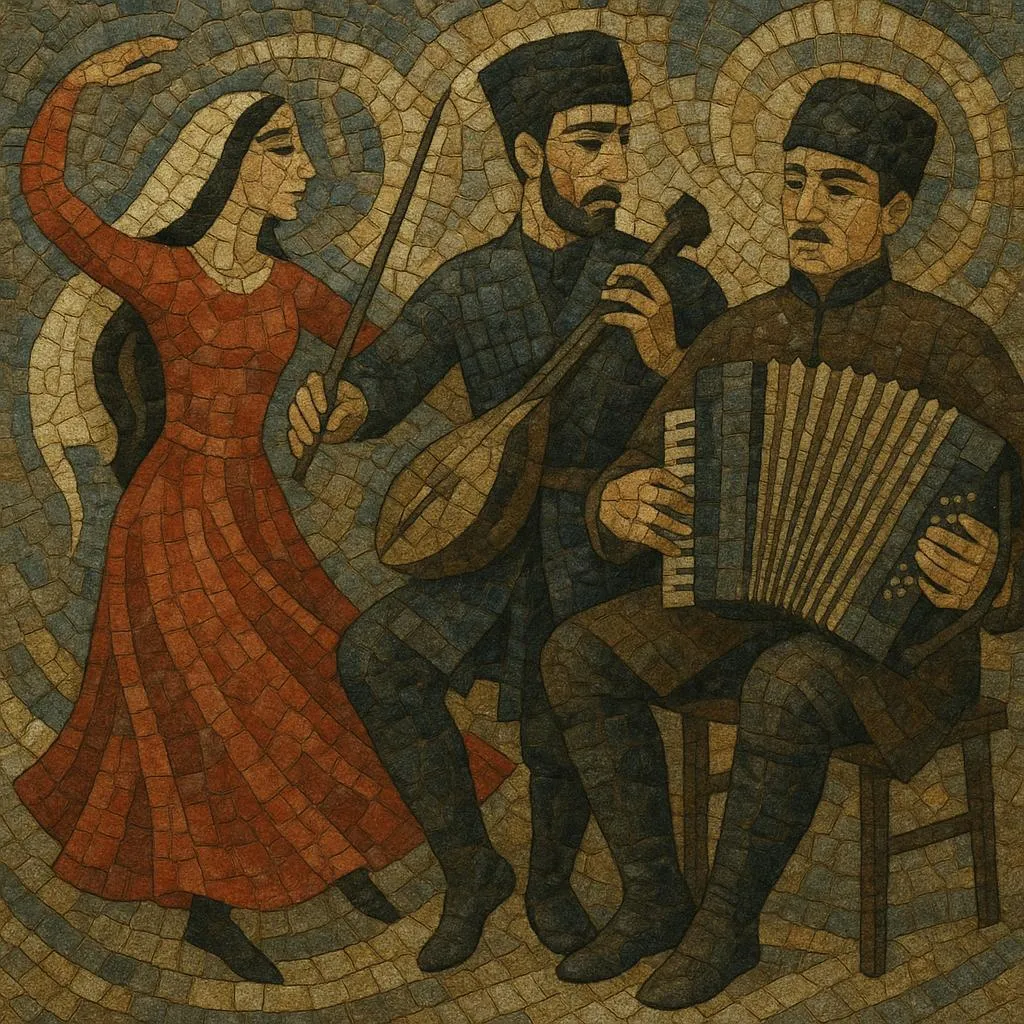
Its core is dance- and ritual-centered: swift, noble couple dances such as Qafe (Kafe) and shared pan‑Caucasian forms like Lezginka are performed to driving ostinati and asymmetric meters. Signature instruments include the shichepshin (a bowed spike-fiddle used for lyrical, ornamented melodies), pkhachich (wooden clappers that supply the crisp beat), and, from the 19th–20th centuries, the garmon/accordion (Adyghe: pşine), which became the principal dance accompanist. Vocals appear as solo laments, toasts, and narrative songs (often in Adyghe/Kabardian), with melodic modes close to natural/harmonic minor and Dorian and a strong taste for modal cadences and ornamental turns.
In diaspora settings (Ottoman/Turkish, Jordanian, Syrian), Circassian music retained core dance identities while absorbing timbres and forms from surrounding traditions. Today it spans village ensembles, state folk orchestras, and studio-produced folk-pop that preserves the dance grammar and characteristic rhythmic lift.
History
Circassian musical practice is centuries old, embedded in communal life cycles—weddings, feats of horsemanship, and the ethics of Adyghe Xabze (customary code). Core genres were dance suites (with fast and dignified sections), epic storytelling related to the Nart sagas, and praise or lament songs. Instruments such as the shichepshin (bowed fiddle) and pkhachich (wooden clappers) anchored the traditional sound.
In the mid‑1800s, war and forced displacement culminated in a vast Circassian diaspora, especially to the Ottoman Empire (modern Turkey, also Jordan and Syria). This movement transplanted the music-making to new locales. The garmon/accordion (pşine) spread widely in the Caucasus and diaspora, becoming a primary vehicle for dance accompaniment and helping standardize dance repertoires like Qafe and Lezginka across communities.
In the 20th century within the USSR (Adygea, Kabardino‑Balkaria, Karachay‑Cherkessia), conservatory-trained arrangers and state folk ensembles (with expanded orchestration, choral parts, and staged choreography) codified and popularized Circassian music. While urbanization brought Western instruments (clarinet, violin, guitar), the music retained its dance metrics, modal tendencies, and call‑and‑response structures.
Post‑1991 cultural revival, digital recording, and diaspora networking revitalized local and global scenes. Contemporary artists craft polished folk-pop and neo‑traditional instrumentals, while community ensembles continue social dance functions at weddings and festivals. Cross‑border exchange (Turkey–Caucasus–Middle East) sustains shared repertoires and pedagogy, ensuring continuity of the Circassian dance‑music grammar.