Your digging level

For this genre
0/8
🏆
Sign in, then listen to this genre to level up

Description

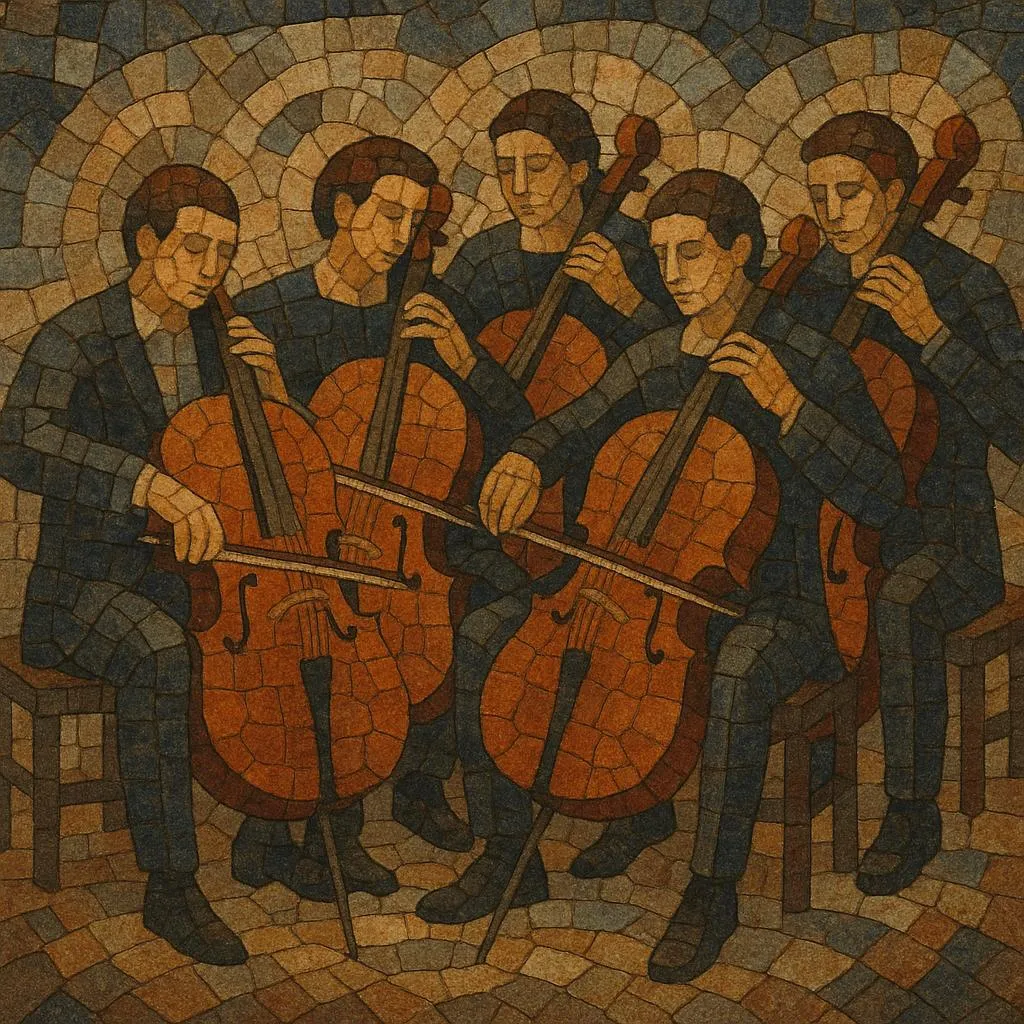
Cello ensemble refers to repertoire and performing groups written for multiple cellos (typically 4–12, and sometimes far more), treating the cello section as a self‑sufficient choir with soprano‑to‑bass roles covered by the instrument’s wide register. The sound palette spans organ‑like chorales, cantabile melodies in tenor/treble clefs, and percussive, guitar‑like textures when using extended techniques.

The idiom coalesced in the early 20th century with Julius Klengel’s Hymnus for 12 cellos (Op. 57), then grew through works such as Villa‑Lobos’s Bachianas Brasileiras Nos. 1 and 5 for at least eight cellos. A major public face of the genre since the 1970s has been dedicated cello‑choir ensembles (e.g., the Twelve Cellists of the Berlin Philharmonic), alongside contemporary octets and crossover groups that commission new music and arrange everything from Baroque to pop and metal.


Sources: Spotify, Wikipedia, Discogs, Rate Your Music, MusicBrainz, and other online sources

History

Early roots (1920s–1940s)
•   1920: Julius Klengel publishes Hymnus for 12 cellos (Op. 57), an iconic, chorale‑style miniature that demonstrated how a full cello choir could function as a complete ensemble; it was famously performed at conductor Arthur Nikisch’s funeral in 1922. •   1930s–1940s: Heitor Villa‑Lobos expands the idiom with Bachianas Brasileiras No. 1 (for at least 8 cellos) and No. 5 (soprano with at least 8 cellos), marrying Bach‑inspired forms with Brazilian melody and rhythm and cementing the concert viability of large cello ensembles.
Institutionalisation (1970s–1990s)
•   1972: Members of the Berlin Philharmonic found The 12 Cellists after a radio production of Klengel’s Hymnus; the group commissions a wide repertoire and tours internationally, becoming the idiom’s best‑known ambassadors. Composers from Pärt and Gubaidulina to Tan Dun and Saariaho contribute works. •   1982: Arvo Pärt completes Fratres in versions for 4, 8, and 12 cellos, emblematic of late‑20th‑century spiritual minimalism entering the cello‑choir medium. •   1983: Aldo Parisot founds the Yale Cellos, a conservatory‑based ensemble that records and tours, helping to institutionalise the format in higher education.
Diversification and crossover (1990s–present)
•   1989→: Cello Octet Amsterdam (formerly Conjunto Ibérico) commissions dozens of premieres (Glass, Pärt, Gubaidulina, Gordon, etc.), proving the octet as a flexible new‑music platform. •   1993→: Finnish cello‑metal quartet Apocalyptica popularises the cello ensemble beyond classical audiences, from Metallica covers to original symphonic metal works, influencing crossover writing and amplification practices for cellos. •   2000s→: Groups like Portland Cello Project (USA) bring the format to clubs and collaborations across hip‑hop, indie and pop; London Cello Sound gathers large cello “orchestras” in the studio; quartets such as the Rastrelli and UK octet Cellophony expand touring and recorded repertoires. •   2012→: Mass participatory projects (e.g., “100 Cellos” led by Giovanni Sollima & Enrico Melozzi) showcase the ensemble’s community and theatrical potential.

How to make a track in this genre

Instrumentation and voicing
•   Typical forces range from quartet (4) to choir (8–12 cellos); larger “cello orchestras” are possible. Assign SATB‑like roles across registers: Cello 1–2 often carry melody in tenor/treble clefs; middle chairs supply inner counterpoint; lower parts sustain pedal tones and harmonic foundations. •   Study reference works: Klengel’s Hymnus (chorale writing for 12 equal voices) and Villa‑Lobos’s Bachianas (contrapuntal textures, vocal/cello pairing).
Texture, harmony, and rhythm
•   Exploit the instrument’s blend: stacked thirds/sixths for organ‑like pads; close‑position clusters sul tasto for a velvety halo; open‑fifth drones or divisi pizzicati for rhythmic underpinning. •   Write antiphonal canons and staggered entries to prevent mud in the low‑mid range; reserve treble‑clef lines for clarity over dense tutti. •   Rhythmic variety helps separation: off‑beat pizzicato ostinati, col legno battuto for percussive drive, and arco/pizz toggling to articulate form.
Idiomatic techniques
•   Use natural/artificial harmonics for bell‑like tintinnabuli sonorities (cf. Pärt’s Fratres in 4/8/12‑cello versions); add sul ponticello/sul tasto color shifts, glissandi and left‑hand pizzicato for contrast. •   Consider occasional voice or soloist overlays (e.g., Bachianas No. 5 soprano + celli) for timbral contrast.
Arranging & crossover practice
•   Orchestrate songs by mapping lead vocals to Cello 1, rhythm guitar/keys to inner voices, and bass to Cello 7–8 with octave doubling; add percussive chops or loop‑like figures for groove (as seen in ensembles like Portland Cello Project and Apocalyptica).
Rehearsal and recording tips
•   Balance is paramount: keep dynamic ceilings lower in inner parts; mark bow distributions to avoid cumulative crescendos. •   In studio/live sound, close‑mic principals for definition and capture a stereo pair for the section blend; add subtle HPF on inner parts to reduce low‑mid buildup.

Top tracks

Locked
Share your favorite track to unlock other users’ top tracks
Influenced by
Has influenced
Challenges
Digger Battle
Let's see who can find the best track in this genre

Download our mobile app

Get the Melodigging app and start digging for new genres on the go
© 2026 Melodigging
Melodding was created as a tribute to Every Noise at Once, which inspired us to help curious minds keep digging into music's ever-evolving genres.
Buy me a coffee for Melodigging