Your digging level
Description
Brill Building pop is a New York–centered style of meticulously crafted pop songcraft that flourished from the late 1950s through the mid‑1960s. It takes its name from the Brill Building at 1619 Broadway (and nearby 1650 Broadway), where teams of professional composers and lyricists wrote hits for a rapidly growing teen market.
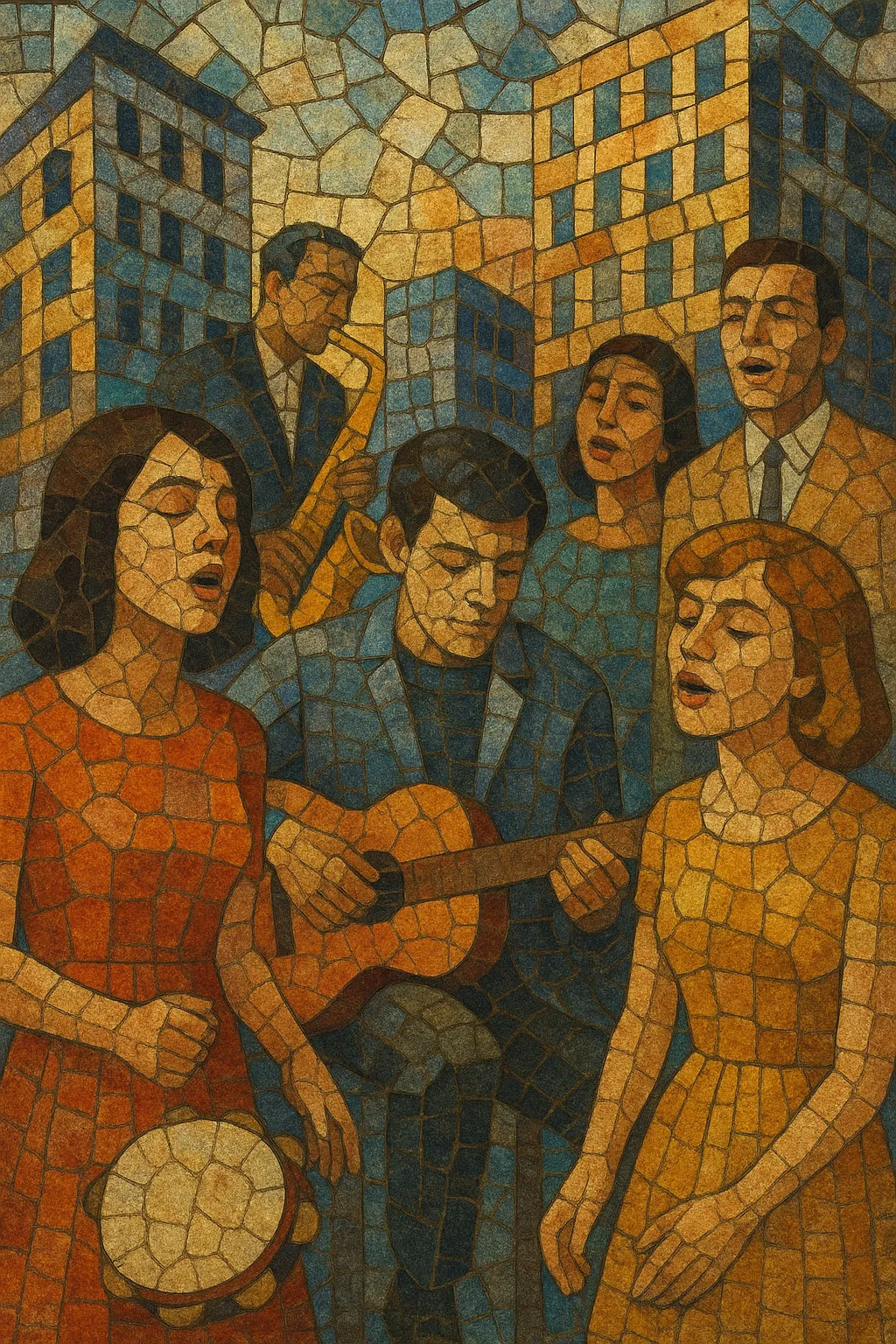
Blending Tin Pan Alley craftsmanship with rhythm and blues energy and early rock and roll verve, the style favors memorable hooks, tight verse–chorus or AABA forms, and succinct storytelling about adolescent love, longing, and everyday drama. Recordings often feature polished arrangements—handclaps, tambourines, strings, saxophones, and backing vocal groups—cut for radio impact and danceability, and frequently delivered by girl groups and smooth vocal ensembles.
History
The Brill Building scene coalesced in Manhattan around 1619 and 1650 Broadway as publishers and producers set up song "factories." Following the Tin Pan Alley model, writers worked in pairs (composer–lyricist) in small rooms with upright pianos, producing songs to order for publishers such as Aldon Music (Don Kirshner and Al Nevins). Early rock and roll’s commercial success opened a new teen market, and the Brill teams refined that energy into radio‑ready pop.
From roughly 1959 to 1964, writer teams like Carole King & Gerry Goffin; Barry Mann & Cynthia Weil; Ellie Greenwich & Jeff Barry; Neil Sedaka & Howard Greenfield; and Doc Pomus & Mort Shuman supplied a torrent of hits for artists including The Shirelles, The Drifters, The Crystals, The Ronettes, and Dionne Warwick. Producers such as Jerry Leiber & Mike Stoller and (often adjacent to the building) Phil Spector shaped a signature sound—concise forms, big hooks, and lush, danceable arrangements—that dominated AM radio.
The British Invasion shifted the industry toward self‑contained bands, reducing demand for publisher‑driven singles. Many Brill writers adapted: Carole King led the 1970s singer‑songwriter movement, while others moved into West Coast pop, film/TV, and adult contemporary. Brill Building pop’s DNA—professionalized hooks, tight structures, and universal teen narratives—directly informed girl group music, bubblegum pop, late‑1960s sunshine pop, 1970s singer‑songwriters, and later waves of teen pop and power pop.