Your digging level

For this genre
0/8
🏆
Sign in, then listen to this genre to level up

Description

Boeremusiek is a predominantly instrumental South African folk-dance style, rooted in house‑party and community dance traditions. Led by concertina or accordion, it favors buoyant two‑steps, polkas, schottisches, waltzes, and the local vastrap, all designed first and foremost for social dancing.

Its sound blends European dance forms brought by settlers (especially from Dutch, German, and British traditions) with local performance practice and repertoire that evolved in rural settings. Typical ensembles combine concertina/accordion, fiddle, guitar/banjo, piano, and bass (or tuba), with a steady, danceable pulse and clear, hummable melodies. While closely associated with Afrikaans rural and working‑class communities—and intertwined with complex socio‑political histories—the music itself functions as convivial dance music and a cultural touchstone of community gatherings.


Sources: Spotify, Wikipedia, Discogs, RYM, MB, user feedback and other online sources

History

Origins (late 19th century–early 20th century)

Boeremusiek grew from the social dance culture of Afrikaans-speaking farming communities, where European couple‑dance forms (polka, waltz, schottische, mazurka, marches) were adapted for local parties and festivals. Portable free‑reed instruments—especially the concertina—became the genre’s emblem, prized for strong melody projection in informal venues.

Consolidation and early recordings (1920s–1950s)

As recording technology reached South Africa, dance bands and concertina-led ensembles documented regional repertoires, standardizing tune types, medleys (keurspel), and characteristic accompaniment patterns. The music circulated on shellac and radio, reinforcing its role at weddings, church bazaars, and community halls.

Dance-hall era, repertoire codification (1960s–1980s)

Through the mid‑20th century, boeremusiek anchored a thriving social dance circuit (langarm/vastrap settings). Bands codified tempos, ensemble formats, and turn‑by‑turn dance sets (seties), keeping the style squarely functional: lively enough to fill the floor, steady enough for intergenerational participation.

Post‑apartheid context and revivals (1990s–present)

After 1994, boeremusiek persisted as heritage dance music and festival fare while also informing adjacent styles (notably sokkie/"sakkie‑sakkie" party dance and Afrikaans country‑leaning productions). Archival reissues, competitions, and community ensembles helped sustain the tradition. Today, the genre continues to symbolize social dancing and local identity, even as its historical associations are debated and reinterpreted.

How to make a track in this genre

Core instrumentation
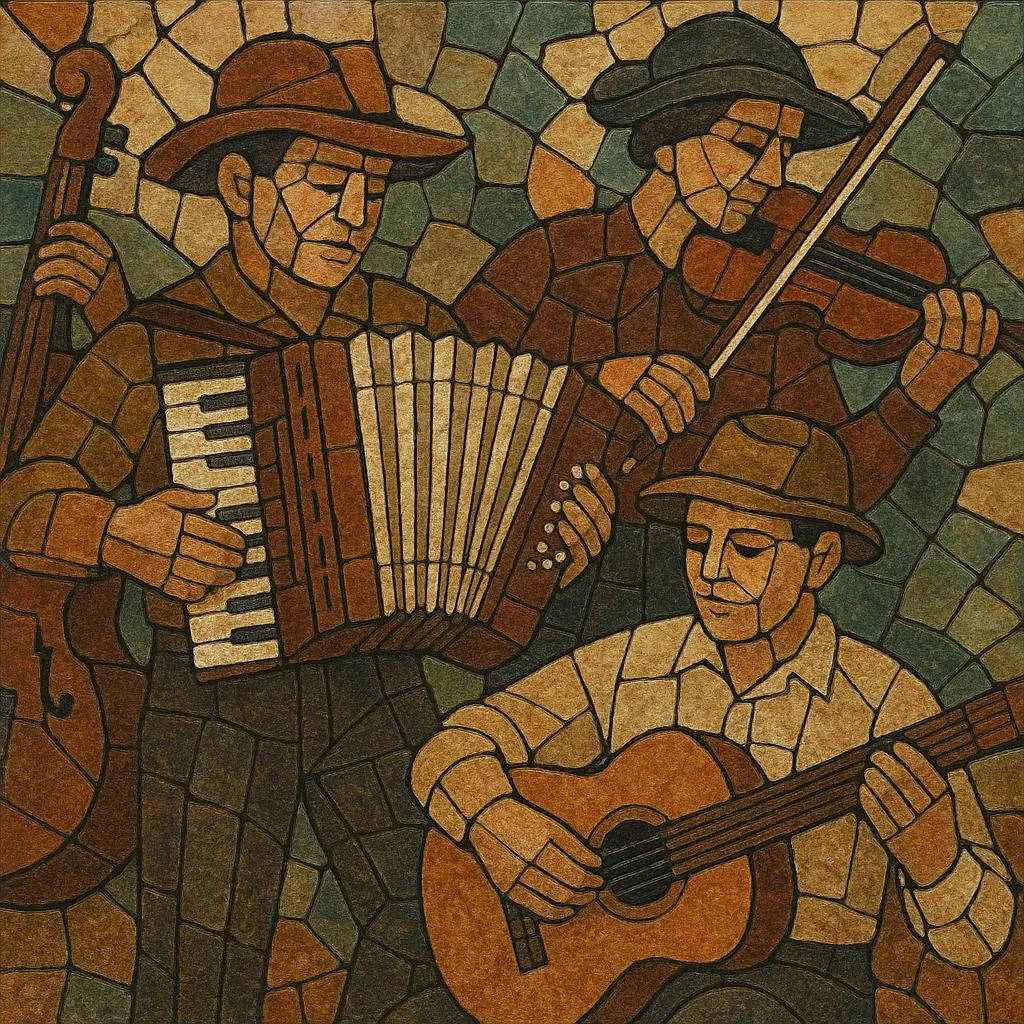
•   Lead: concertina or accordion (the signature voice), often sharing melodies with fiddle. •   Rhythm section: guitar or banjo (strummed two‑beat), piano (oom‑pah or stride‑like left hand), bass/tuba, and light drums/percussion where available.
Rhythm & tempo
•   Vastrap/polka/schottische: usually 2/4, with a clear two‑beat feel (bass on 1, chord on 2), steady and danceable at roughly 110–132 BPM. •   Waltz: 3/4 at a moderate, lilting tempo (≈ 80–100 BPM) with strong beat‑1 emphasis. •   Keep grooves even and grounded; avoid syncopations that disrupt the floor.
Harmony & melody
•   Functional diatonic harmony (I–IV–V, occasional ii and vi). Use simple, singable melodies that outline triads and stepwise motion. •   Phrase shapes in 8‑ or 16‑bar periods (AABB is common), with tidy cadences to cue dancers. •   Add tasteful ornaments (mordents, grace notes, bellows shakes on concertina; slides/doubles on fiddle) without obscuring the beat.
Forms & repertoire
•   Program sets for dancing: alternate tune types (e.g., polka → schottische → waltz), or stitch medleys (keurspel) of related keys. •   Include local standards (vastrap motifs, seties) and arrange them into predictable sequences so dancers know what’s next.
Arrangement & performance tips
•   Balance: keep the lead slightly forward, rhythm section dry and metronomic. •   Dynamics: moderate—enough lift into new sections to energize the floor, but avoid dramatic rubato. •   Intros/outros: short pickups, clear turnarounds, and buttoned endings (often a held tonic or quick tag) to signal set changes. •   Record with minimal processing; a natural, room‑like sound supports the communal dance feel.

Top tracks

Locked
Share your favorite track to unlock other users’ top tracks

Upcoming concerts

in this genre
Influenced by
Has influenced
No genres found

Download our mobile app

Get the Melodigging app and start digging for new genres on the go
© 2026 Melodigging
Melodding was created as a tribute to Every Noise at Once, which inspired us to help curious minds keep digging into music's ever-evolving genres.
Buy me a coffee for Melodigging