Your digging level
Description
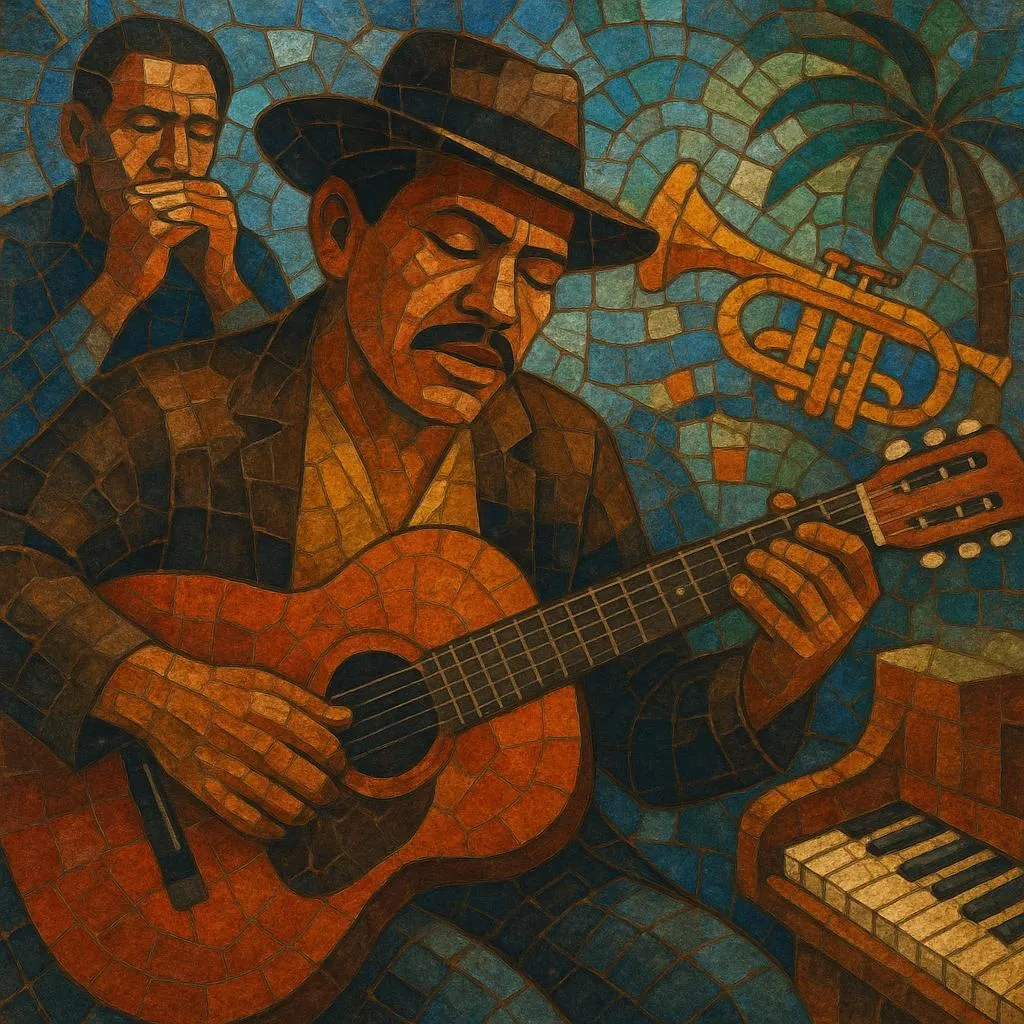
Blues latinoamericano is the adaptation of the African American blues tradition to Spanish- and Portuguese-speaking Latin America, with lyrics, phrasing, and rhythms filtered through local cultures.
It keeps core blues features—12‑bar and 8‑bar forms, blue notes, shuffles, slow blues, and call‑and‑response—while adding regional accents, slang, and occasional fusion with local styles (tango in Argentina, candombe in Uruguay, son and bolero in parts of Mexico and the Caribbean). Electric guitar and harmonica remain central, often joined by Hammond organ, brass, and a more pronounced backbeat or Afro‑Latin groove.
The result is a gritty yet lyrical blues variant that carries the genre’s classic themes—love, work, city life, and social observation—into Latin American streets, bars, and festivals.
History
Argentina became the early focal point for Spanish‑language blues. Inspired by U.S. electric blues and British blues‑rock imports, Buenos Aires musicians began writing blues in their own language and vernacular, setting a precedent for the region. Bands and singer‑guitarists embraced the 12‑bar form but placed it inside an urban porteño context, helping seed what would become a broader Latin American blues identity.
Through the 1970s, Argentine acts popularized a distinctly local take on electric blues with raw guitar tones, walking bass lines, and harmonica. Their success demonstrated that blues could thrive in Spanish, encouraging neighboring scenes. Chile, Uruguay, and Mexico cultivated club circuits and independent labels, while musicians began to fold in traces of local rhythm: candombe colors in Uruguay, hints of tango phrasing in Argentina, and bolero/son inflections further north.
Independent and major labels alike started issuing blues records from Mexico, Chile, and Argentina. Dedicated blues festivals and bar circuits formed, and radio shows helped canonize Spanish‑language blues standards. Cross‑pollination with rock en español created enduring hybrids, and the harmonica‑fronted, guitar‑driven quartet became a regional archetype.
The 21st century saw stable touring networks, international collaborations, and festival stages shared with U.S. and European artists. Many bands now blend shuffle and slow blues with funk, soul, or roots rock, while others lean harder into local rhythms. Archival reissues and documentaries have helped codify a Latin American blues lineage and connect new audiences to the pioneers.
While grounded in African American blues, the Latin American branch forged its identity through language, storytelling, and neighborhood context—singing the blues of Latin American cities, work, migration, and love, with a tone that can swing from streetwise grit to nostalgic tenderness.