Your digging level
Description
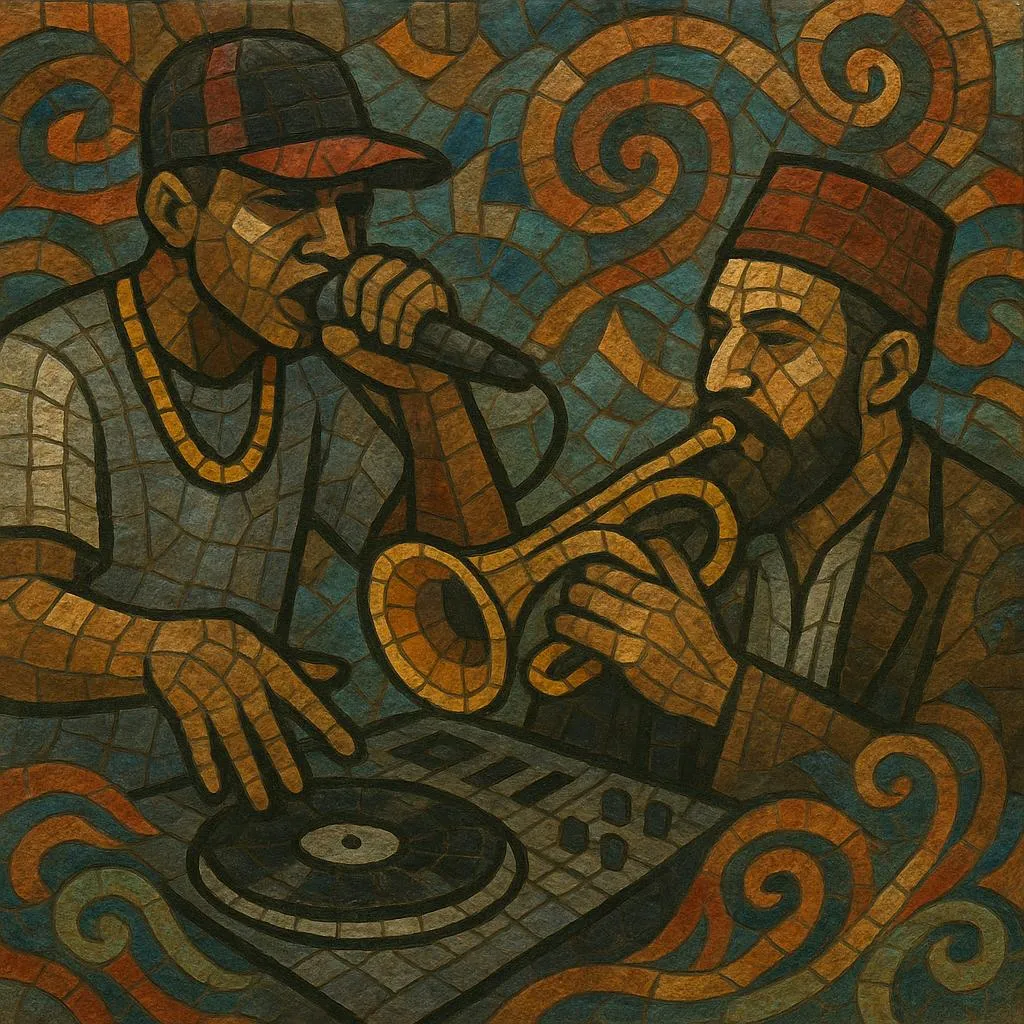
Balkan hip hop is the regional form of hip hop that developed across the countries of the Balkans, fusing classic rap aesthetics with local folk melodies, brass-band energy, and distinctive asymmetrical rhythms (such as 7/8 or 9/8). It keeps the core elements of MCing, DJing/production, and sampling, while embracing instruments and scales familiar to Southeastern Europe.
Lyrically, it mixes street reportage, social satire, and dark humor with post‑transition realities, diaspora identity, and the aftermath of the 1990s. Sonically, you’ll hear boom‑bap and trap palettes alongside Balkan brass stabs, gaida/kaval timbres, and modal flavors (e.g., Hijaz/Phrygian dominant), often reframed as hooks. The result swings between gritty, politically charged storytelling and cathartic, dance‑forward party tracks.
History
Hip hop culture arrived in the Balkans in the late 1980s through breakdance, tapes, and music television, but its first consolidated scenes formed in the 1990s within (and just after) the former Yugoslavia. Crews and MCs adopted American boom‑bap flows and sampling practice, then quickly localized the sound with Balkan melodic and rhythmic signatures. The political and social upheavals of the decade—economic transition, war, and rebuilding—gave the music a reportage function: lyrics centered on urban survival, corruption, and generational change.
In the 2000s, national scenes in Bosnia and Herzegovina, Croatia, Serbia, Slovenia, North Macedonia, Montenegro, Bulgaria, Albania, and Greece forged recognizably local dialects of rap. Producers began to thread Balkan brass, sevdah, turbo‑folk, chalga/manele, and other folk‑pop references into sample banks and hooks. Mixtapes, local labels, and regional festivals built a networked circuit, while diasporic artists further cross‑pollinated the style across Europe.
The 2010s brought trap’s 808 aesthetics, Auto‑Tune, and club‑centric structures, spawning a wave of Balkan trap and drill hybrids that kept the core identity intact: asymmetrical meters, folk‑tinged motifs, and colloquial lyricism. Streaming amplified cross‑border collaborations, and Balkan hip hop now comfortably alternates between protest anthems, storytelling rap, and high‑energy party singles—often in the same artist’s catalog—while remaining a key voice for youth culture across Southeastern Europe.