Your digging level

For this genre
0/8
🏆
Sign in, then listen to this genre to level up

Description

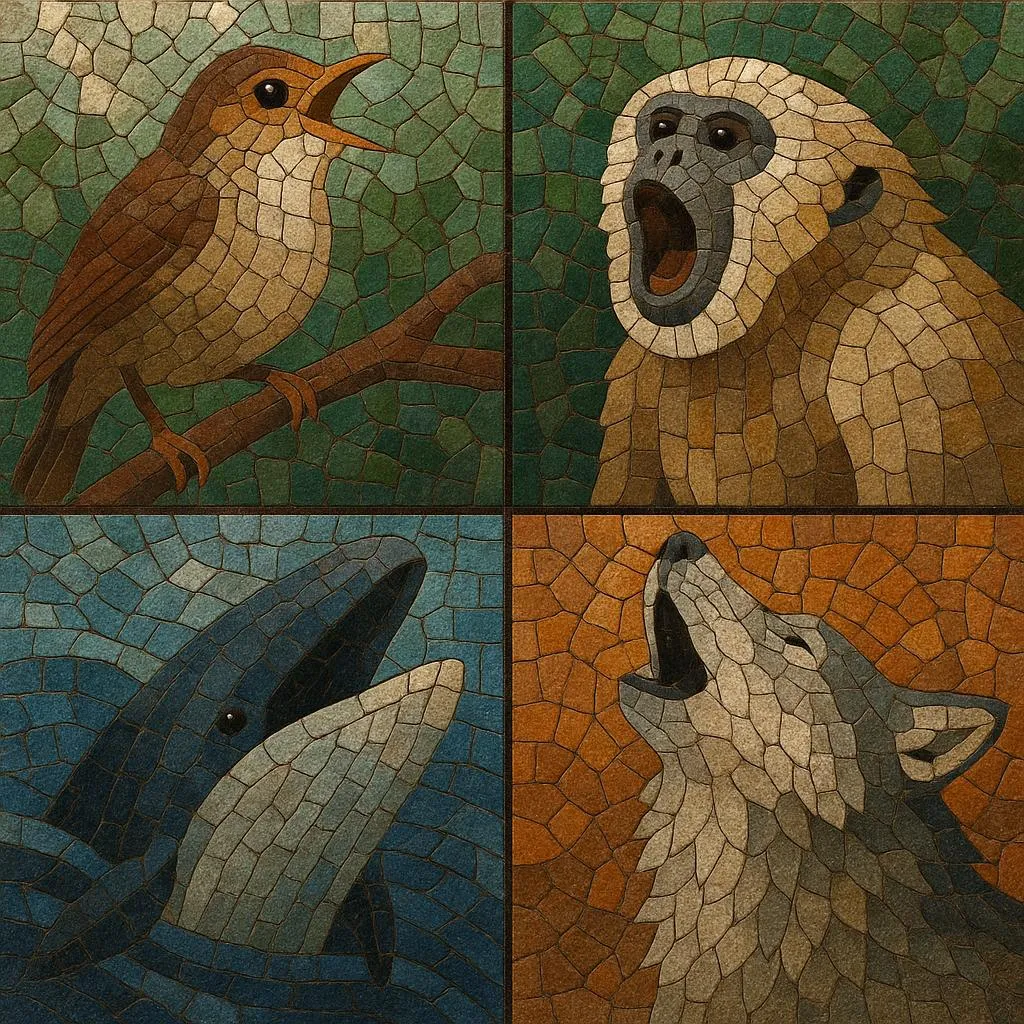
Animal singing is a niche field-recording–driven music genre centered on the melodic, rhythmically patterned vocalizations of non‑human animals (for example, birdsong, whale song, gibbon duets, wolf howls), presented as listening music rather than as documentary audio alone.

Releases typically foreground the animal as the primary "singer," either in unaccompanied, minimally edited form, or interwoven with light human instrumentation, electroacoustic processing, or ambient textures. Whereas the broader category of "animal sounds" includes any fauna noises, animal singing focuses on tonal, phrase‑structured calls that humans readily perceive as musical.

Beyond its aesthetic aims, the genre intersects with bioacoustics and soundscape ecology: recordings can reveal seasonal cycles, habitat health, and species behavior. Albums frequently double as environmental advocacy, inviting slow, attentive listening to voices that predate human music by millions of years.

Sources: Spotify, Wikipedia, Discogs, RYM, MB, user feedback and other online sources

History

Origins (1900s–1930s)
•   The practical birth of animal singing as a listening genre follows the earliest wildlife sound recordings. In the 1900s, German recordist Ludwig Koch issued commercial discs of caged and wild birds, demonstrating that non‑human vocalizations could be compelling in their own right, not merely scientific curios. •   Early shellac technology favored loud, nearfield sources; birds kept near horns (or later microphones) provided feasible material, shaping an initial bias toward avian “singers.”
Tape era and natural history (1940s–1960s)
•   Portable magnetic tape and parabolic microphones enabled cleaner, more distant, habitat‑authentic captures. Broadcasters (notably the BBC) and naturalists curated LPs of “singing birds” framed for home listening. •   Jim Fassett’s mid‑century collage works and curated birdsong records helped listeners hear phrasing, motifs, and counterpoint in animal vocalizations, blurring science and musicality.
Whale‑song wave (1970s)
•   Roger Payne’s “Songs of the Humpback Whale” (1970) became a landmark crossover: long‑form, patterned humpback phrases were presented as extended ‘songs.’ The LP catalyzed conservation sentiment, showed chart viability for non‑human voices, and expanded the genre beyond birds.
Ambient, New Age, and eco‑aesthetics (1980s–1990s)
•   Ambient and New Age movements embraced animal singing for contemplative listening, integrating gentle synths or acoustic drones with minimally processed fauna voices. Bernie Krause articulated the geophony/biophony/anthrophony framework, curating albums that treated whole habitats as orchestras. •   Wildlife labels in Europe, North America, and Oceania issued extensive catalogs (birds, whales, primates, canids), sometimes pairing liner‑note biology with audiophile production.
Digital era, soundscape ecology, and ethics (2000s–present)
•   High‑resolution digital recorders, hydrophones, and array techniques improved fidelity and spatial realism. Artists like Chris Watson elevated the compositional use of unmanipulated animal song within narrative soundscapes. •   Cross‑disciplinary collaborators (e.g., David Rothenberg improvising with birds/whales) explored interspecies performance while debates sharpened around ethical playback, anthropomorphism, and crediting the non‑human ‘performers.’ •   Streaming broadened reach; playlists range from pure animal solos to electroacoustic pieces that respectfully foreground the non‑human lead.

How to make a track in this genre

Fieldwork and preparation
•   Choose a species and season when songs are most active (e.g., dawn chorus for passerines; breeding season for whales, gibbons, or wolves). Scout locations to minimize anthropogenic noise (roads, aircraft, HVAC). •   Obtain permits where required and follow local wildlife guidelines; keep a respectful distance and avoid playback that could disturb territorial or breeding behavior.
Microphones and rigs
•   Birds/terrestrial: parabolic dish with a small‑diaphragm mic for focused pickup, or ORTF/AB stereo for habitat context; wind protection is essential. •   Marine: hydrophones with low self‑noise and appropriate impedance matching; monitor sea state and boat noise. •   Power/recorders: 24‑bit recorders with low‑noise preamps; carry ample batteries, desiccants, and redundant storage.
Recording practice
•   Roll long takes to capture full phrase cycles. Note coordinates, time, weather, species ID, and behavior in a log; photograph habitats for liner notes. •   Use mic discipline: no handling noise, body shadows on parabolas, or clothing rustle; monitor with closed headphones.
Musical integration
•   Treat the animal as the lead vocalist. If adding instruments, match register, timbre, and phrasing (e.g., clarinet with thrush, bowed strings with whale moans). Keep human layers sparse; leave air for the call‑and‑response of multiple individuals. •   For electroacoustic settings, favor gentle processes (EQ to reveal harmonics, subtle time‑expansion to expose micro‑motifs, light convolution reverb that reflects real spaces). Avoid heavy pitch‑correction that masks species identity.
Harmony, rhythm, and form
•   Derive pitch sets from the animal’s partials; modal drones or pedal tones can frame non‑equal‑tempered intervals without forcing them into 12‑TET. •   Build form around behavioral cycles: strophe/antistrophe of countersinging males, dawn‑to‑noon habitat arcs, or full whale song themes and variations. •   Rhythmic backing (if any) should mirror natural periodicities (e.g., repetitive wing‑beat rustle, surf wash) rather than metronomic grids.
Editing, mastering, and credits
•   Sequence for ecological continuity; avoid jarring crossfades across habitat types. Use spectral repair sparingly to preserve authenticity. •   Master conservatively to retain dynamic range; loudness wars flatten micro‑detail crucial to identification and immersion. •   Credit species, recordists, locations, dates, and equipment. Include ethical statements (no baiting/playback), and—where appropriate—donate proceeds to conservation.
Performance options
•   In concert, project spectrograms in real time; alternate solo animal sections with responsive human improvisation. For installations, use multichannel diffusion to recreate habitat spatial cues.

Top tracks

Locked
Share your favorite track to unlock other users’ top tracks

Upcoming concerts

in this genre
Influenced by
Has influenced

Download our mobile app

Get the Melodigging app and start digging for new genres on the go
© 2026 Melodigging
Melodding was created as a tribute to Every Noise at Once, which inspired us to help curious minds keep digging into music's ever-evolving genres.
Buy me a coffee for Melodigging