Genres
Artists
Albums
Make Music
Sign in
Sign in
Artists
Barockinterpreten
Artists
Barockinterpreten
Berliner Barock Compagney
1994
·
1 album
Listen
2
/5
Genres
Barockinterpreten
Barockinterpreten (German for “Baroque interpreters”) is a performer-focused category within Western classical that centers on historically informed performances (HIP) of 17th–18th century Baroque repertoire. It emphasizes period instruments, historical tunings, and style-sensitive articulation and ornamentation. Typical recordings feature smaller, agile ensembles, vivid rhythmic profiles (often derived from courtly dances), and continuo-led textures. Tempi, articulation, and dynamics aim for rhetorical clarity, with vibrato treated as an expressive ornament rather than a constant. The result is an energetic, transparent, and dance-inflected sound that contrasts with the heavier, Romantic-influenced Baroque of the mid-20th century mainstream.
Discover
Listen
Baroque Violin
Baroque violin refers both to the instrument in its Baroque setup and to the repertory and performance practice for violin from roughly 1600–1750. Typical instruments use gut strings, a lighter bass bar, a shorter/shallower neck angle, and no chin- or shoulder-rest. They are paired with a Baroque bow, whose camber and weight distribution encourage speech‑like articulation, sprung strokes, and a clear attack/decay. Pitch is commonly at A≈415 Hz (varying by region), and temperaments may be circulating or meantone rather than modern equal temperament. Stylistically, Baroque violin playing emphasizes rhetorical phrasing (the "Doctrine of Affections"), ornamental vibrato (used as a coloristic embellishment rather than a constant), extempore ornamentation, and expressive bowing. The music lives in sonatas (da chiesa/da camera), dance suites, concerti (including the concerto grosso), and theatrical or sacred contexts, nearly always underpinned by basso continuo.
Discover
Listen
Bohemian Baroque
Bohemian Baroque refers to Baroque-era music cultivated in the historical lands of Bohemia and Moravia (today the Czech Republic). It flourished in courts, cathedral chapels, Jesuit colleges, and pilgrimage churches during the 17th and early 18th centuries. Stylistically, it blends Italianate concertato writing and the stylus phantasticus with the contrapuntal rigor of Central Europe. It emphasizes basso continuo, expressive rhetoric, chromatic inflection, and brilliant writing for strings and natural trumpets, while also preserving a rich vernacular hymn tradition (kancionál) in Czech. The repertoire spans masses, litanies, motets, sonatas, sacred cantatas, and devotional songs, ranging from monumental polychoral works to intimate pieces for voice and continuo. Its sound world is at once ceremonial and devotional, often marked by festive trumpets for feast days and poignant chromaticism in penitential movements.
Discover
Listen
Albums
1994
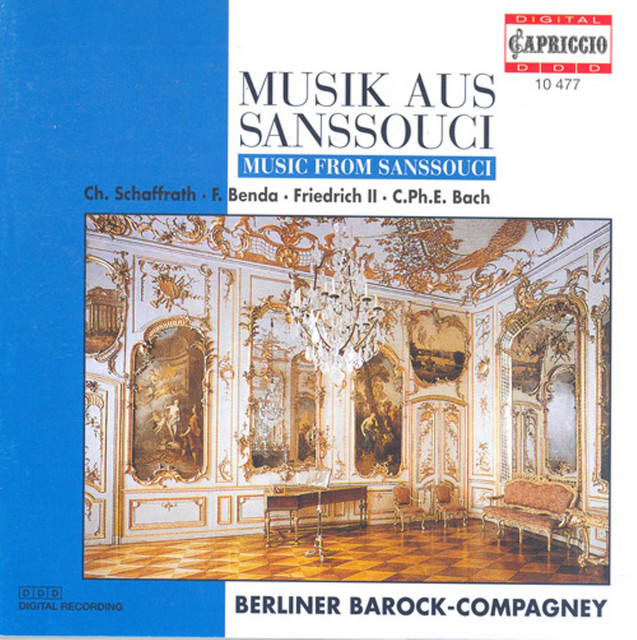
Chamber Music (Baroque) - Frederick Iii / Schaffrath, C. / Bach, C.P.E. / Benda, F. / Janitsch, J.G. (Music From Sansso…
Berliner Barock Compagney
Baroque Violin
Bohemian Baroque
Barockinterpreten
Download our mobile app
Get the Melodigging app and start digging for new genres on the go
Download on the App Store
Get it on Google Play
© 2026 Melodigging
Give feedback
Legal
Melodding was created as a tribute to
Every Noise at Once
, which inspired us to help curious minds keep digging into music's ever-evolving genres.