Genres
Make Music
Artists
Albums
Challenges
Sign in
Sign in
Albums
By Brian Eno
Albums
By Brian Eno
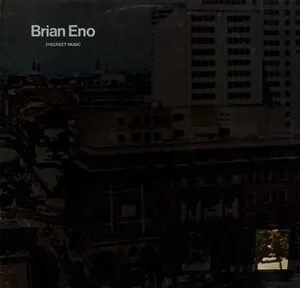
Discreet Music
December 5, 1975
Listen
2
/5
Genres
Ambient
Ambient is a form of electronic and electroacoustic music that prioritizes tone, atmosphere, and texture over conventional song structures and rhythmic drive. It typically features slow-moving harmonies, sustained drones, gentle timbral shifts, and extensive use of space and silence. Rather than drawing attention to itself through hooks or beats, ambient is designed to be as ignorable as it is interesting, rewarding both background listening and focused immersion. Artists often employ synthesizers, samplers, tape loops, field recordings, and subtle acoustic instruments, with reverb and delay creating a sense of place. Substyles range from luminous, consonant soundscapes to darker, more dissonant atmospheres.
Discover
Listen
Process Music
Process music is a movement in which a composition is generated by a clearly defined procedure or rule-set. Sometimes this procedure is made audible—so the listener can follow the gradual changes as they unfold—and sometimes the process remains hidden behind the surface of the sound. Typical processes include phasing (two identical patterns drifting out of sync), additive or subtractive procedures (expanding or contracting a pattern by fixed steps), iterative feedback (repeating an operation so the output becomes the next input), permutations, stochastic or probabilistic rules, or instruction-based performance systems. The aesthetic ranges from hypnotic and pulse-driven to fragile and static, but the core idea remains: the music arises from the process.
Discover
Listen
Rock
Rock is a broad family of popular music centered on amplified instruments, a strong backbeat, and song forms that foreground riffs, choruses, and anthemic hooks. Emerging from mid‑20th‑century American styles like rhythm & blues, country, and gospel-inflected rock and roll, rock quickly expanded in scope—absorbing folk, blues, and psychedelic ideas—while shaping global youth culture. Core sonic markers include electric guitar (often overdriven), electric bass, drum kit emphasizing beats 2 and 4, and emotive lead vocals. Rock songs commonly use verse–chorus structures, blues-derived harmony, and memorable melodic motifs, ranging from intimate ballads to high‑energy, stadium‑sized performances.
Discover
Listen
Classical
Classical music is the notated art-music tradition of Europe and its global descendants, characterized by durable forms, carefully codified harmony and counterpoint, and a literate score-based practice. The term “classical” can refer broadly to the entire Western art-music lineage from the Medieval era to today, not just the Classical period (c. 1750s–1820s). It privileges long-form structures (such as symphonies, sonatas, concertos, masses, and operas), functional or modal harmony, thematic development, and timbral nuance across ensembles ranging from solo instruments to full orchestras and choirs. Across centuries, the style evolved from chant and modal polyphony to tonal harmony, and later to post-tonal idioms, while maintaining a shared emphasis on written notation, performance practice, and craft.
Discover
Listen
Similar albums
2009
Feliu i Joan Albert
Feliu i Joan Albert
2013
Intense
Armin van Buuren
2023
Everywhere at the End of Time: Stage 1
The Caretaker
1986
Reality in Love ひとつぶの海
Toshifumi Hinata 日向敏文
1977
Low
David Bowie
2001
'80s Pop Hits
Europe
2002
Treasure Planet
John Rzeznik
2017
BoJack Horseman (Music from the Netflix Original Series)
Nina Simone
2014
Illumination: Peaceful Gregorian Chants
Dan Gibson & Daniel May
2005
Takk...
Sigur Rós
Download our mobile app
Get the Melodigging app and start digging for new genres on the go
Download on the App Store
Get it on Google Play
© 2026 Melodigging
Give feedback
Legal
Melodding was created as a tribute to
Every Noise at Once
, which inspired us to help curious minds keep digging into music's ever-evolving genres.