Genres
Make Music
Artists
Albums
Challenges
Sign in
Sign in
Albums
By Laurie Sucher
Albums
By Laurie Sucher
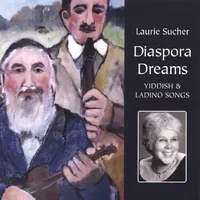
Diaspora Dreams : Yiddish & Ladino Songs
January 1, 2002
Listen
1
/5
Genres
Yiddish Folksong
Yiddish folksong is the vernacular vocal tradition of Ashkenazi Jews, sung in the Yiddish language and rooted in the everyday life of Eastern and Central Europe. It encompasses lullabies, love songs, wedding and dance tunes, work and street songs, humorous couplets, and political or devotional pieces. Musically it blends Jewish modal practice with Slavic and Central European folk idioms. Typical features include minor tonalities, modal scales such as Freygish (Ahava Rabbah/Phrygian dominant) and Misheberakh (often akin to Ukrainian Dorian), flexible rhythms with parlando-rubato phrasing, and expressive ornaments (krekhtsn “sob-like” grace notes and kvetch “bent” tones). While often sung unaccompanied, performances frequently use small ensembles—violin, clarinet, tsimbl (hammered dulcimer), accordion, and later guitar or piano—drawing on the neighboring klezmer dance tradition. The repertoire carries the social memory of the shtetl, urban immigrant life, and the labor movement, and it survived through oral transmission, community songbooks, and later field recordings and stage interpretations.
Discover
Listen
Ladino Folksong
Ladino folksong is the secular song tradition of the Sephardic Jews, sung in Judeo‑Spanish (Ladino/Djudeo‑Espanyol) that preserves medieval Iberian Spanish alongside Hebrew and regional loanwords. The repertoire includes romances (narrative ballads), kantikas (lyric songs), coplas (strophic songs), lullabies, wedding and life‑cycle songs. Musically, it blends medieval Iberian balladry with modal aesthetics and rhythms absorbed across the Sephardic diaspora in the Ottoman Balkans, Anatolia, North Africa, and the Eastern Mediterranean. Typical modes include Hijaz/Phrygian‑dominant and Nahawand (harmonic minor), with ornamented melodies and flexible intonation that may reflect local makam practice. Rhythms often use asymmetric meters (9/8, 7/8) alongside simple duple/triple. Traditional accompaniment features oud, qanun, violin, guitar, darbuka/frame drum, and sometimes accordion; historically many songs were transmitted a cappella, especially in women’s domestic and communal contexts.
Discover
Listen
Similar albums
1986
Songs in Yiddish and Ladino
Jacqueline Reisel & Grietje Meter
2005
Romances séfardies: Noches (Sephardic Songs)
Françoise Atlan
2008
The Unternationale / Унтернационал / דער ארנטערנאַציאָנאַל
Daniel Kahn & Psoy Korolenko & Oy Division
1960
Jewish Folk Songs of Europe
Raasche
2007
Música i cants sefardís d'Orient i Occident
Aman Aman
2017
היא הופיעה כמו הרוח
Berry Sakharof ברי סחרוף / Ehud Banai אהוד בנאי
1994
Margaritkalach
Chava Alberstein חוה אלברשטיין
1958
Theodore Bikel Sings Jewish Folk Songs
Theodore Bikel
2022
In Love and In Struggle: The Musical Legacy of the Jewish Labor Bund
Zalmen Mlotek
2023
The Bulding and Other Songs
Daniel Kahn & Jake Shulman-Ment
Download our mobile app
Get the Melodigging app and start digging for new genres on the go
Download on the App Store
Get it on Google Play
© 2026 Melodigging
Give feedback
Legal
Melodding was created as a tribute to
Every Noise at Once
, which inspired us to help curious minds keep digging into music's ever-evolving genres.