Genres
Make Music
Artists
Albums
Challenges
Sign in
Sign in
Albums
By Ryoji Ikeda
Albums
By Ryoji Ikeda
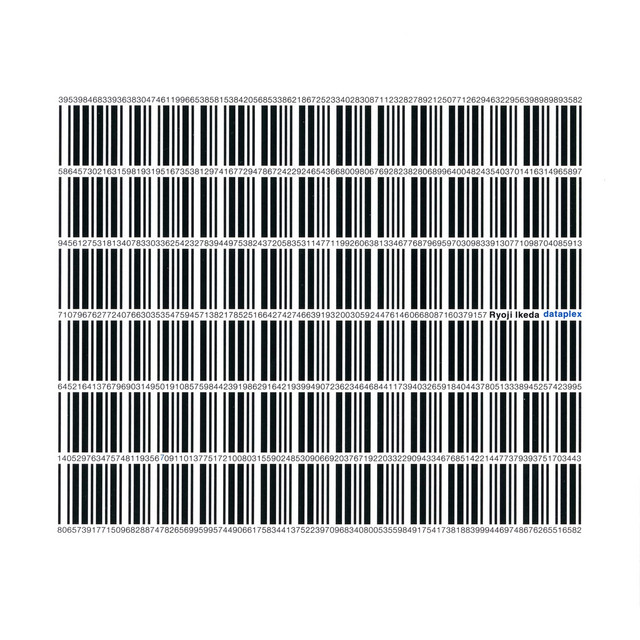
Dataplex
December 10, 2005
Listen
2
/5
Genres
Data Sonification
Data sonification is a practice and genre in which numerical or categorical datasets are mapped to sound so that patterns in the data are perceived as musical structure. It differs from simple parameter automation by letting the data itself determine pitch, rhythm, dynamics, timbre, and spatial behavior through clearly defined mappings. Works range from direct audification of scientific signals (e.g., seismic or astronomical measurements) to carefully designed parameter mappings and model-based approaches that translate complex, multivariate datasets into layered sonic textures. Because it sits at the intersection of art, science, and design, data sonification is used both for aesthetic expression and for communicating or revealing structure in data that might be hard to see visually.
Discover
Listen
Microsound
Microsound is an experimental electronic music aesthetic that focuses on sound at extremely small time scales, often in the range of milliseconds. Rather than developing melodies and rhythms in the conventional sense, it foregrounds the grain, texture, and morphology of audio—clicks, cuts, sine blips, static, and near-silent filigree—arranged with surgical precision. Heavily shaped by digital signal processing and granular/spectral techniques, microsound treats errors, residual noise, and computational artifacts as musical material. The results are sparse, highly dynamic soundfields that emphasize detail, negative space, and the sensation of listening under a microscope. The style sits at the intersection of glitch, ambient, electroacoustic composition, and minimalism, and it is frequently associated with labels and artists who advanced “post-digital” aesthetics in the late 1990s and early 2000s.
Discover
Listen
Glitch
Glitch is an experimental electronic music genre that foregrounds the sounds of technological error—digital clicks, pops, clipping, buffer underruns, CD skipping, software crashes, and bit‑reduction. Rather than hiding artifacts, producers use them as primary musical material, often arranged through extreme micro‑editing and non‑linear sequencing. Texturally, glitch spans austere minimalism to warm, hazy ambience. Rhythms tend to be fragmented and asymmetrical, with sudden cuts, stutters, and silences that create tension and negative space. The palette commonly includes sine‑tone grains, granular clouds, filtered noise, and hyper‑detailed percussive fragments, sometimes sitting over subdued drones or dub‑inflected low end. The style emerged in the late 1990s around labels such as Mille Plateaux, influenced by IDM, minimal techno, and the aesthetics of failure in digital media. It later permeated pop and beat‑driven styles through sound‑design techniques that evoke imperfection and transience.
Discover
Listen
Similar albums
2022
Ultratronics
Ryoji Ikeda
2004
Chessa
Shuttle358
1996
+/-
Ryoji Ikeda
1998
0°C
Ryoji Ikeda
2022
hypochondriac
brakence
2023
i care so much that i dont care at all
glaive
2025
Y'all
glaive
2023
10,000 gecs
100 gecs
2009
From Rotting Fantasylands
Nero's Day at Disneyland
2021
Haunted
food house, food house, 100 gecs, Brady, Dylan, 100 gecs, Bixby, 100 gecs, Char…
Download our mobile app
Get the Melodigging app and start digging for new genres on the go
Download on the App Store
Get it on Google Play
© 2026 Melodigging
Give feedback
Legal
Melodding was created as a tribute to
Every Noise at Once
, which inspired us to help curious minds keep digging into music's ever-evolving genres.