Genres
Artists
Albums
Make Music
Sign in
Sign in
Record label
Rondeau Production
Germany
Related genres
Baroque
Baroque is a period and style of Western art music spanning roughly 1600–1750. It is characterized by the birth of functional tonality, the widespread use of basso continuo (figured bass), and a love of contrast—between soloist and ensemble, loud and soft, and different timbres. Hallmark genres and forms of the era include opera, cantata, oratorio, concerto (especially the concerto grosso), dance suite, sonata, and fugue. Textures range from expressive monody to intricate counterpoint, and melodies are richly ornamented with trills, mordents, and appoggiaturas. Baroque music flourished in churches, courts, and theaters across Europe, with regional styles (Italian, French, German, English) shaping distinctive approaches to rhythm, dance, harmony, and ornamentation.
Discover
Listen
Christmas Music
Christmas music is a body of sacred and secular repertoire associated with the celebration of Christmas and the winter season. It spans medieval carols, liturgical hymns, and oratorios through to 20th‑century Tin Pan Alley standards, crooner ballads, jazz‑swing arrangements, pop hits, gospel renditions, and contemporary acoustic or R&B interpretations. Stylistically it is diverse but often shares warm, nostalgic melodies, memorable choruses, and lyrics that reference the Nativity story, peace and goodwill, family gatherings, winter imagery, and figures like Santa Claus. Sleigh bells, choirs, strings, brass, and glockenspiel/celesta are common coloristic touches, while harmony ranges from simple I–IV–V progressions to richer jazz voicings. Its seasonal recurrence has made it a cultural tradition that reappears annually across radio, streaming, film, advertising, and public spaces.
Discover
Listen
Classical
Classical music is the notated art-music tradition of Europe and its global descendants, characterized by durable forms, carefully codified harmony and counterpoint, and a literate score-based practice. The term “classical” can refer broadly to the entire Western art-music lineage from the Medieval era to today, not just the Classical period (c. 1750s–1820s). It privileges long-form structures (such as symphonies, sonatas, concertos, masses, and operas), functional or modal harmony, thematic development, and timbral nuance across ensembles ranging from solo instruments to full orchestras and choirs. Across centuries, the style evolved from chant and modal polyphony to tonal harmony, and later to post-tonal idioms, while maintaining a shared emphasis on written notation, performance practice, and craft.
Discover
Listen
Western Classical
Western classical is the notated art-music tradition that developed in Europe from medieval Christian chant into the large-scale secular and sacred forms of the Baroque, Classical, Romantic, and modern eras. It is characterized by staff notation, evolving systems of modality and tonality, and forms such as symphony, sonata, concerto, mass, opera, and chamber music. Across its history, Western classical established an extensive theory of harmony and counterpoint, refined orchestration across strings, winds, brass, and percussion, and cultivated performance practices from a cappella chant to full symphonic and operatic forces. Its repertoire, pedagogy, and institutions (conservatories, orchestras, opera houses) made it a global reference point for compositional craft and instrumental technique.
Discover
Listen
Choral
Choral refers to music written for and performed by a choir—an ensemble of voices organized into sections such as soprano, alto, tenor, and bass (SATB), or same-voice groupings (SSA, TTBB). It encompasses both sacred and secular repertoire and may be sung a cappella or with accompaniment by organ, piano, or full orchestra. Stylistically, choral music ranges from chant-like monophony to intricate polyphony and rich homophonic textures. Texts are drawn from liturgy, scripture, poetry, and vernacular sources, and are set in many languages. Performance contexts include church services, concert halls, and community events, making choral one of the most socially embedded and widely practiced forms of ensemble music. Across history, choral music has served as a laboratory for vocal counterpoint, word painting, and text-driven form, while functioning as a cultural bridge among religious rites, national traditions, and contemporary concert practice.
Discover
Listen
Albums
Embrace: Songs by Hensel, Liszt, Ullmann, Grieg
Fanny Mendelssohn, Franz Liszt, Viktor Ullmann, Edvard Grieg; Äneas Humm, Renat…
Klangvoll
Psycho-Chor der FSU Jena e.V.
Carmina Burana
Carl Orff; Heidi Elisabeth Meier, Jean-Sébastien Stengel, Stefan Adam, NDR Radi…
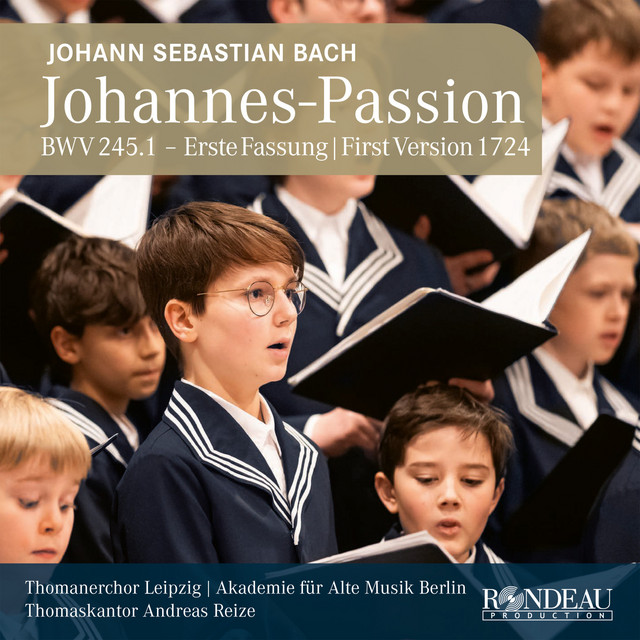
Johannes-Passion / St John Passion BWV 245.1 (1724)
Johann Sebastian Bach; Thomanerchor Leipzig, Andreas Reize, Akademie für Alte M…
Duke Ellington Sacred Concerts
Duke Ellington
Concerti per l’Organo
Johann Sebastian Bach, George Frideric Handel, Carl Philipp Emanuel Bach; Lucas…
Abendgebet für Schabbat Leipzig 1928
Leipziger Synagogalchor, Philipp Goldmann, Assaf Levitin & Ivo Mrvelj
Libertas
Ludwig van Beethoven, Franz Schubert, Amy Beach, Joseph Marx; Äneas Humm, Doria…
Chormusik im 20. Jahrhundert
Strawinsky, Pärt, Reger, Kodály, Müller, Strohbach, Vogt, Gunsenheimer, Wolf; W…
Kantaten BWV 19, 50, 79, 80
Johann Sebastian Bach; Thomanerchor Leipzig, Gewandhausorchester, Georg Christo…
Show more
Artists
Ludwig van Beethoven
Wolfgang Amadeus Mozart
Benjamin Britten
Duke Ellington
Johann Sebastian Bach
George Frideric Handel
Franz Schubert
Carl Philipp Emanuel Bach
Joseph Haydn
Gewandhausorchester
Franz Liszt
Edvard Grieg
Akademie für Alte Musik Berlin
Luigi Cherubini
Johann Christian Bach
Heinrich Schütz
Michael Praetorius
Arvo Pärt
Fanny Mendelssohn
Felix Mendelssohn
Igor Stravinsky
Richard Strauss
César Franck
Carl Orff
Barbara Schlick
Alban Berg
Peter Schreier
Deutsches Symphonie-Orchester Berlin
Ingeborg Danz
Thomanerchor Leipzig
Dorothee Mields
Christine Schäfer
Tobias Berndt
Knabenchor Hannover
Zoltán Kodály
NDR Radiophilharmonie
Hille Perl
Teresa Żylis-Gara
Mathias Mönius
Windsbacher Knabenchor
Markus Schäfer
Various Artists
Franz Crass
Max Reger
Hugo Wolf
Amy Beach
Stephen Varcoe
Ensemble S
Claudia Barainsky
Elisabeth von Magnus
Paul Elliott
Harald Weiss
Joseph Marx
Johann Rosenmüller
Thomas Quasthoff
Viktor Ullmann
amarcord
Judit Polgar
London Brass
Viva Voce
Otto Sander
Friedrich Kiel
Gotthold Schwarz
Dresdner Barockorchester
Andreas Hammerschmidt
Deutsche Kammerakademie Neuss am Rhein
Tilman Lichdi
Catalina Bertucci
Marcus Ullmann
Karl-Friedrich Beringer
Hans Thamm
Sebastian Noack
Sirius VIOLS
Äneas Humm
Daniel Ochoa
Oue, Eiji
Renate Rohlfing
Psycho-Chor der FSU Jena e.V.
Heidi Elisabeth Meier
Jean-Sébastien Stengel
Stefan Adam
Andreas Reize
David Fischer
Matteo de Bastiani
Leopold Görsch
Jannes Arndt
Carlos Voß
Ha Dong Lee
Robert Pohlers
Konrad Führer
Lucas Pohle
Leipziger Synagogalchor
Philipp Goldmann
Assaf Levitin
Ivo Mrvelj
Doriana Tchakarova
Müller
Strohbach
Vogt
Gunsenheimer
Georg Christoph Biller
Paul Gerhardt
Schwesternhochfünf
Matthias Neumann
Klaus Haffke
Collegium Musicum des WDR
Kammerchor Hochschule für Musik Franz Liszt Weimar
Jürgen Puschbeck
ensemberlino vocale
Sua Baek
Matthias Stoffels
Denkmalchor
La Capella
Reussisches Kammerorchester
Kammerchor der Frauenkirche Dresden
Matthias Grünert
J.S. Bach
Ensemble Frauenkirche
Johann Rosenmüller Ensemble
Barockorchester L'Arco
Jörg Breiding
Andreas Karasiak
Ingeborg Russ
Himlische Cantorey
Christine Wolff
Martin Petzold
Bach Consort Leipzig
Bremer Lautten Chor
Deutsche Kammer-Virtuosen Berlin
Doerthe Maria Sandmann
Sebastian Bluth
Tobias Scharfenberger
Mädchenchor Hannover
Ensemble Vocapella Limburg
Tristan Meister
Britta Schwarz
Hanna Zumsande
Geneviève Tschumi
Wolfram Lattke
Thomas Laske
Tobias Hunger
Philipp Meierhöfer
Fortissimo
Martina Mayer
Wuppertaler Kurrende
Collegium Vocale Hannover
Florian Lohmann
Birgit Bachhuber
Gudrun Schröfel
Download our mobile app
Get the Melodigging app and start digging for new genres on the go
Download on the App Store
Get it on Google Play
© 2026 Melodigging
Give feedback
Legal
Melodding was created as a tribute to
Every Noise at Once
, which inspired us to help curious minds keep digging into music's ever-evolving genres.