
Description
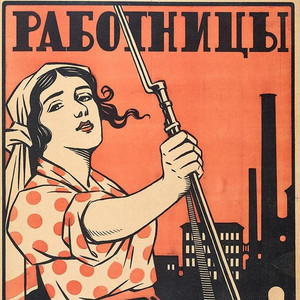
Socialist realism is a broad artistic movement rather than a narrowly defined musical genre. In music, it generally favors accessible, tuneful writing, a conservative style and motifs drawn from traditional folk music. Its guiding ideals call for art that is understandable to workers, depicts typical life and supports the aims of Marxist-Leninist parties and states.
A characteristic form is the Soviet mass song: a semi-popular song designed for choruses or crowds, often with simple melodies and lyrics and alternating four-line stanzas and refrains. Individual works could differ, but direct communication and collective participation were important ideals.
Based on: Rate Your Music
History
Formation and institutions
Socialist realism developed in Russia, drawing on nineteenth-century Russian realism and Marxist-Leninist philosophy. It was formally named and established as an artistic doctrine in the Soviet Union during the 1930s. The Union of Soviet Composers, founded in 1932, regulated composers; Tikhon Khrennikov and Dmitri Kabalevsky were prominent advocates of the style.
Artistic conflict
Although adherence to the style was compulsory, it was contested. Dmitri Shostakovich, Sergei Prokofiev and Aram Khachaturian pushed against censorship and tested the style’s limits. They drew criticism from Soviet authorities as well as from Khrennikov and Kabalevsky.
International spread and later use
After the Second World War, Eastern Bloc states broadly followed Soviet guidance in music. Composers associated with the movement included Hanns Eisler in East Germany, Matei Socor in Romania and Jan Kapr in Czechoslovakia. Chinese red songs, revolutionary opera, Korean revolutionary opera and Vietnamese nhạc đỏ also grew out of the movement.
Restrictions on the arts and adherence to socialist realism loosened under Nikita Khrushchev, although the style continued in government media. Its official use declined in Eastern Bloc states from the late 1960s until perestroika, but it continued in various capacities elsewhere.
Start with a direct melody
Write a clear, memorable tune that can be grasped readily by a group of singers. Keep the melodic and verbal ideas straightforward, and consider using a motif inspired by traditional folk music. Favor an accessible, stylistically conservative sound over elaborate musical complexity.
Build a collective song
For a mass-song approach, alternate four-line stanzas with a recurring refrain. Shape the refrain so a chorus or crowd can sing it together, and let repetition reinforce its main musical idea.
Shape the subject and arrangement
The movement’s stated ideals emphasize typical life, communication with workers and support for Marxist-Leninist political aims. You could express those themes through plain, concrete lyrics and a strong collective voice. As a practical arrangement choice, begin with the melody and voices, then add an accompaniment that supports the words without obscuring them.



Best playlists


Influenced by

Has influenced