Your digging level
Description
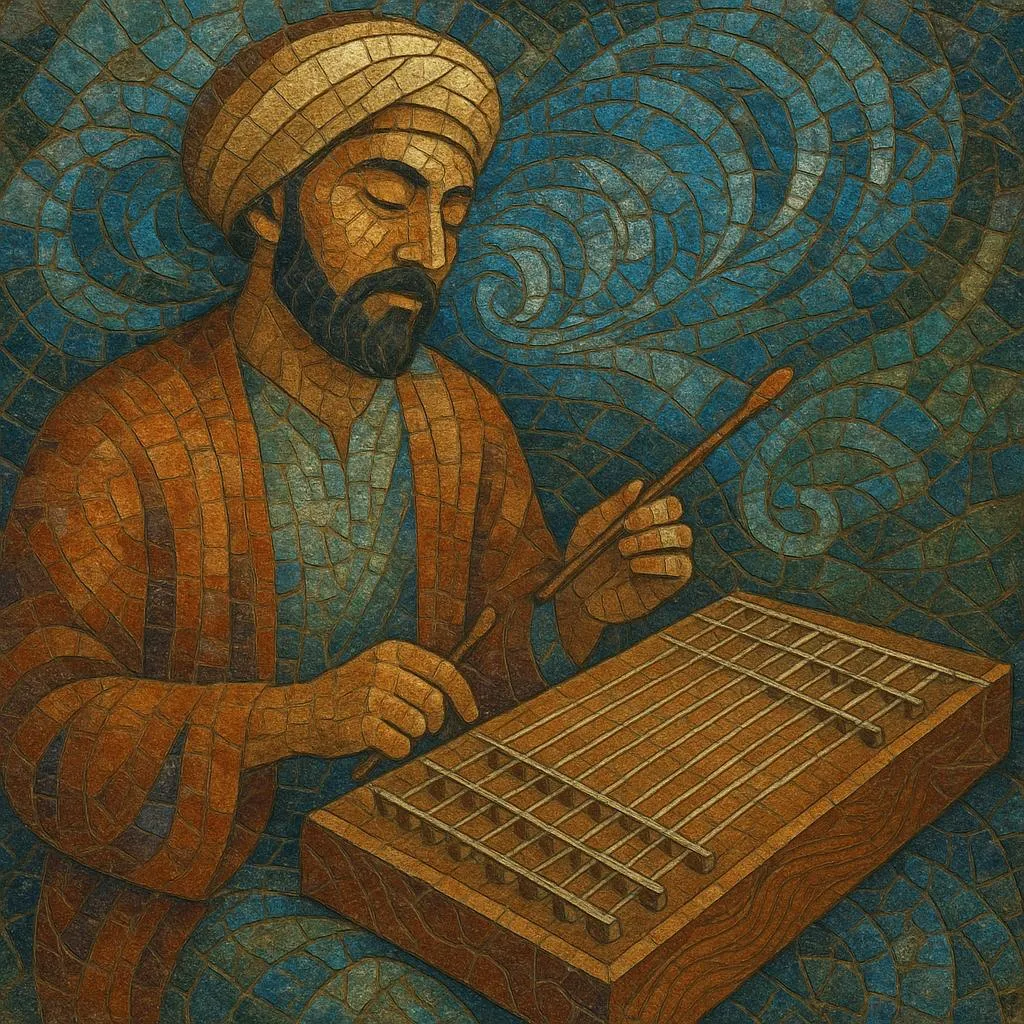
Santoor music centers around the santoor, a trapezoid-shaped hammered dulcimer made of walnut wood, originally from the Kashmir valley.
It is characterized by its ethereal, resonant, and water-like sound quality, produced by striking strings with lightweight wooden mallets called 'kalams' or 'mezrabs'.
Traditionally an accompanying instrument in Kashmiri Sufiana Mausiqi, it was adapted for Hindustani classical solo performance, featuring complex melodic improvisations (alap), rhythmic compositions (gat), and the unique use of gliding techniques (meend) to mimic the human voice.
History
The santoor's lineage is often traced back to the 'Shata-tantri Veena' (hundred-stringed lute) mentioned in ancient Sanskrit texts like the Rigveda, though its direct ancestor is the Persian Santur.
It was introduced to the Kashmir Valley from Persia around the 14th century, where it became a staple of 'Sufiana Mausiqi' (Sufi music), used primarily to accompany choral singing in a spiritual context. For centuries, it remained a folk instrument restricted to this region.
In the mid-20th century, Pandit Shivkumar Sharma pioneered the transformation of the santoor from a folk accompaniment to a solo classical instrument. He modified the instrument's structure by increasing the number of bridges and strings to improve its tonal range and sustain. Most significantly, he developed a playing technique that allowed for 'meend' (gliding notes), a prerequisite for Hindustani classical music, thereby establishing the santoor as a major genre on the global stage.
Composing or performing santoor music requires a deep understanding of Raga (melodic framework) and Tala (rhythm cycle).
The instrument typically has 100 strings stretched over 25 to 31 bridges. It is tuned diatonically to the specific Raga being performed. The player sits in a cross-legged posture (Ardha-Padmasana) with the instrument on their lap.
Sound is produced by striking the strings with a pair of curved wooden mallets (kalams) held between the index and middle fingers and the thumb. The right hand usually plays the melody while the left hand provides rhythmic support or resonance.
A performance generally begins with the 'Alap', a slow, rhythmic-free improvisation exploring the Raga's notes. This is followed by the 'Jod' and 'Jhala', introducing a pulse and increasing tempo. Finally, the 'Gat' (fixed composition) is played with Tabla accompaniment, featuring intricate rhythmic interplay and rapid melodic runs.