Your digging level
Description
Pontian folk is the traditional music of the Pontic Greeks, an ethnocultural community that historically lived along the southern coast of the Black Sea (the Pontus region, in present‑day northeastern Turkey) and later in the Caucasus and Greece. It is sung predominantly in the Pontic Greek dialect and is closely tied to dance, ritual, and communal storytelling.
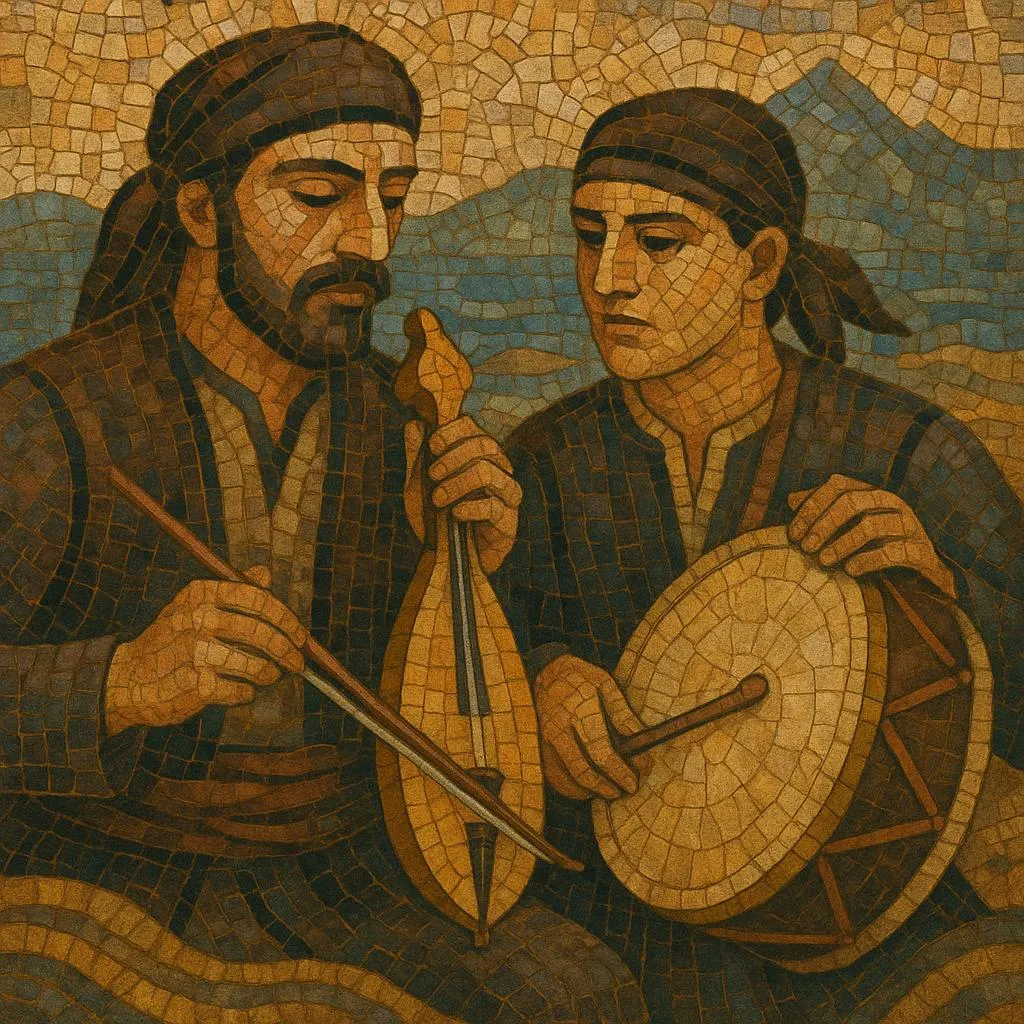
At its core is the Pontic lyra (kemençe), a small bowed fiddle whose tense, cutting tone leads line‑driven melodies and dance figures. Rhythms follow the steps and shapes of iconic dances such as Omal, Tik, Kotsari, and Serra, with meters ranging from even duple to asymmetric 5/8 and 7/8. Melodic language mixes Greek folk modality with Byzantine chant aesthetics and regional makam (modal) inflections, producing scales and turns that feel both ancient and immediate. Supporting instruments can include daouli (double‑headed drum), zurna, tulum (Black Sea bagpipe), lute family instruments, and voice in responsorial or solo strophic forms.
Themes often turn on memory and displacement—love, migration, sea and mountain landscapes, heroic histories—and the genre’s sound alternates between ecstatic dance energy and piercing, nostalgic lyricism.
History
Pontian folk crystallized in the late Byzantine and early Ottoman periods among Greek communities of the Pontus (Black Sea) region. The emblematic instrument, the Pontic lyra (kemençe), appears in medieval sources and became a principal vehicle for dance‑led social music, weddings, and seasonal festivities. Melodic practice reflects a meeting of Byzantine chant contour, local Caucasian and Anatolian patterns, and modal thinking akin to nearby makam traditions.
The repertoire’s close bond with dance shaped both rhythm and form. Set dances such as Omal (often in 2/4), Tik (commonly in 5/8), Kotsari (2/4 or 5/8 variants), and the dramatic Serra (typically 7/8 subdivided 3+2+2) encode community identity. The Pontic lyra carries the melody with expressive slides and ornaments, supported by percussion (daouli), and, in some locales, zurna or tulum. Songs are typically strophic, with improvisatory preludes (taksim‑like) and refrains that invite collective singing.
The early 20th century brought forced migration and resettlement of Pontic Greeks, particularly to mainland Greece and later to global diasporas (e.g., Europe, the Americas, Australia). This upheaval intensified the music’s role as a keeper of memory and identity. Recording technology and urban Pontic associations helped codify a shared repertoire; regional variants from the Black Sea littoral and Caucasus were documented and taught in cultural clubs and dance troupes.
Since the late 20th century, Pontian folk has experienced strong revivalism in Greece and abroad. Festival circuits, cultural societies, and conservatory‑style teaching have professionalized performance while sustaining community participation. Contemporary artists expand the palette—pairing lyra with guitar, piano, or strings; integrating Byzantine choral textures; or fusing Pontic rhythms and modes with rock, jazz, and world‑fusion settings—while preserving the genre’s dance foundations and Pontic‑Greek lyrical identity.
Choose the meter to match the dance:
•Omal: steady 2/4 with gentle lift and smooth phrasing.
•Tik (and Tik diplon): asymmetric 5/8 (often 2+3 or 3+2), tight and incisive bowing.
•Kotsari: 2/4 or 5/8 variants with accented off‑beats for the steps.
•Serra: 7/8 (3+2+2), driving and dramatic; emphasize the first subdivision.
•Keep tempi danceable; let percussion mark the step accents; use brief rubato only in introductions or interludes.