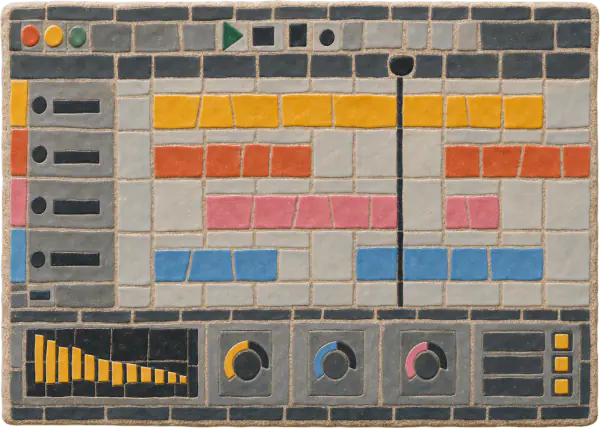
Description
The New York school was a community of avant-garde composers and performers based in New York in the early to mid-1950s, rather than a single musical style. Centered on John Cage, its members worked in contemporary classical and experimental music, questioning established ideas about what a composition could be.
Their approaches included graphic notation, open forms, chance procedures, indeterminacy and modified instruments. The scene was also connected to New York’s abstract expressionist art world and drew inspiration from the work of Henry Cowell and Edgard Varèse.
Its members did not agree on every approach: Christian Wolff and Earle Brown gave performers considerable freedom and emphasized improvisation, while Cage and Morton Feldman criticized that flexibility.
Sources: Rate Your Music
History
Formation
The scene developed in New York around John Cage. In 1949, Cage met Morton Feldman at a performance of Anton Webern’s Symphony, beginning a friendship that influenced both composers. Cage helped Feldman develop graphic notation, while Feldman’s experiments with notation helped prompt Cage’s work with chance.
A circle of composers and performers
Christian Wolff and Earle Brown joined the circle in the early 1950s after meeting Cage. Their interest in improvisation and performer freedom distinguished their work from that of Cage and Feldman, who were critical of those aspects. Pianist David Tudor was also a fundamental member: his playing made it possible to perform the scene’s often demanding works.
Dispersal and legacy
The school came apart in the mid-1950s as its members’ aims changed and Cage and Tudor moved away from New York. Its ideas nevertheless reached beyond the original circle: European avant-garde composers later incorporated chance and graphic notation into their work, and the scene also inspired the Fluxus art movement.
Start with an open musical question
Work within an experimental or contemporary classical setting, but treat the piece as an investigation into how a composition is made and performed. You could decide which elements to specify precisely and which to leave open to chance or interpretation.
Design the notation and form
Try a graphic score in which shapes, positions or other visual relationships guide the performer without prescribing every note. Alternatively, use an open form that lets the performer choose how passages are ordered or connected. Make the intended degree of freedom clear in the instructions.
Explore performance and sound
Consider modifying an instrument to change its sound, or write a demanding part that asks the performer to explore unfamiliar techniques. If improvisation is central, give the player a set of materials or constraints rather than a fully fixed sequence. These are different possible approaches in the spirit of the scene, not a recipe for a uniform style.