

Your digging level
Description
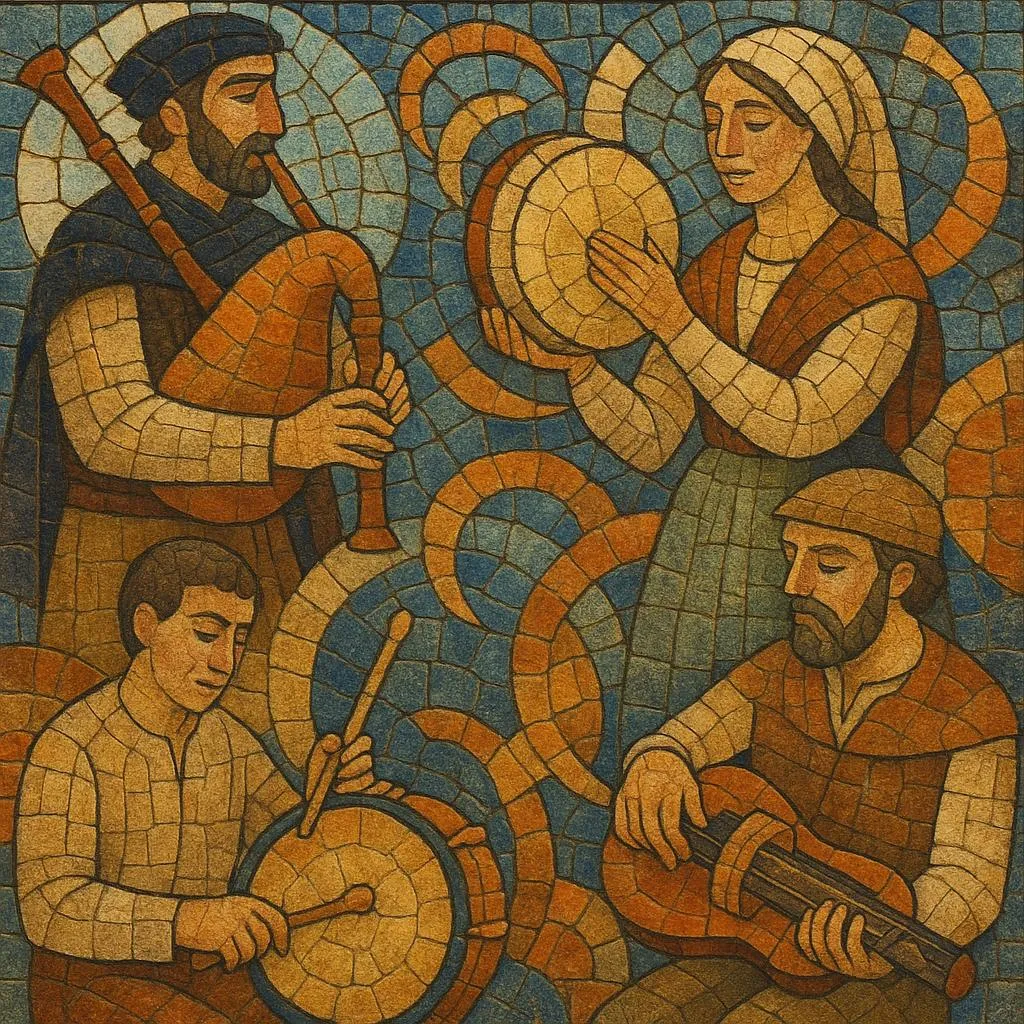
Galicia’s music refers to the traditional and contemporary practices of the north‑west of the Iberian Peninsula, where Atlantic “Celtic” sonorities meet Iberian song and dance. Core timbres include the gaita (Galician bagpipe), pandeireta (Galician tambourine), bombo and tamboril (bass and side drums), zanfona (hurdy‑gurdy), and the small transverse flute called requinta. Signature forms range from the free‑flowing, chant‑like alalá to lively communal dances such as the muiñeira (typically in 6/8) and festive alboradas and foliadas.
Although its roots are older, the first large notated corpus in the region’s medieval Galician‑Portuguese language appears in the 13th‑century Cantigas de Santa Maria. In modern times, a folk revival beginning in the 1970s (and peaking in the 1990s) professionalized bands and soloists and projected Galician music internationally.
History
The earliest extensive written repertoire connected to Galicia is the 13th‑century Cantigas de Santa Maria, a vast collection of monophonic songs in Galician‑Portuguese compiled at the court of Alfonso X. While devotional, the Cantigas document melodic contours, instruments, and a prestige for Galician language and song, situating Galicia within a broader medieval network of sacred and courtly practice.
Across the rural centuries, vocal genres (notably the free, chant‑like alalá) coexisted with dance tunes led by the gaita. Canonical social forms include the muiñeira (sprightly, commonly in 6/8), alborada (dawn piece in simple meter), and foliada (evening gathering with communal singing and dancing). Their modal flavors and drones link Galicia to both the Iberian and Atlantic “Celtic” spheres.
Galician ensembles traditionally center on the gaita with bombo and tamboril, complemented by zanfona, requinta and—crucially—pandeireta, performed by female pandeireteiras/cantareiras whose voice‑and‑tambourine repertories preserved oral poetry and dance rhythms. This gendered custodianship of repertory has been publicly recognized in recent years.
Bagpipes flourished through the 19th century, dipped in the early 20th, and resurged during the late‑Franco era and Spain’s transition to democracy. From the 1970s, fieldwork, luthiers, schools, and new bands catalyzed a “roots revival,” which broadened into international touring and cross‑Atlantic collaborations through the 1990s and beyond.
Since the 1980s, ensembles such as Milladoiro and Luar na Lubre, and soloists like Carlos Núñez, have connected Galicia’s sound to the global Celtic circuit; newer projects fuse tradition with electronics and popular styles, and pandeireteira ensembles have re‑entered center stage.

