

Your digging level
Description
Music of Andorra encompasses the traditional and contemporary musical life of the Catalan-speaking microstate in the central Pyrenees. Its folk core is closely tied to Catalan and broader Iberian traditions, with village dances such as the contrapàs and the ritual marratxa preserved most vividly in Sant Julià de Lòria, the contrapàs in Andorra la Vella, and Saint Anne’s dance in Escaldes-Engordany. The sardana, emblematic of Catalan identity, also appears in Andorra and reflects the close cultural continuum across the Pyrenees.
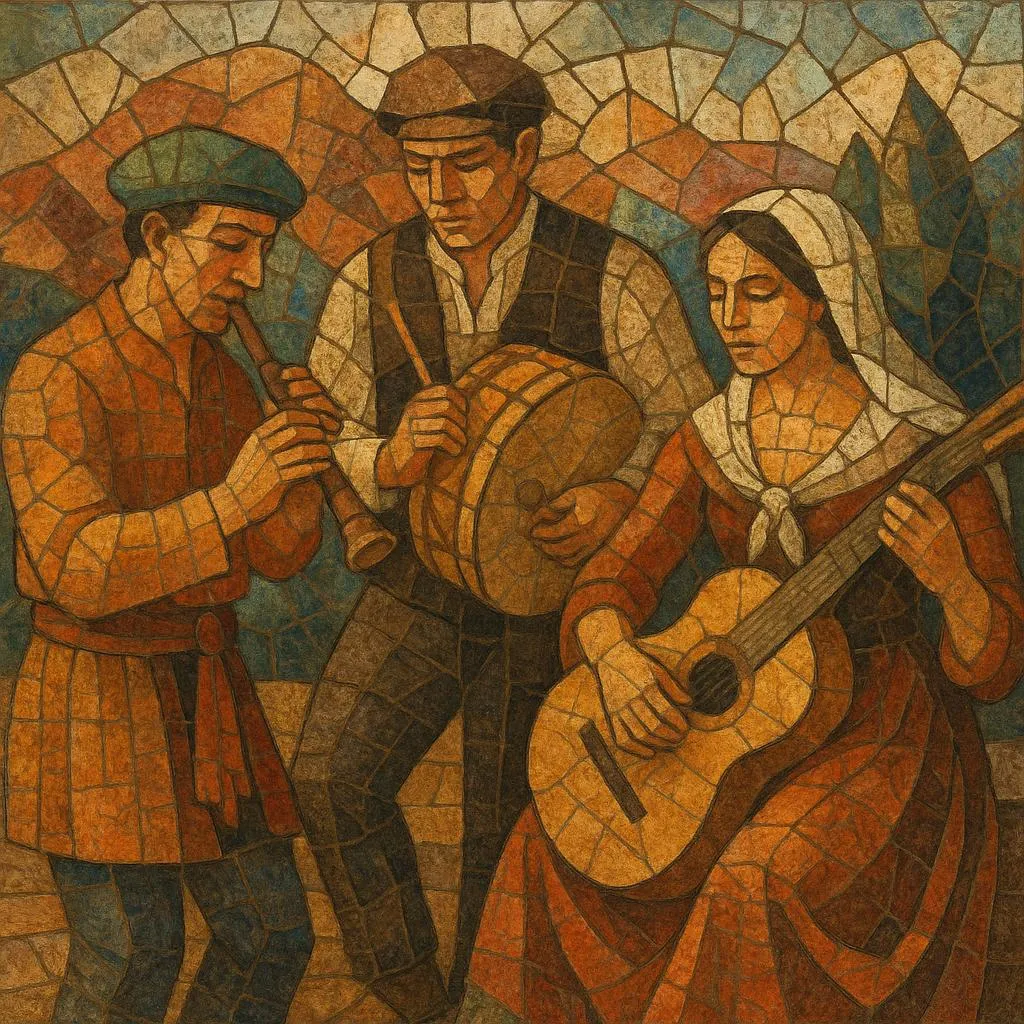
Traditional performance relies on instruments heard in Catalan-Pyrenean music—flabiol i tamborí (pipe-and-tabor), gralla and shawms (tible/tenora when a cobla is present), diatonic accordion, guitar, and occasional bagpipe (sac de gemecs)—with march-like or ceremonial rhythms that accompany communal circle and processional dances. In the 20th century, Radio Andorra (a powerful cross-border broadcaster) and, later, Andorra’s Eurovision entries helped connect local identity with broader popular styles, so the modern Andorran scene now spans folk revival, choral and classical institutions, pop-rock, and internationally known metal bands.
History
Andorra’s musical traditions grew within the Catalan-Pyrenean world, so village festivities long centered on communal dances. The contrapàs (a solemn, processional form) and the ritual marratxa survive especially in Sant Julià de Lòria, while Saint Anne’s dance remains closely identified with Escaldes-Engordany. The sardana—strongly Catalan in character—circulated with cobla-style ensembles and became a symbolic bridge between Andorra and neighboring Catalonia. Instrumentation reflects this geography: flabiol i tamborí (pipe-and-tabor), gralla and other double-reed shawms, diatonic accordion, guitar, and, in some contexts, the sac de gemecs (bagpipe).
In the mid-20th century, Radio Andorra (founded 1939) beamed music widely across Europe and shaped regional listening habits. While Andorra remained small and rural, folk preservation intensified around parish festivals and dance troupes (esbarts). In parallel, classical and choral institutions formed, culminating in the Orquestra Nacional Clàssica d’Andorra (ONCA) and regular sacred and civic music-making. The late 20th-century folk revival in the Catalan-speaking lands reinforced interest in cobla timbres, traditional dance cycles, and community ensembles.
From the 2000s, Andorra’s participation in Eurovision (2004–2009) publicized Catalan-language pop and local performers abroad. A new generation of bands diversified the country’s profile—from pop-rock to progressive and extreme metal—while festivals and conservatory training sustained classical and chamber music. Today, the "music of Andorra" spans ritual dance at parish festes, cobla-influenced folk programs, institutional classical concerts, and popular genres that circulate throughout the Pyrenees and broader Iberia.

